 KL Observer
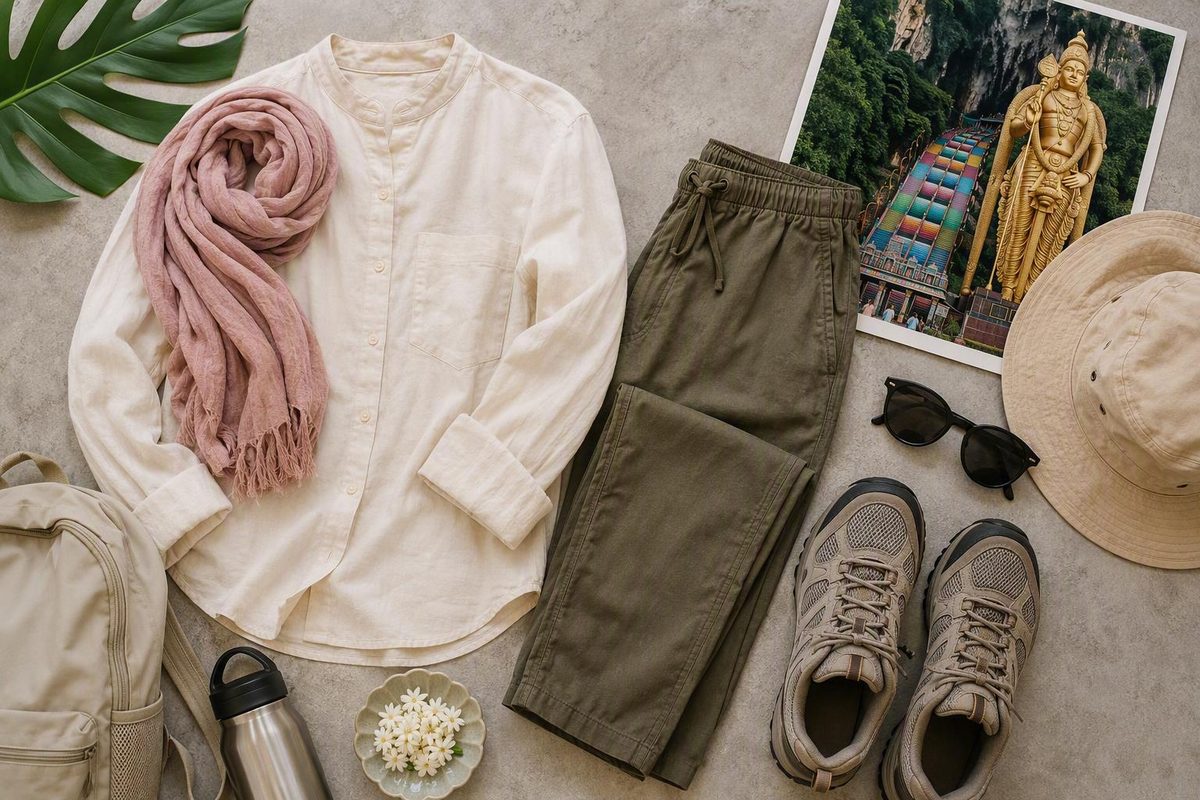
A respectful, heat-smart outfit for the Temple Cave climb
Last reviewed: September 3, 2026
The short answer: cover your shoulders and knees
The lowest-risk interpretation of the Batu Caves dress code is straightforward: wear a sleeved top, cover your midriff, and choose trousers, culottes, a skirt, a dress, or shorts that fall clearly below the knees. Lightweight full-length bottoms remove the most uncertainty.
This commonly reported coverage standard applies to visitors of every gender. Avoid tank tops, uncovered sleeveless tops, crop tops, above-knee shorts or skirts, sheer garments, swimwear, and other beach-oriented clothing. A current local tour-operator guide describes the same shoulder-and-knee standard for women and men, although it is not an official policy issued by temple management. See the tour operator’s Batu Caves clothing guidance.
Batu Caves outfit at a glance
Safest: A sleeved T-shirt or loose shirt, breathable full-length trousers, and secure walking shoes with grippy soles.
Potentially borderline: Shorts, skirts, or dresses ending exactly at the knee; notably fitted clothing; leggings without a longer top; and ripped jeans exposing skin.
Best avoided: Tank tops, uncovered sleeveless tops, singlets, crop tops, exposed midriffs, above-knee shorts or skirts, sheer clothing, swimwear, and beachwear.
Exact-knee hemlines cause the most confusion. Some recent third-party guides treat knee-length shorts as acceptable, while others warn that a garment ending precisely at the knee may still be questioned. That does not mean knee-length clothing will necessarily cause a problem; it means there is no reliable basis for guaranteeing acceptance. Wear something visibly below the knee if you want to avoid that judgment call.
Fitted clothing is similarly uncertain. Coverage is the clearest shared expectation, but some unofficial guides also discourage body-hugging garments. Leggings, fitted dresses, and distressed jeans are therefore better treated as higher-friction choices rather than as items proven to be formally prohibited. A longer tunic, loose overshirt, or wrap creates a more conservative outfit.
This article offers cautious planning guidance synthesized from third-party travel websites, tour operators, and visitor reports. None of the available sources reproduces a current policy issued by Batu Caves temple management. Signs and instructions from authorized staff or volunteers on the day of your visit take precedence.
Why modest clothing matters at Batu Caves
Batu Caves is an active Hindu temple complex, not simply a colorful staircase, photography location, or sightseeing stop. Visitors share its shrines and worship spaces with devotees taking part in prayers, rituals, and offerings. Clothing should be chosen for that religious setting rather than solely for photographs. A current third-party visitor guide describes Batu Caves as an active Hindu temple complex.
Modest dress is therefore more than a way to pass a possible clothing check. Covering the shoulders, knees, and midriff acknowledges that you are entering spaces used for worship. The same principle should guide your conduct: give devotees room, do not obstruct shrine entrances, and follow local instructions.
Practical considerations matter as well. The approach to the main Temple Cave involves 272 steps, so clothing needs to allow a comfortable stride while footwear needs to suit a substantial staircase. A recent commercial trip guide recommends modest clothing and comfortable shoes for this climb. Trip.com identifies the Temple Cave approach as a 272-step climb.
Respectful clothing does not need to be formal, heavy, or traditional. A regular sleeved T-shirt with loose trousers is a suitable conservative formula. The objective is to combine adequate coverage with breathable fabric and freedom of movement.
Do not interpret the absence of an obvious checkpoint as permission to dress carelessly. A clothing check is an operational procedure; modest conduct is a visitor responsibility. An open courtyard or an area without someone inspecting clothes can still form part of an active religious complex.
What to wear: acceptable, borderline, and best avoided
The following categories are conservative planning guidance, not a guarantee that every garment will be assessed identically on every visit.
| Lowest risk | Potentially borderline | Best avoided |
|---|---|---|
| Sleeved T-shirts | Shorts ending exactly at the knee | Tank tops and singlets |
| Sleeved blouses or loose shirts | Skirts or dresses ending exactly at the knee | Uncovered sleeveless tops |
| Lightweight full-length trousers | Opaque leggings without a longer top | Crop tops and exposed midriffs |
| Jeans providing full coverage | Bodycon dresses or notably fitted clothing | Short shorts |
| Culottes falling clearly below the knee | Ripped jeans exposing skin | Miniskirts and above-knee dresses |
| Loose below-knee or ankle-length skirts | Sleeveless dresses with an unstable shawl | Sheer or see-through garments |
| Full-length dresses with covered shoulders | Loose flip-flops for the staircase | Swimwear and beachwear |
| Secure walking shoes or strapped sandals | Fashion footwear with limited grip | High heels for the climb |
T-shirts, blouses, and shirts
A standard T-shirt with sleeves is one of the simplest options. Polo shirts and casual button-down shirts also provide uncomplicated shoulder coverage. Whichever style you choose, check that the top continues to cover your midriff when you lift your arms or take a high step.
A short-sleeved blouse or loose shirt works as well as a T-shirt. The available guidance does not generally require long sleeves; the repeated expectation is that the shoulders are covered. A light short-sleeved garment may also be more comfortable than unnecessary layers.
Sleeveless tops
A sleeveless top can become more suitable if you add a cardigan, lightweight shirt, shawl, or scarf that completely covers both shoulders and remains in place. A covering that repeatedly slips down is less dependable.
Test the layer before leaving your accommodation. Raise your arms, carry your day bag, and make sure the fabric does not slide away from your shoulders. An open shirt may work, but fastening it is more reliable than continually readjusting it.
A sarong tied around the waist addresses only lower-body coverage. It does not make exposed shoulders suitable. If your original outfit exposes both the shoulders and knees, bring separate coverage for both areas.
Shorts
A sleeved shirt with shorts reaching the knees is commonly presented as acceptable, especially in outfit examples for men. Recent commercial guidance includes knee-length shorts among possible options, but it also indicates that exact-knee hems can be assessed inconsistently. The Batu Caves Tours guide illustrates both the commonly reported standard and its uncertainty.
The practical difficulty is that “at the knee” can look different when standing and climbing. A hem can shift upward with movement, and different people may interpret the boundary differently. Below-knee shorts, cropped trousers, or lightweight full-length trousers are easier choices if you want to minimize uncertainty.
Short running shorts, beach shorts, and other styles that leave the thighs exposed are best avoided.
Jeans and trousers
Jeans are generally reported as suitable when they provide adequate coverage and do not have large tears exposing the knees or thighs. Their casual appearance does not make them inherently disrespectful.
Comfort is the main drawback. Thick or restrictive denim may be less pleasant for the climb than loose cotton, linen, or lightweight travel trousers. If jeans suit the rest of your day, select a pair that allows a full stride and remains comfortable when you lift your knees.
Ordinary trousers are a strong option for visitors of any gender. They need not be formal. Loose travel pants, lightweight chinos, linen trousers, and breathable hiking trousers can all combine coverage with mobility.
Skirts and dresses
A skirt or dress falling clearly below the knee is a practical modest option. An ankle-length garment creates even less uncertainty, provided its hem is manageable on the staircase.
Choose a cut that allows an unrestricted stride. A narrow skirt may cover enough skin while still making climbing awkward. A full-length dress should also cover the shoulders or be paired with a secure upper-body layer.
A skirt or dress ending exactly at the knee is harder to recommend without qualification because reports differ and the hem may rise while walking. If that is your planned outfit, carrying a wrap gives you a straightforward backup.
Leggings, fitted clothing, and ripped jeans
The available evidence does not establish a consistent formal prohibition on leggings, fitted garments, or ripped jeans. Some commercial guides discourage them, while others focus primarily on shoulder, knee, and midriff coverage.
Treat these garments as uncertain rather than automatically forbidden. Full-length opaque leggings with a loose, longer top are more conservative than thin leggings paired with a cropped or short top. Small distressed details on jeans are also less conspicuous than large openings exposing the knees or thighs.
When choosing between a borderline garment and a loose alternative, the loose option is simpler. The aim is not to test the narrowest possible interpretation of a rule but to arrive dressed appropriately for a worship space.
Outfit formulas for Kuala Lumpur heat and possible rain
Adequate coverage does not require heavy fabric. A better strategy is to cover more skin with lightweight, loose clothing rather than relying on thick or tightly fitted garments.
Lowest-risk hot-weather formula
Wear:
- A loose cotton or linen T-shirt, blouse, or shirt with sleeves
- Lightweight full-length trousers
- Secure walking shoes with firm, grippy soles
- A light wrap packed as backup
This combination covers the shoulders, knees, and midriff without depending on a covering being available at the entrance. It also allows a natural climbing stride and can work for the rest of a day in Kuala Lumpur.
Below-knee alternative
Wear:
- A sleeved top
- Loose culottes or a skirt falling clearly below the knee
- Secure sneakers, walking shoes, or firmly strapped sandals
Check the outfit while moving, not only while standing in front of a mirror. The hem should continue to provide coverage without restricting your stride or creating excess fabric that is difficult to manage.
If the rest of your day calls for a sleeveless outfit
Pack a lightweight button-up shirt, overshirt, cardigan, or shawl. Put it on before approaching temple access areas and choose a layer that can remain in place without continual adjustment.
A shawl can work when it covers both shoulders securely. An overshirt may be easier if you expect to carry a bag, use a handrail, or take photographs, because it leaves your hands free and is less likely to shift.
Do not base your plan on receiving a covering at the site. Bringing your own layer is more reliable and lets you choose a breathable fabric that fits properly.
Planning for damp steps
If the staircase is damp during your visit, prioritize stable footing, move at a comfortable pace, and use the handrail where appropriate. Commercial visitor guidance recommends flat or securely fitted shoes with good grip and discourages loose footwear for the climb. MyTravelLane provides comparable grip and footwear guidance.
A compact water-resistant bag may be useful for protecting a wrap or carrying footwear after you remove it at a shrine, if desired. Keep the bag small enough that it does not obstruct other visitors.
Compact packing checklist
- A lightweight shirt, cardigan, or shawl that covers both shoulders
- A sarong or below-knee wrap brought from home
- Loose, breathable clothing
- Secure footwear with traction
- A compact bag for removed footwear, if desired
- A simple way to secure loose layers while climbing
Traditional clothing is not required, and no available guidance establishes a required color. A head covering is also not generally reported as an entry requirement. Simple, modest casual clothing is sufficient.
Footwear: shoes for the stairs, shoes off at shrines
Expect a two-stage practice: keep your footwear on for the main staircase, then remove it before entering an individual shrine or sacred interior where signs or authorized personnel require it. Third-party guidance consistently distinguishes the outdoor climb from shrine-specific shoes-off areas. This Batu Caves ticketing guide describes the staircase footwear and shrine-removal practices.
Practical options include:
- Sneakers
- Walking shoes
- Lightweight hiking shoes
- Securely strapped sandals with firm soles
Closed shoes often provide a secure fit, but they are not the only workable choice. A well-fitted sandal with heel or ankle straps can be practical when it stays firmly on the foot and has a suitable sole.
Flip-flops are better described as a less suitable stair choice than as prohibited footwear. High heels and loose fashion sandals are similarly poor practical choices; this is safety-oriented advice, not a claim that they breach an official clothing rule.
Balance traction with ease of removal. Straightforward lace-up sneakers, stable slip-on walking shoes, and firmly strapped sandals can all work, provided you can remove and replace them without difficulty at shrine entrances.
Do not remove your shoes before beginning the main climb merely because the site contains temples. Keep them on unless current signs or authorized personnel direct otherwise. Inside the cave and around shrines, look for posted instructions and designated footwear areas. A shoes-off requirement may apply to one sacred interior rather than the entire cave, courtyard, or complex.
Where clothing checks and modesty expectations may apply
Several recent commercial visitor guides place the clearest clothing checkpoint at the base of the Temple Cave staircase. They associate shoulder-and-knee coverage most directly with access to the stairs, Temple Cave, and worship spaces above. One tour website describes checks before the staircase.
The reported boundaries are not consistent, however. The tour guide above says formal checks focus on the staircase and do not cover the open forecourt, Ramayana Cave, or Cave Villa. By contrast, another third-party visitor guide describes the same modesty expectation as applying across temple areas, including ground-level shrines and the wider complex. See the broader interpretation in this Batu Caves visitor guide.
Because no supplied source reproduces an official, current, location-by-location policy, it would be misleading to publish a categorical enforcement map. A more useful planning summary is:
- Before the Temple Cave staircase: Expect the clearest access requirements and the greatest possibility that insufficient coverage will be noticed.
- On the staircase and in Temple Cave: Keep the shoulders, knees, and midriff covered.
- At individual shrines: Maintain modest clothing and follow posted footwear or access instructions.
- In the open forecourt: A formal clothing check may be less apparent, but respectful dress remains appropriate.
- At other caves or attractions: Check the signs at the relevant entrance rather than assuming that procedures match the Temple Cave route.
Formal enforcement and respectful conduct are not the same thing. Passing through an unchecked area in revealing clothing does not make the outfit suitable for an active religious setting. Another visitor’s experience is not a dependable precedent either, because staffing and procedures may vary.
The simplest approach is to dress modestly from arrival until departure. That avoids having to determine where one reported requirement ends and another begins.
If you arrive underdressed: your lowest-risk options
Prevention is the most reliable solution. Carry a lightweight overshirt or shawl for your shoulders and a sarong or wrap long enough to fall below your knees. These items take little space in a day bag and prevent your visit from depending on uncertain on-site arrangements.
Several third-party guides report that coverings may be available near the staircase for visitors whose clothing is considered unsuitable. The reports conflict over whether sarongs are sold, rented, loaned, or consistently stocked. One commercial guide describes changing purchase and proposed rental arrangements, demonstrating why those details should not be treated as permanent. MyTravelLane documents the conflicting reported arrangements.
Do not rely on a price, deposit, payment method, or rental term quoted online. Such operational details can change, and the available sources do not agree. A suitable covering may also be unavailable in your preferred size or style.
If your shorts or skirt are too short, a waist-wrapped sarong may provide lower-body coverage. Secure it so it remains below the knees while you walk and does not loosen or create an awkward hem.
If your shoulders are exposed, a waist wrap does not solve the problem. Add an overshirt, cardigan, shawl, or another layer that covers both shoulders. If both halves of the outfit are unsuitable, address both before attempting to continue.
Third-party reports indicate that an underdressed visitor may be asked to add coverage and may be unable to proceed to the Temple Cave without doing so. This should not be interpreted as a guarantee that every visitor is checked or that enforcement is identical every day.
If you receive an instruction from authorized on-site personnel, follow it calmly. Current signs and local directions should take precedence over a travel article, another visitor’s clothing, or an account of what happened on a previous day.
A final respectful-visit checklist
Before leaving for Batu Caves, assess the complete outfit:
- Shoulders covered: Wear sleeves or a layer that stays securely over both shoulders.
- Midriff covered: Check that your top does not expose your stomach when you raise your arms.
- Knees covered: Choose a hem clearly below the knees where possible.
- Movement comfortable: Test the outfit with a high step.
- Shoes secure: Select stable footwear with a firm, grippy sole.
- Backup packed: Carry an overshirt, shawl, sarong, or wrap.
- Shrine etiquette understood: Keep footwear on for the main climb and remove it where signs or authorized personnel direct.
- No dependency on on-site supplies: Bring the coverage you expect to need.
A head covering is not generally reported as required, although visitors should still respect any instructions posted in a particular prayer space.
Children should also be dressed modestly. The available sources disagree about age thresholds and how much flexibility younger children receive, so avoid planning around a precise age rule. A comfortable sleeved top, sufficiently long bottoms, and stable shoes are uncomplicated choices for a child making the climb.
During major religious occasions, thoughtful clothing and conduct are especially important because visitors are sharing the complex with worshippers. There is no need to invent a festival-specific outfit: sleeves, adequate lower-body coverage, and practical footwear remain the conservative combination.
All detailed guidance in this article comes from third-party travel websites, commercial guides, tour operators, and visitor reports rather than a reproduced temple-management policy. Checkpoints, enforcement practices, and covering arrangements can change. Current signs and instructions from authorized on-site personnel control.
Frequently asked questions
Can I wear knee-length shorts and a T-shirt at Batu Caves?
A sleeved T-shirt with shorts reaching the knees is commonly reported as acceptable. However, exact-knee hems create some uncertainty because sources differ about how they are assessed. Below-knee shorts or lightweight full-length trousers are safer.
Check that the shorts continue to provide coverage while walking and climbing. The T-shirt should have sleeves and remain long enough to cover your midriff when you raise your arms.
Can women wear jeans or trousers instead of a long skirt?
Yes. Jeans and trousers are generally reported as suitable when they provide adequate coverage. A long skirt is not required, and the core shoulder-and-knee guidance should not be framed as fundamentally different for women and men.
Loose cotton, linen, or lightweight travel trousers may feel more comfortable than thick denim. If you wear jeans, choose a pair that permits easy movement and does not expose substantial skin through large rips.
Can I wear a sleeveless top if I bring a shawl?
Potentially, provided the shawl fully covers both shoulders and stays securely in place. Put it on before approaching temple access areas rather than waiting to be asked.
A lightweight sleeved overshirt may be easier to manage because it is less likely to slip while you climb or carry a bag. If your bottoms are also too short, you will need a separate lower-body wrap.
Are sarongs available at Batu Caves if my clothes are too short?
They may be, but do not depend on it. Third-party reports disagree about whether sarongs are sold, rented, loaned, or consistently available.
Bring your own sarong or below-knee wrap if you may need one. Remember that a waist-wrapped sarong addresses short bottoms but not exposed shoulders.
Do I remove my shoes before climbing the Batu Caves steps?
No. The commonly reported practice is to keep your footwear on for the main staircase and remove it only at individual shrines or sacred interiors where signs or authorized personnel direct you.
Choose footwear that combines traction with convenient removal, such as walking shoes, stable slip-ons, sneakers, or securely strapped sandals. Flip-flops are not clearly prohibited, but visitor guidance presents them as a less suitable choice for the climb.
For the simplest plan, wear a breathable sleeved top, loose full-length or clearly below-knee bottoms, and secure shoes with good grip, with a lightweight wrap in your bag. This combination respects an active place of worship, suits the staircase, and avoids depending on uncertain sarong arrangements. Treat it as conservative planning advice and follow current signs and on-site instructions when you arrive.