 KL Observer
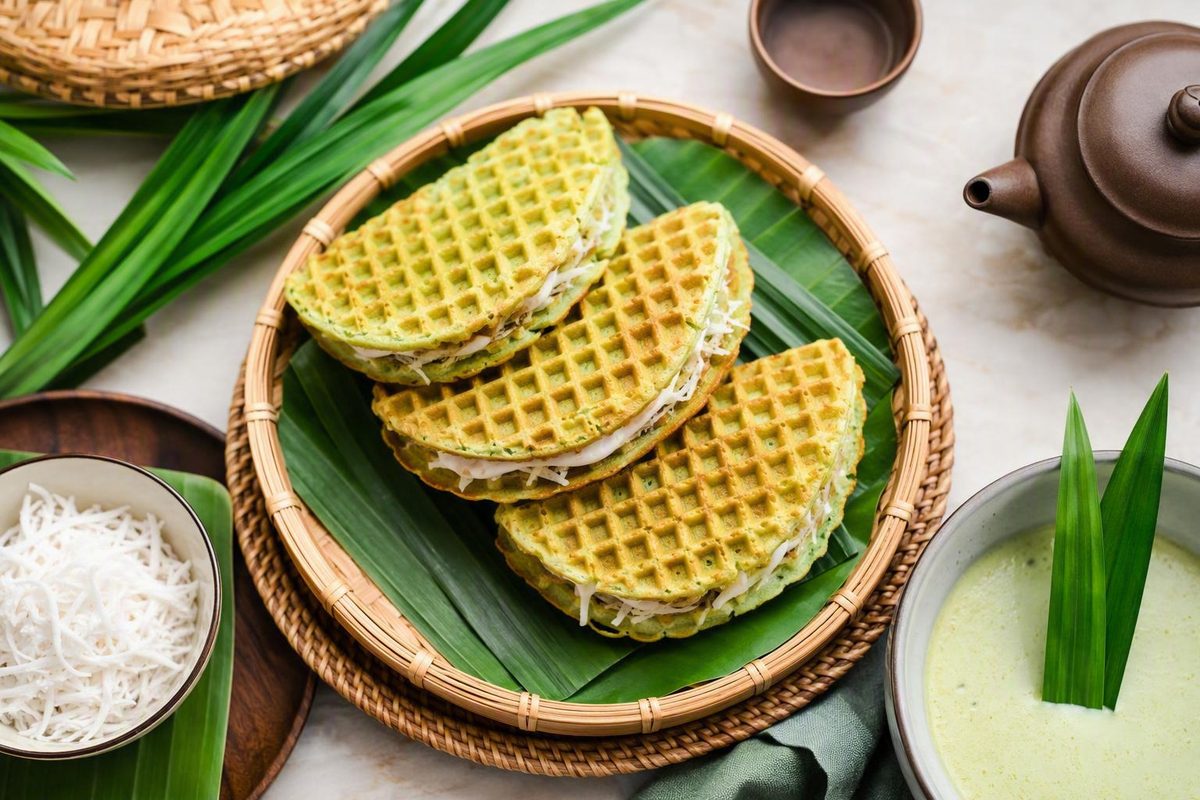
What Is a Pandan Waffle?
A pandan waffle is a coconut-and-pandan waffle commonly identified by recipe authors as Vietnamese and called bánh kẹp lá dứa. Compared with a conventional wheat-flour waffle, many versions aim for a stronger textural contrast: a crisp or set exterior surrounding a soft, tender, or distinctly chewy center.
That texture is not universal. Some pandan waffle recipes rely heavily on wheat flour and produce a fluffier, more familiar crumb. Others combine tapioca starch, regular rice flour, and all-purpose flour to pursue a crisp-chewy balance. The formula matters more than the green color alone.
Pandan, also called screwpine, is an aromatic plant used in South and Southeast Asian cuisines. Its leaves flavor both sweet and savory foods. In these waffles, recipe authors commonly pair pandan with coconut milk or coconut cream, producing a coconut-pandan profile whose exact flavor depends on the leaves, bottled product, coconut ingredient, and individual perception. Milk and Pop explains pandan and its use in Vietnamese pandan waffles.
The available recipe sources consistently identify the waffles as Vietnamese, but they do not provide enough historical documentation to establish a definitive place, date, or single origin story. It is therefore more accurate to use the familiar Vietnamese name without making stronger claims about precisely where the dish began or how universally it is served.
Color is similarly variable. Fresh pandan juice can create a subtle or muted green, while some commercial pastes and extracts produce a brighter result.
This guide uses one published recipe as a coherent reference rather than assembling quantities from unrelated formulas. The ingredient amounts and one-hour rest come from Hungry Huy. They have not been tested or verified by KL Observer and should not be treated as universally definitive. Comparisons with other recipes are included to show where methods differ and why casually mixing them can create an unpredictable batter.
The Reference Recipe and Ingredient Checklist
The most predictable approach for a first batch is to choose one complete formula and preserve its internal proportions. Combining the flour ratio from one recipe, the coconut liquid from another, and the fat level from a third creates a new, untested formula.
The reference method is the Hungry Huy pandan waffle formula. It uses coconut cream and a three-part flour system, with either freshly extracted pandan liquid or a specifically measured store-bought natural extract mixture.
Dry ingredients
The published reference formula specifies:
- 285 grams tapioca starch
- 73 grams regular rice flour
- 75 grams all-purpose flour
- 10 grams baking powder
- 1 gram salt
Use regular, non-glutinous rice flour. Do not substitute sweet rice flour, glutinous rice flour, or Mochiko and assume the center will remain the same.
Wet ingredients
The same formula specifies:
- 3 large eggs
- 200 grams sugar
- 13.5 fluid ounces coconut cream
- One of the pandan-liquid options below
- 1 tablespoon neutral oil
Pandan-liquid option 1: leaves
For the leaf-based route, use:
- 35 grams fresh or frozen pandan leaves
- 118 grams water
Cut the leaves into pieces your blender can process. Blend them with the measured water, strain the mixture, and squeeze the pulp to recover as much liquid as practical.
Pandan-liquid option 2: specified natural extract
For the recipe author’s bottled-extract route, use:
- 50 grams store-bought natural pandan extract
- 103 grams water
This amount applies to the type of natural extract used by the recipe author. It is not a universal conversion for every paste, essence, flavoring, or concentrated extract.
Equipment
Have the following ready before mixing:
- A digital kitchen scale
- A blender and fine strainer if using leaves
- Mixing bowls
- A whisk and flexible spatula
- A flour sifter or fine-mesh sieve
- A waffle maker
- Neutral oil and an applicator if the plates need greasing
- A wire cooling rack
A scale is especially useful because the three dry ingredients have different densities.
The reference notes mention approximately eight waffles, although the displayed serving label is incomplete. Actual yield depends on the plate dimensions, cavity depth, and batter portion. A deep Belgian iron and a shallow classic iron should not be expected to produce the same count.
No calorie estimate is reproduced here. The source does not provide a sufficiently clear serving basis or calculation method for treating its displayed number as a dependable comparison.
Before beginning, check three labels:
- The rice flour should be regular or non-glutinous.
- The coconut product should say coconut cream rather than coconut milk.
- The pandan product should match the format required by the selected route.
Those checks address three substitutions that can substantially change the batter.
Reference workflow at a glance
- Prepare the measured pandan liquid.
- Combine the eggs, sugar, coconut cream, pandan liquid, and oil.
- Sift in the dry ingredients.
- Fold only until incorporated.
- Rest the batter for the period specified by the recipe.
- Preheat the waffle maker fully.
- Cook one conservatively portioned test waffle.
- Adjust the portion, setting, or time one variable at a time.
- Cool each finished waffle separately on a rack.
Fresh Leaves, Frozen Leaves, Extract, or Paste?
Published pandan waffle recipes use several forms of pandan:
- Fresh leaves
- Frozen leaves
- Homemade leaf juice or extract
- Bottled natural extract
- Concentrated commercial extract
- Pandan paste
- A combination of leaf juice and extract
These are not standardized versions of one interchangeable ingredient. Leaf juice contains the water introduced during blending. Paste may contain concentrated flavor and color. An essence or extract may be much stronger than either, and products bearing similar names can differ in concentration.
Fresh or frozen leaves
The reference route blends 35 grams of pandan leaves with 118 grams of water, then strains the liquid and squeezes the pulp. The aim is to recover the extraction liquid rather than add wet, fibrous leaf pieces directly to the batter.
Recipe authors generally describe fresh or frozen leaves as producing subtler flavor and less vivid color than commercial extract or paste. Results can also vary with the leaves, their condition, the blender, and how thoroughly the pulp is squeezed.
Extraction methods are not standardized. Cooking Therapy, for example, blanches eight leaves for 30 seconds, blends them with reserved water, and strains the mixture to obtain approximately half a cup of juice. That process belongs to a different complete batter and should not replace the reference quantities without also changing its hydration. Cooking Therapy documents its leaf-extraction method.
Bottled extract or paste
Commercial products offer convenience and may create a more assertive flavor or brighter color. Wok and Kin’s author favors extract for potency and consistency while describing fresh-leaf juice as milder. That recipe has its own flour, dairy, coconut, and resting system, so its extract quantity should not be transferred into the reference batter. Wok and Kin compares commercial extract with fresh pandan juice.
If you have the natural extract specified by Hungry Huy, follow the reference route of 50 grams extract plus 103 grams water. If the bottle instead says paste, essence, concentrated extract, or flavoring, use the product’s own directions as the starting point. Do not assume that the reference weight applies.
In particular, do not assume that:
- One teaspoon of paste equals one teaspoon of extract
- Two brands labeled “natural” have equal concentration
- Leaf juice can replace concentrated flavoring without changing hydration
- Brighter green proves stronger pandan flavor
- Browned or muted waffles lack pandan
The supplied evidence does not support claims that fresh pandan is inherently healthier or that artificial pandan products are harmful. Ingredient preferences, added colors, concentration, and labeling can be considered without turning them into unsupported health conclusions.
Browning also affects appearance. A waffle can begin green and become olive or golden where it contacts the hot plates.
For a first batch, use the pandan format named by the complete recipe you selected. Once you understand how that batter cooks, compare another format in a later batch and record the exact product and amount.
How the Flour Blend Shapes Crispness and Chew
The reference batter uses three flour or starch components. Across several published recipes, authors associate tapioca starch with chewiness, regular rice flour with crispness, and all-purpose flour with bulk or structure. These are recurring recipe-author observations, not the results of a controlled scientific comparison.
| Ingredient | Role reported by recipe authors | Likely problem if confused or omitted |
|---|---|---|
| Tapioca starch | Promotes elasticity and chewiness | Too little may reduce the characteristic chew; an untested increase may make the center more elastic or gummy |
| Regular rice flour | Supports a drier, crisper exterior | Replacing it with glutinous rice flour can produce a stickier, more mochi-like center |
| All-purpose flour | Adds bulk and structural support | Omitting or replacing it changes the reference system; its presence also means the recipe is not gluten-free |
| Baking powder | Provides leavening | Leaving it out can contribute to a denser result |
| Salt | Balances the overall flavor | Omission may make the flavor seem flatter, although salt does not replace a structural ingredient |
Bun Bo Bae describes the same general division of roles and specifically warns against replacing regular rice flour with Mochiko in its own formula. See Bun Bo Bae’s flour guidance.
Regular rice flour is not sweet rice flour
Despite their similar names, regular rice flour is not the same ingredient as:
- Glutinous rice flour
- Sweet rice flour
- Mochiko
In a waffle batter, however, sweet or glutinous rice flour can create a noticeably gooier, gummier, or more mochi-like center than regular rice flour.
That does not make sweet rice flour an invalid waffle ingredient. Cooking Therapy publishes a deliberately different system containing sweet rice flour, cornstarch, and all-purpose flour. Its existence shows that sweet rice flour can work in a formula designed for it; it does not establish that sweet rice flour can directly replace regular rice flour in the reference recipe.
If you want the reference formula’s intended balance, inspect the front and ingredient panel of the package. Choose a product labeled simply as rice flour and avoid one labeled glutinous rice flour, sweet rice flour, or Mochiko.
Is the reference recipe gluten-free?
No. It contains 75 grams of all-purpose flour, which is wheat flour. Tapioca starch and rice flour form most of the dry blend, but their presence does not make the complete formula gluten-free.
The supplied recipes do not establish a tested cup-for-cup replacement that preserves the same expansion, crispness, chew, and release. A gluten-free adaptation may be possible, but replacing the wheat flour would create an experimental version rather than the reference recipe.
Mixing and Resting the Batter
Follow the selected formula in sequence:
- Prepare the pandan liquid. Blend and strain the measured leaves and water, or combine the specified natural extract with its measured water.
- Combine the wet ingredients. Mix the eggs, sugar, coconut cream, prepared pandan liquid, and neutral oil.
- Sift in the dry ingredients. Sift the tapioca starch, regular rice flour, all-purpose flour, baking powder, and salt into the wet mixture.
- Fold until incorporated. Stop when no substantial pockets of dry flour remain.
- Rest for at least one hour.
- Stir gently before portioning each waffle.
These steps, including the one-hour rest, belong to Hungry Huy’s formula rather than to pandan waffle batter in general. Hungry Huy provides the complete mixing and resting sequence.
Avoid prolonged or vigorous mixing. Several recipe authors advise gentle mixing, and Milk and Pop explicitly accepts small lumps in its own batter. The practical target is an incorporated, pourable batter rather than one beaten until perfectly smooth.
Do not expect an exact visual match across kitchens. Before adding flour or liquid to correct the consistency, verify every measurement and confirm that the intended coconut and pandan products were used.
How long should the batter rest?
For the reference formula, use its stated rest of at least one hour. That duration should not be described as scientifically optimal.
Published instructions differ because the batters differ. Bun Bo Bae rests its coconut-milk batter for at least 15 minutes, while Wok and Kin calls for at least three hours or overnight for its coconut-cream, milk, and shredded-coconut formula. Bun Bo Bae gives the shorter rest for its own batter, while Wok and Kin specifies the longer rest for its formula.
A three-hour rest cannot be assumed to improve a formula written for 15 minutes, and a quick-rest recipe does not prove that the reference hour is unnecessary. The recipes also differ in flour, sugar, fat, coconut product, and leavening.
If following a recipe that calls for an extended or overnight rest, use that author’s stated handling instructions. The supplied recipe blogs do not establish authoritative multi-day safety limits for raw batter containing eggs, so their longer storage claims are not reproduced here.
Changing only the rest time can be a useful home comparison, but it remains an experiment. Keep the ingredient brands, batter weight, waffle setting, and cooking time as consistent as possible if you want to observe the difference.
Preheating, Filling, and Cooking the Waffle Iron
There is no universal pandan waffle setting. Waffle makers vary in:
- Plate depth
- Plate diameter and shape
- Heating power
- Temperature cycling
- Nonstick condition
- Rotating or fixed design
- Whether the control changes heat, browning, or time
Treat the first waffle as a calibration waffle.
Preheat thoroughly
Allow the appliance to complete its normal preheating cycle. If its instructions call for oil, apply a light, even coating rather than allowing oil to pool in the cavities.
Because machines differ, use the appliance’s normal indicator and the behavior of the first waffle rather than assuming a fixed preheating time works for every model.
Fill conservatively
Do not begin by filling every recess to the rim. Pour a conservative portion into the center, close the lid, and observe how far the batter expands.
Wok and Kin fills its own iron approximately three-quarters full, while Cooking Therapy uses approximately two-thirds cup per waffle for a different batter and appliance. Those values are recipe-specific, not universal measurements for Belgian, classic, rotating, or mini waffle makers. Cooking Therapy gives the two-thirds-cup portion for its formula.
A shallow classic iron may require much less batter than a deep Belgian model.
Record the first portion by weight or use a consistent scoop. If the batter does not reach the outer cells, increase the next portion slightly. If it escapes the sides, reduce it.
Use time as a starting point, not a verdict
The reported times vary widely:
- Hungry Huy reports approximately three minutes in the author’s Belgian iron.
- Milk and Pop gives approximately 2–3 minutes for its formula.
- Cooking Therapy specifies 4–6 minutes.
- Bun Bo Bae estimates 5–7 minutes.
- Bakeomaniac specifies 8–10 minutes for a wheat-flour-heavy formula containing substantially more oil. Bakeomaniac documents that longer cook for its own recipe.
These numbers are not interchangeable. If you are using the reference batter, begin checking around the reference author’s reported result, but pair the clock with practical cues:
- Steam has decreased substantially
- The waffle releases without tearing
- The edges feel set or crisp
- The surface shows controlled, even browning
- A test waffle does not have a wet, paste-like center
Treat changing steam as one cue rather than an absolute rule.
After the test waffle, record:
- Batter amount
- Heat or browning setting
- Cooking time
- Steam level when opened
- Ease of release
- Exterior color
- Center texture after brief cooling
Change one variable at a time. If you alter the heat, portion, and cooking time together, you will not know which adjustment produced the result.
Troubleshooting Gummy, Soft, Pale, Burnt, or Stuck Waffles
Start with the symptom rather than immediately changing the flour ratio. The checks below synthesize recurring advice from the supplied recipe authors and should be treated as bounded troubleshooting steps, not guaranteed corrections.
| Symptom | Likely checks | Smallest next adjustment |
|---|---|---|
| Gummy center | Confirm the package says regular rice flour, not glutinous rice flour, sweet rice flour, or Mochiko. Check for overfilling or early opening. | Use slightly less batter or cook the next waffle a little longer before changing the formula. |
| Soft exterior | Check whether the iron completed preheating and whether cooked waffles were stacked. | Preheat fully, cook until the edges set, and move the waffle directly to a rack. |
| Brown outside, underdone inside | The portion may be too large, or the setting may brown the surface before the center sets. | Lower the setting incrementally and extend the cook, or reduce the portion slightly. |
| Excessive browning | The setting or cooking time may be too high for this batter and machine. | After confirming the center is cooked, shorten the next cook or reduce the setting one step. |
| Weak or muddy green | Fresh juice may be muted; product concentration and browning both affect appearance. | Do not chase color alone. If the waffle is overbrowned, reduce heat or time without leaving the center wet. |
| Weak pandan flavor | The extraction may be subtle, or the bottled product may be less concentrated than expected. | Adjust that specific product cautiously according to its label rather than using a universal conversion. |
| Tough or dense texture | Check for prolonged mixing, omitted baking powder, or inaccurate measurements. | Verify the baking powder and fold only until incorporated in the next batch. |
| Waffle sticks | Check preheating, plate condition, greasing requirements, and whether the iron was opened early. | Preheat fully, apply a thin coat of oil if appropriate, and allow more time before opening. |
| Batter seems unusually thick | Verify the weights, stir gently, and confirm that coconut cream was used. | Recheck the formula before adding any extra liquid. |
| Batter seems unusually thin | Check whether coconut milk replaced coconut cream or excess water entered with homemade pandan juice. | Return to the specified ingredients on the next batch rather than adding arbitrary flour. |
| Oily waffle | Confirm the selected formula’s fat quantity. | Do not borrow butter, shortening, or oil amounts from another recipe. |
Change the process before changing the formula
If the center seems gummy, first rule out glutinous rice flour and insufficient cooking. A tapioca-rich waffle is intended to have some chew, so a warm, elastic center is not automatically raw. A wet or paste-like interior is a better reason to try a smaller portion or a little more cooking time.
If the outside is soft, avoid stacking finished waffles. Transfer each waffle to a rack in a single layer and allow the machine to return to its normal ready state before adding the next portion.
If the exterior becomes dark before the middle sets, increasing the setting is unlikely to correct that imbalance. Try a slightly lower setting with more time or a smaller portion. These are calibration adjustments rather than promises that every machine will respond identically.
Color calls for restraint. Longer cooking generally increases browning and can obscure green tones, but shortening the cook solely to preserve color can compromise the center. Judge the test waffle by release and texture before judging its shade.
Finally, do not freely add flour or liquid until an unfamiliar batter “looks right.” First confirm that the weights and products match the selected recipe. Coconut milk in place of coconut cream, or diluted leaf juice in place of concentrated flavoring, can change the batter before it reaches the iron.
Cooling, Serving, Freezing, and Reheating
Transfer each finished waffle directly to a wire rack and keep the waffles in a single layer while hot. Stacking them traps steam and softens the exterior.
Allow a test waffle to settle briefly before judging its center. Tapioca-rich waffles can become firmer or chewier as they cool. SugarYums similarly reports that its waffles become chewier and harder after cooling, although that observation belongs to its own formula. SugarYums describes this cooling-related texture change.
For the clearest contrast between a crisp exterior and tender-chewy center, serve the waffles reasonably soon after cooking. They can be eaten plain. Cream cheese, chocolate, peanut butter, and jam are serving suggestions offered by recipe authors, not required or historically established accompaniments.
Freezing cooked waffles
Several recipe authors freeze cooked pandan waffles for later reheating. For practical freezing:
- Cool the waffles completely on a rack.
- Package them airtight.
- Separate layers if needed so individual waffles can be removed.
- Reheat only the quantity you plan to serve.
The blogs give differing refrigerated and frozen storage periods, but those durations have not been independently verified as food-safety limits. Treat them as recipe-author quality guidance and follow applicable authoritative food-storage guidance for safety decisions.
Reheating for crispness
A toaster or toaster oven is convenient for individual waffles, while a conventional oven can handle several at once. Milk and Pop gives a starting point of approximately 350°F for five minutes and also recommends a toaster; the time should be adjusted for waffle thickness and whether the waffle is chilled or frozen. Milk and Pop provides that reheating guidance.
Watch the surface rather than extending the time automatically. The objective is to warm the center while restoring some exterior crispness without burning the ridges.
Recipe authors also note that a microwave can warm the waffle but does not restore the same crisp exterior. If crispness is the priority, use a toaster or oven instead.
Substitutions and Shortcut Options
Substitutions are most predictable when they are incorporated into a complete recipe. Replacing a major liquid, flour, or fat while retaining every other quantity can alter batter consistency, browning, spread, structure, and release.
Coconut milk versus coconut cream
Coconut milk and coconut cream are related but not identical. Coconut cream is thicker and richer, while coconut milk is runnier. Replacing the reference recipe’s coconut cream with an equal volume of coconut milk may create a thinner batter and a different coconut profile.
Many pandan waffle recipes use coconut milk successfully because their flour, fat, sugar, and liquid quantities were designed around it. If coconut milk is what you have, the lowest-uncertainty route is to select a complete coconut-milk recipe and follow it intact rather than forcing that ingredient into the coconut-cream reference.
Fat substitutions
Published recipes use several fats:
- Neutral oil
- Melted butter
- Vegetable shortening
- Coconut oil
Their quantities vary widely. The reference recipe uses one tablespoon of neutral oil, while other formulas use different amounts because the rest of their ingredient systems differ. Do not replace that tablespoon with the full butter, shortening, or oil quantity from another recipe.
If you experiment, change only the fat and record the result.
Gluten-free and egg-free versions
The reference formula is not gluten-free because it contains all-purpose flour. It also uses three eggs. The supplied sources do not establish a gluten-free flour replacement or egg substitute that produces equivalent results in this exact formula.
Adaptations may be possible, but they should be treated as separate recipe development rather than promised as direct substitutions.
Commercial mix
Quoc Viet Foods lists a Vietnamese-style pandan waffle mix in 3-pound and 6-pound sizes. The seller says it requires vegetable oil, water, an egg or egg substitute, and a waffle maker. See the manufacturer’s pandan waffle mix listing.
That listing is not sufficient to recommend or review the product. The supplied page does not show a complete ingredient list, allergen statement, nutrition panel, precise preparation quantities, finished yield, or unambiguous size-specific price. Review the package label and directions before deciding whether it meets your needs.
No waffle maker?
Wok and Kin suggests using pandan waffle batter for pancakes or cooking it in an oven waffle mold, waffle tin, or grill pan.
A pancake will have fewer crisp ridges and a different ratio of surface to center. Treat either method as an adaptation rather than an equivalent result.
Choosing the least uncertain route
- For a from-scratch first attempt: Follow the attributed Hungry Huy formula without importing quantities from other recipes.
- If only coconut milk is available: Choose a complete recipe designed around coconut milk and preserve its flour, fat, and resting instructions.
- If using paste or concentrated essence: Follow product-specific guidance rather than applying the reference natural-extract weight.
- If considering a mix: Review the complete label, allergens, package directions, yield, and price before purchasing.
- If you lack a waffle maker: Try pancakes or a mold while expecting a different crust and crumb.
Frequently Asked Questions
Is regular rice flour the same as glutinous rice flour or Mochiko?
No. Regular rice flour differs from glutinous rice flour, sweet rice flour, and Mochiko. Use regular, non-glutinous rice flour in the reference formula.
A sweet or glutinous rice product can create a stickier, more mochi-like center. It may work in a recipe specifically formulated for it, but it is not a direct replacement here.
Can I use pandan extract instead of fresh pandan leaves?
Yes, when the complete recipe provides an extract route or the product supplies suitable usage guidance. Extracts, pastes, essences, and leaf juices vary in concentration, so do not assume equal-volume or equal-weight substitutions.
For the reference recipe, use only its specified natural-extract route. For another product, begin with its label rather than importing the reference amount.
Why are my pandan waffles chewy or gummy in the middle?
Some chewiness is intentional in a tapioca-rich waffle. If the center is wet or excessively gummy, confirm that you used regular rice flour, fully preheated the iron, avoided overfilling, and allowed enough cooking time.
If the exterior is already dark, try a lower setting and a longer cook or a smaller portion instead of increasing the heat.
How long should pandan waffles cook?
There is no universal time because recipes and waffle makers differ. Use the selected recipe’s stated time as the first checkpoint, then judge the waffle by reduced steam, clean release, set edges, and controlled browning.
Record the portion, setting, and time that work for your machine.
Can pandan waffles be frozen and reheated?
Yes. Multiple recipe authors freeze cooked waffles and reheat them in a toaster, toaster oven, or conventional oven.
Cool them before packaging, keep them airtight, and reheat only what you need. A microwave can warm a waffle, but a toaster or oven is the better choice when restoring crispness is the goal.
First-Batch Checklist
For the first batch:
- Select one complete formula.
- Confirm that the rice flour is non-glutinous.
- Measure the exact pandan format specified by that recipe.
- Fold gently and stop once the batter is incorporated.
- Follow the selected formula’s stated rest.
- Preheat the waffle maker fully.
- Cook one conservatively portioned test waffle.
Then calibrate your machine by batter amount, setting, steam, release, and browning rather than chasing a universal timer. Change one variable at a time, cool each waffle separately on a rack, and use a toaster or oven when crispness needs restoring.