 KL Observer
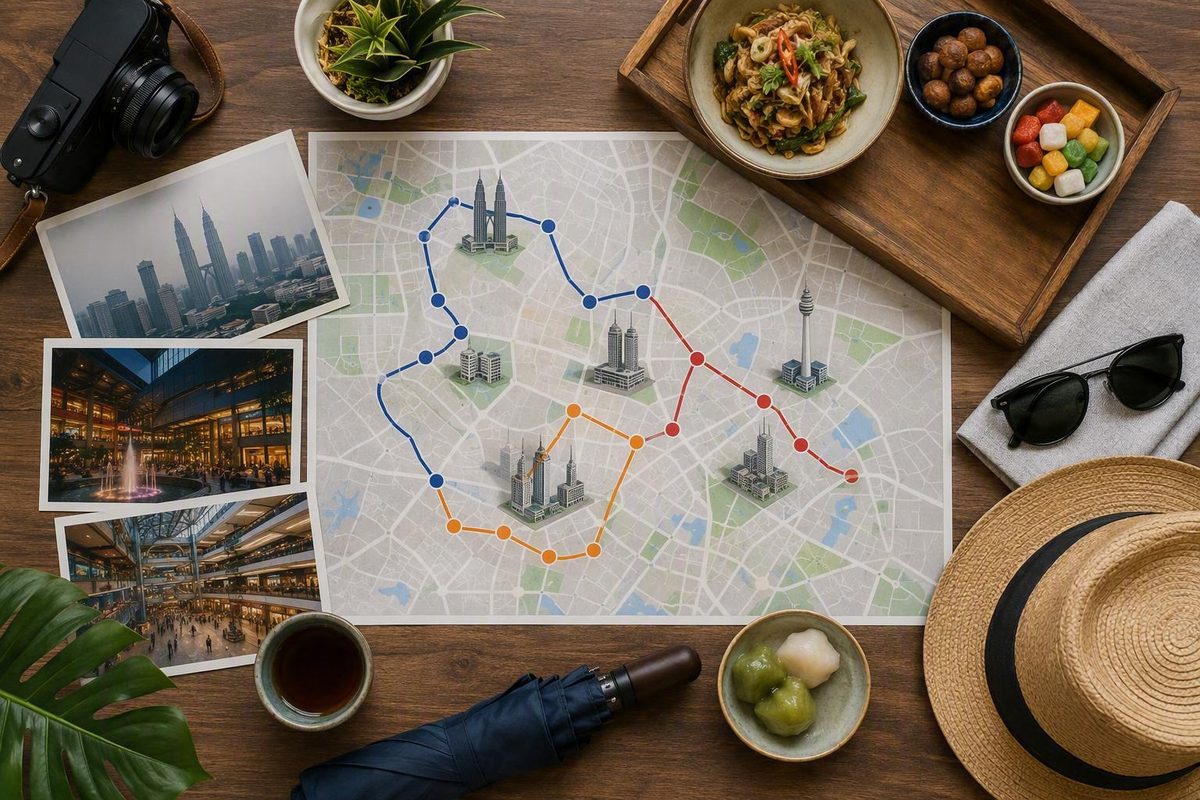
At the unhealthy API reading of 154 recorded at one Kuala Lumpur monitoring station on August 25, 2026, a sightseeing day should be rerouted rather than automatically cancelled. Most of a simple KLCC day can happen inside Suria KLCC, but parks, skyline stops and any unverified transfer should come out of the plan. The reading was from one station, not a citywide average or a current value (CNA).
That verdict has a firm limit. An air-conditioned building is not proof of effective filtration or healthy indoor air, and reaching it may involve sidewalks, open platforms or exterior queues. Check current government information for both your starting point and destination, follow current restrictions and health guidance, and stay at suitable accommodation when those instructions or your health needs call for it.
Why “Stay Indoors” Is Right but Incomplete
The received advice during a haze spike is to stay indoors or postpone outdoor plans. That is sound when the official API and health guidance require it. Malaysia classifies API readings of 101–200 as unhealthy, 201–300 as very unhealthy and above 300 as hazardous. CNA also reported that the national haze action plan requires outdoor activities to be suspended when the API exceeds 100.
That means KLCC Park, walking tours, street markets and outdoor food routes should not be salvaged during such conditions. The consensus is also right that an indoor attraction does not cancel the exposure involved in getting there.
Where the advice becomes too broad is in treating the entire visitor day as lost. Suria KLCC contains shopping, dining and Petrosains, while Aquaria KLCC is at the Kuala Lumpur Convention Centre. A rail-oriented guide identifies Petrosains as an interactive science and technology museum and Aquaria as an attraction accessible from KLCC Station (Pelago). Those facts support a compact, visibility-independent day, although they do not prove that every transfer is enclosed.
The defensible strategy is therefore one indoor cluster, not a citywide chain of nominally indoor attractions. Keep same-building activities, verify every connection and remove anything requiring outdoor circulation when current rules suspend it.
Test Your Haze-Day Route
The router counts itinerary blocks, not minutes or air quality inside a venue. “Covered” means the activity stays in the same building or you have personally confirmed the complete sheltered route. “Verify” remains unresolved rather than being presented as safe.
Enter the API and choose your base; then correct any transfer after checking the route you will actually use.
This counts selected itinerary blocks. It does not measure time, dose, filtration or indoor air quality.
| Use | Itinerary Block | Route Evidence | Your Status |
|---|---|---|---|
| Petrosains | Inside Suria KLCC | ||
| Meal in Suria KLCC | Same-building choice | ||
| Shopping, café or mall activity | Same-building choice | ||
| Aquaria KLCC | Convention-centre transfer not proven enclosed | ||
| KLCC Park | Outdoor attraction | ||
| Browsing in one chosen mall | Same-building choice | ||
| Meal in the same mall | Same-building choice | ||
| Cinema in the same mall | Same-building if confirmed | ||
| Lot 10 Hutong from another mall | Exact connection not established | ||
| Night market | Outdoor circulation | ||
| Muzium Negara | Direct arrival and queue need checking | ||
| Islamic Arts Museum | Transfer not established as sheltered | ||
| National Textile Museum | Entrance and transfer need checking | ||
| Central Market main building | Indoor core; route and adjacent areas vary | ||
| Petaling Street | Open-air or semi-open circulation |
Source: API bands, the 154 station reading and the action-plan threshold are from CNA; itinerary classifications use only the venue and route evidence described in this article. “—” applies where no measured exposure or filtration figure is available.
The default KLCC plan has three of five blocks inside the same mall, so its indoor core forms a majority. Aquaria’s transfer remains unverified, while KLCC Park is explicitly outdoor. Removing both leaves a shorter but coherent Petrosains, meal and mall-activity day.
Bukit Bintang can produce a similar result when shopping, dining and a cinema are all inside one chosen mall. It does not follow that every mall-to-mall movement in the district is covered. Chinatown and the museum areas require more route verification, so they are weaker choices when the aim is to minimise uncertain transfers.
KLCC Has the Strongest Indoor Core
“Strongest” refers to itinerary convenience and variety, not measured indoor air quality. KLCC works because a visitor can build the day around activities inside Suria KLCC and treat everything beyond that building as optional.
Keep Petrosains, a Meal and One Mall Activity
Petrosains is inside Suria KLCC and does not depend on a clear skyline. It can anchor a family day without requiring a sequence of outdoor landmarks.
A restrained KLCC itinerary is:
- Travel directly to the verified entrance that best suits your route and mobility needs.
- Visit Petrosains.
- Eat inside Suria KLCC.
- Add shopping, a café or another same-building activity.
- Return to your accommodation without adding KLCC Park.
Confirm current admission, session availability, entrances, queue arrangements and accessibility with the venue. A listing or travel guide cannot establish same-day availability.
Add Aquaria Only After Checking the Transfer
Aquaria KLCC is at the Kuala Lumpur Convention Centre, making it a logical second anchor. The available evidence does not establish that the complete route from your starting point is enclosed, however. Check the precise station exit, mall connection, convention-centre entrance and any ticket queue before treating it as covered.
A power-wheelchair user reported that Aquaria’s underwater tunnel had a fixed walkway usable by wheelchair users and people with strollers. The same traveler reported wheelchair access during a Petronas Towers tour (Wheelchair Travel). These are firsthand observations, not current accessibility certifications. Reconfirm lifts, toilets, assistance and temporary route changes.
If the transfer is uncertain or conditions worsen, stop after Petrosains and the meal. A three-part day inside one building is more useful than preserving an ambitious schedule with an exposed second leg.
Save the Petronas Towers for Clearer Air
The Petronas Towers may be enclosed at the observation level, but their value depends heavily on visibility. A December 2025 guide said the towers used timed entry and recommended advance booking (Lonely Planet). Current ticket rules, entrances and waiting arrangements still need direct confirmation.
If the skyline is obscured, Petrosains or Aquaria retains more of its purpose. Timed admission also does not prove that every access or waiting stage is sheltered.
Bukit Bintang Works Best Inside One Chosen Mall
Bukit Bintang offers flexibility for travelers who prefer shopping, food and entertainment to a fixed museum schedule. Its useful haze-day unit is one mall, not the whole district.
Choose a mall where the combination you want—shopping, a meal and a cinema—can remain inside the same building. That creates a complete half-day without depending on a clear view or repeated street crossings.
Lot 10 Hutong can serve as an indoor food destination with hawker-style variety. If it is not in the building where you begin, classify the transfer as unverified until you have checked the exact route and entrance. A nearby building on a map is not necessarily connected by a fully enclosed path.
A practical sequence is one mall activity, a long meal and a cinema. An escape room can replace the cinema if its current operator, location, age rules, accessibility and session time have been confirmed. The point is to give the day a defined endpoint rather than using each indoor stop as a reason to cross into another part of Bukit Bintang.
The same caution applies to Pavilion, Lot 10 and other central malls: covered links may reduce street exposure, but the draft evidence does not establish a seamless, fully enclosed KLCC-to-Bukit Bintang network. Temporary closures, lift detours and the entrance actually in use can change the route.
Chinatown and Museum Days Need More Verification
A culture-focused day remains worthwhile when haze removes the appeal of parks and skyline views. Muzium Negara, the Islamic Arts Museum and the National Textile Museum do not depend on clear weather, but they should not be assembled into a walking circuit.
Choose one principal museum, arrange a direct journey and add a second venue only if its complete transfer is acceptable. Confirm current opening hours, ticket arrangements, entrance, queue conditions and accessibility before leaving.
Central Market is a more cautious option. Its main building provides substantial indoor time, but adjacent stalls and parts of the visitor experience involve more open circulation. Petaling Street is an outdoor market route, not an indoor substitute.
This makes Chinatown a weaker base than KLCC during an API-above-100 plan unless you have verified a specific door-to-door route. A direct car may reduce walking for some museum or gallery trips, but pickup waits, traffic, drop-off points and exterior queues still count.
Independent venues such as GMBB KL, Gerimis, The Godown and Temu House depend on current programming. Check the same day whether an exhibition or workshop is running, whether booking is required, which entrance is open and whether waiting occurs outside. No current filtration figures are available in the draft, so none should be assumed.
Rail and Grab Both Leave Exposure Gaps
Rail can be the spine of a compact itinerary when the full station-to-venue route has been checked. A station described as near or accessible to an attraction does not establish an underground or continuously covered connection.
Possible gaps include the walk to the station, open or partly open platforms, interchanges, lift detours, exposed exits and exterior ticket queues. These details matter particularly for wheelchair users, families with children and anyone who needs to limit standing.
Grab may be more practical when rail requires a longer exterior approach or several changes. It does not eliminate exposure: pickup waits, traffic delays and the distance from the drop-off point to the usable entrance remain part of the journey.
Compare complete routes rather than choosing by transport label. Reducing the number of neighborhoods usually removes more uncertainty than repeatedly switching between rail and cars.
Postpone Outdoor and View-Dependent Landmarks
When current rules suspend outdoor activities, the substitutions are direct:
| Postpone | Use Instead |
|---|---|
| KLCC Park | Petrosains or Aquaria KLCC |
| Batu Caves | One substantial museum |
| Outdoor food walk | Indoor restaurant or Lot 10 Hutong |
| Night market | Same-mall dining and cinema |
| Rooftop sunset | Workshop, cinema or performance |
| Observation deck | Visibility-independent attraction |
Batu Caves is not an indoor workaround. Its cave and temple spaces are reached through substantial outdoor access, including a 272-step climb reported in a firsthand visitor account (The World Wanderers).
Rooftop venues have two disadvantages during haze: they may expose visitors to outside air, and the skyline or sunset that justifies the booking may disappear. Observation decks have the same visibility problem even when the viewing area itself is enclosed.
Do not assume a day trip offers cleaner air. Conditions vary by location and time, and the available evidence does not identify an excursion destination that is automatically outside the haze. Check official conditions for the proposed destination before traveling.
The Plan Changes at API 100
The cited action-plan threshold is straightforward: outdoor activities are to be suspended when the API exceeds 100. For an itinerary, that means removing outdoor and unresolved blocks rather than treating 101 as merely a less photogenic day.
The article cannot supply a live official reading, and the available draft evidence does not identify a verified government API page or app. Obtain the latest government information independently before departure. A historical report cannot determine whether a journey is suitable now.
Anyone with individual health concerns should follow current official health guidance and consult a qualified clinician where appropriate. No indoor itinerary can establish a personal exposure limit or guarantee healthy air.
A successful haze day is narrower than an ordinary sightseeing day: one verified cluster, one main attraction, one indoor meal and an optional same-building extension. At KLCC, that can preserve most of a first-time visitor’s day without pretending that every rail, mall and convention-centre connection is exposure-free.