 KL Observer
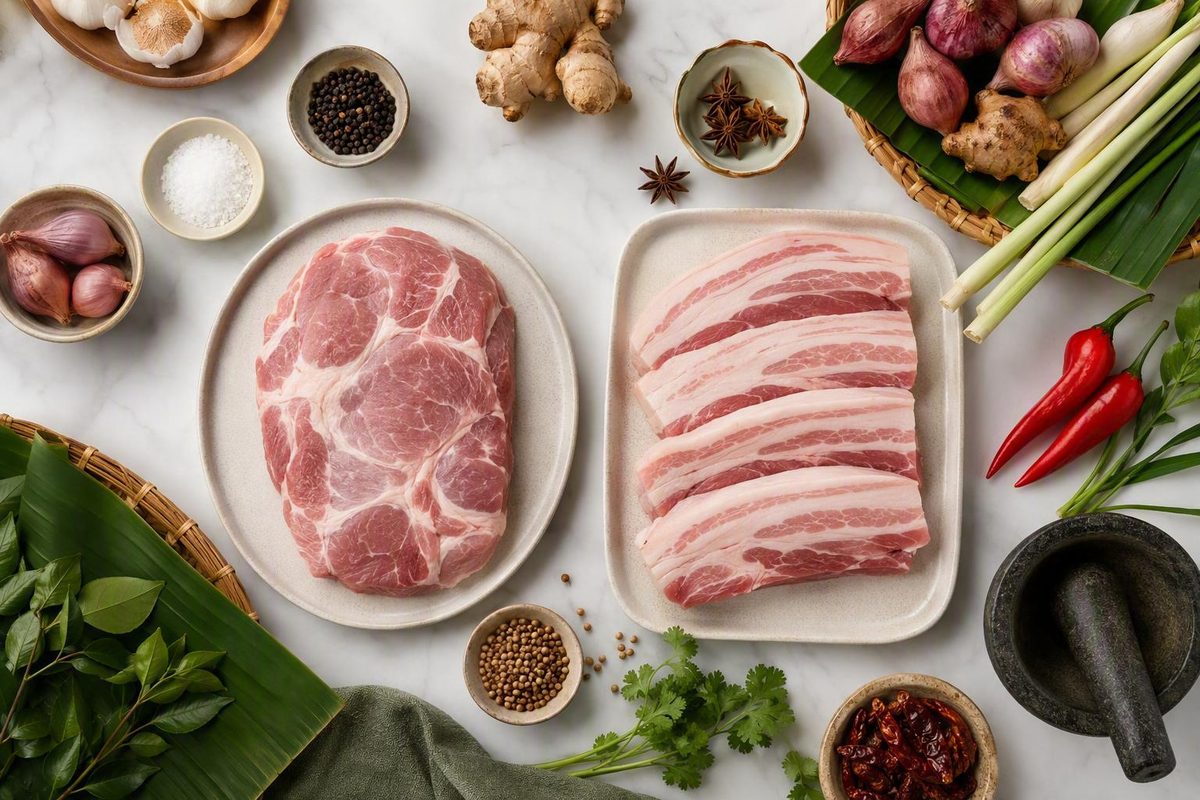
The short answer: pork scotch fillet and pork belly are not the same
Pork scotch fillet and pork belly are distinct cuts. In Australian terminology, pork scotch fillet comes from the shoulder collar between the neck and loin. Pork belly comes from the underside of the pig and belongs to the belly primal. Bruemar’s guide to pork cuts identifies scotch fillet steak as a collar-butt cut and places the collar and belly in separate primal areas.
The simplest selection rule is:
- Choose sliced pork scotch fillet for marbled steaks cooked on a barbecue, grill or frying pan.
- Choose a whole pork scotch for slow roasting, smoking, braising or shredding.
- Choose rind-on pork belly for pronounced layers of meat and fat with the possibility of crisp crackling.
- Choose rindless or sliced belly when you want belly’s richness without a skin-based finish.
Both cuts tolerate slow cooking, but they do not produce the same result. Scotch gives you cohesive, shoulder-style meat with fat distributed through and between the muscles. Belly retains a visibly layered structure and may provide a crisp skin exterior when sold rind-on.
| Point of comparison | Pork scotch fillet | Pork belly |
|---|---|---|
| Anatomical location | Shoulder collar between the neck and loin | Underside of the pig; belly primal |
| Fat pattern | Marbling distributed through and between muscles | Conspicuous alternating layers of meat and fat |
| Common formats | Sliced steaks or a larger whole scotch/collar | Whole slab, rolled belly, rashers, strips or smaller slices |
| Rind | Not normally selected for a belly-style crackling result | Available rind-on or rindless |
| Suitable methods | Steaks: grill, barbecue or pan-fry. Whole cut: roast, smoke, braise, stew or shred | Roast, braise, smoke or slow-cook; thinner pieces can be grilled, seared, fried or stir-fried |
| Typical result | Marbled steak portions or cohesive meat that can be sliced or shredded | Rich, layered slices with rendered fat; rind-on versions can produce crackling |
Neither cut is universally better. Scotch is the more natural choice for individual steak-like portions or a shoulder-style braise. Belly is the clearer choice when visible layers, rendered richness and crackling define the dish.
Where each cut comes from—and why the name can be confusing
“Scotch fillet” can be confusing because its meaning depends on the animal and the regional butchery system.
Australian guides place pork scotch fillet in the shoulder. More precisely, scotch fillet steaks are sliced from the collar butt, which sits between the neck and loin. The collar is close to the loin anatomically, but the supplied evidence does not support classifying Australian pork scotch fillet as a pork-loin cut.
The same general collar area may appear under several labels:
- Pork scotch
- Pork scotch fillet
- Pork neck
- Pork collar
- Collar butt
- Whole scotch
These names can overlap, but they do not guarantee that every butcher trims or portions the meat identically. “Scotch fillet steak” usually signals an individual portion suitable for relatively quick cooking. “Whole scotch,” “pork collar” or “pork neck” more often refers to a larger piece intended for roasting, smoking or braising. An Australian producer’s pork-cut guide groups scotch fillet steaks and whole scotch under the shoulder, while listing belly separately.
Pork belly is less ambiguous anatomically: it belongs to the belly primal and comes from the underside. Its retail format can still vary considerably. It may be rind-on, rindless, rolled, cut into rashers, sliced into strips or sold as a thick slab.
Terminology becomes more complicated when recipes cross borders. Some US-oriented guides divide pork into categories such as loin, shoulder and belly without using the Australian term “pork scotch fillet.” One US barbecue cut guide separates loin, shoulder and belly but does not identify a cut by the scotch name. A recipe written for pork collar or neck may therefore suit an Australian pork scotch, while a recipe calling simply for “pork steak” may mean another shoulder portion.
When buying, do not rely on the familiar sound of the name. Ask the butcher:
Is this sliced from the neck or shoulder collar, and is it intended as steaks or as a whole slow-cooking piece?
That question establishes both the anatomical area and the product format. If the answer is loin, treat it as a different cut rather than assuming it will behave like Australian pork scotch fillet.
Marbling versus layers: how their fat and texture differ
The most useful comparison is not simply “fatty versus lean.” It is marbling versus layers.
Pork scotch fillet contains fat distributed within and between the muscles. In a steak, this appears as visible marbling. A larger collar piece also contains connective tissue and natural seams between muscles. That structure allows a sliced scotch fillet to retain the identity of a steak under direct heat, while a whole collar can respond well to extended cooking.
Pork belly has a different architecture. It contains pronounced alternating bands of meat and fat, often topped with rind when sold skin-on. Some fat renders during cooking, but the layered construction remains a defining part of the appearance and texture of each slice.
This structural difference affects the finished dish:
- Scotch steak: Fat is distributed through the portion instead of appearing mainly as broad, separate layers.
- Whole scotch: Extended cooking can soften connective tissue and take the meat from sliceable to shreddable.
- Pork belly: Distinct fat layers render during cooking but remain central to the cut’s texture and presentation.
- Rind-on belly: The skin adds an exterior element that can be prepared as crackling.
This is a qualitative comparison, not a measured numerical difference between matched portions.
The available evidence does not provide comparable laboratory values for equally trimmed, equally cooked portions of pork scotch and belly. A rind-on belly slab, a heavily trimmed rindless portion, a marbled scotch steak and a whole collar roast are not nutritionally equivalent products. Cooking also changes what reaches the plate because rendered fat may be retained, served in a sauce or cooking liquid, or drained away.
For those reasons, it would be misleading to state that one cut contains a specific number of grams more fat, calories or saturated fat than the other. The evidence also does not establish that either cut is universally healthier. Any reliable nutritional comparison would need to account for rind, trimming, portion size and preparation.
Descriptions such as “tender,” “juicy,” “succulent” and “flavourful” should also be treated as qualitative culinary language, not controlled measurements proving that one cut is objectively more tender or better tasting.
The practical distinction is visible in the raw meat. A steak-shaped portion with fine or moderate fat seams through the muscle is intended to provide a marbled, cohesive bite. Broad horizontal layers of meat and fat beneath a sheet of skin indicate a richer, more visibly layered result.
Product format matters as much as the cut name
A cut name does not tell you everything required to choose a cooking method. Thickness, rind and whether the meat is whole or sliced can be just as important.
Scotch fillet steaks versus whole pork scotch
A sliced scotch fillet steak is portioned for relatively quick cooking. Its broad surfaces can be browned on a grill, barbecue plate or frying pan while the portion remains recognisably steak-like.
A whole pork scotch is much thicker and contains connective tissue across a larger piece. It can be slow-roasted, smoked, braised or stewed. Continued cooking can take it beyond a sliceable roast towards meat that separates into strands.
This is why advice about pork scotch may appear contradictory. “Grill it” and “cook it low and slow” can both be appropriate recommendations, but for different formats. Applying a steak method to a thick whole collar—or treating every sliced steak as an all-day braising cut—ignores that distinction.
Rind-on belly versus rindless belly
Rind-on belly is the relevant format when crackling is central to the meal. Crackling is made from the skin, so removing the rind removes the element that would become that crisp exterior.
Rindless belly still retains the characteristic layers of meat and fat. Depending on its size and thickness, it may be slow-roasted, braised, smoked, grilled, fried or cut into smaller pieces for stir-frying. Its exposed surface can brown and crisp, but it cannot reproduce skin-based crackling.
Whole belly and thin belly slices also require different treatment. A thick slab needs sufficient cooking for heat to move through the meat and for the fat to render to the intended degree. Belly rashers, strips and other thin slices can tolerate brief high-heat pan-frying or barbecuing. A general pork-cut guide lists roasting, smoking, searing and braising for belly, illustrating the range of methods available when format is taken into account.
Before selecting a recipe, check five details:
- Is the scotch sold as steaks or as one whole piece?
- Is the belly whole, rolled, sliced or cut into rashers?
- Does the belly still have its rind?
- How thick is the portion?
- Does the recipe aim for quick browning, gentle braising, shredding or crackling?
There is no single universal method for everything called pork scotch, just as there is no single method for every form of pork belly.
Best cooking methods for pork scotch fillet
The best method for pork scotch fillet depends primarily on whether you have steaks or a whole collar piece.
For sliced scotch fillet steaks
Suitable direct-heat methods include:
- Grilling
- Barbecuing
- Pan-frying
- Searing, followed by gentler cooking if the steak’s thickness requires it
The objective is to brown the broad surface while retaining the identity of an individual steak.
A scotch steak should not automatically go into an extended braise merely because the larger collar is suitable for slow cooking. The steak has already been portioned to make faster cooking practical.
For a whole pork scotch or large collar
Suitable gradual-cooking methods include:
- Slow roasting
- Smoking
- Braising
- Stewing
- Pot roasting
- Cooking until shreddable
The collar-butt section contains marbling and connective tissue and is recommended for smoking, stewing and braising. Bruemar’s guide distinguishes quick-cooked scotch steaks from the slow-cooked collar butt, resolving the apparent contradiction between the two approaches.
A whole scotch is useful when you want meat with a cohesive shoulder structure. It can be cooked to a sliceable endpoint or taken further until the muscles separate easily for pulled-pork-style servings. Those are different goals, so the intended dish should determine the endpoint.
In stews and braises, collar provides marbled pork without belly’s broad alternating fat layers. The cooking liquid may still become rich, but each portion retains a more meat-centred shoulder structure. That can be preferable when distinct belly layers would dominate the texture of the dish.
Smoking follows the same format principle. A thick whole scotch suits an extended cook, whereas an individual scotch steak is more naturally treated as a grilled or barbecued portion.
Universal cooking times are not useful across all these formats. A steak, a compact collar and a larger roast do not cook at the same rate.
Best cooking methods for pork belly—and when crackling decides the choice
Pork belly can be roasted, braised, smoked, seared, grilled, slow-cooked or stir-fried. The appropriate method depends on thickness, portion size and whether the skin remains attached.
Whole rind-on belly
Choose a whole rind-on slab when the goal is a roast with crisp crackling and layered slices underneath. The broad principle is to give the meat enough gentle cooking to tenderise and render fat while exposing suitably prepared skin to high heat so it can crisp.
There is no single agreed sequence for achieving that result. Some Australian guidance recommends scoring and salting the rind, beginning with high heat to establish crackling and then reducing the heat. Other recipes reverse the sequence.
For example, one Australian pork guide recommends scoring and salting the rind before a high-heat start and slower roast. By contrast, RecipeTin Eats’ slow-roasted crispy pork belly method calls for dry, unscored and level skin, low-temperature cooking and a high-heat finish. Its approximately three-hour schedule is written for a roughly 1-kilogram belly around 3 centimetres thick, so it is a recipe-specific example rather than a universal cooking time.
The methods differ on two important points:
- Whether to score the skin
- Whether the high-heat stage comes first or last
Do not combine isolated steps from conflicting methods and assume the hybrid will work predictably. Follow one complete, tested recipe that matches the format and approximate thickness of your belly. Skin preparation, heat sequence, tray arrangement and cooking time operate as a system.
Whole rindless belly
Without the skin, crackling is no longer an objective. The belly can still be roasted until browned, smoked, braised in liquid or cooked slowly before being portioned and seared. Its exposed meat and fat can caramelise, but the exterior will not be the same as crisp pork skin.
Rindless belly is a practical choice when the recipe will:
- Submerge the pork in braising liquid
- Cut it into cubes or strips
- Apply a glaze directly to the meat
- Finish portions on a grill or in a pan
- Serve the layered interior without crackling
Sliced belly, rashers and strips
Thin belly slices can be pan-fried, grilled or barbecued over relatively high heat. Strips can also be stir-fried if the recipe accounts for the fat released during cooking.
Smoked or braised belly
Smoking suits thicker belly portions when the desired result is rendered richness and a seasoned exterior rather than conventional oven crackling.
Belly does not inevitably become pulled meat. Depending on the method and endpoint, it can remain tender but sliceable, allowing the striped cross-section to remain visible when carved. A whole scotch can also be sliceable, but its slices display marbled shoulder meat rather than belly’s alternating bands.
A task-based chooser: which cut works for your dish?
Starting with the intended dish is the easiest way to choose between pork scotch fillet and pork belly.
For grilled or pan-fried steaks: sliced pork scotch fillet
Choose individually sliced scotch fillet steaks when you want distinct portions with internal marbling. Their format suits grilling, barbecuing and pan-frying without requiring the extended cooking associated with a whole collar or belly slab.
If quick cooking is the goal, confirm that the scotch has been cut into suitable steak portions rather than buying a thick whole piece.
For pulled pork: whole pork scotch
Whole pork scotch is the more natural choice for pulled-pork-style meat. Its shoulder-collar structure can soften during prolonged cooking and separate into strands.
Belly can also become very tender and may be shredded, but its conspicuous fat layers produce a richer result. It can work when that richness is intentional, but it is not an equivalent replacement for shoulder-style pulled pork.
For a stew or braise: usually whole scotch, with belly as a richer alternative
Choose whole scotch, collar or suitably diced scotch when you want marbled meat that becomes tender while retaining a predominantly meaty structure.
Belly can work in braises designed around its layers and rendered fat.
Before substituting one cut for the other, consider whether the recipe depends on:
- Distinct belly layers
- A meat-centred shoulder texture
- A particular degree of rendered richness
- Neat slices rather than strands
- Skin or crackling
A substitution may be workable without being equivalent.
For a slow roast: choose according to the desired carving result
Choose whole scotch for a marbled shoulder roast that can be carved or cooked further until shreddable. Choose belly for layered slices and rendered richness.
If the belly is rind-on, the roast may also incorporate crackling. A scotch roast can develop a browned exterior, but it does not offer the same meat-fat-skin construction.
For smoking: either cut, but for different outcomes
Whole scotch suits prolonged smoking when the goal is shoulder-style slices or pulled meat. Belly suits smoking when the goal is rich layered pieces, cubes or slices with a smoky exterior.
Format and thickness still control the method. A large whole collar and a thin belly strip should not follow the same schedule merely because both can be smoked.
For crackling: rind-on pork belly
If crisp skin defines the dish, buy rind-on belly. Rindless belly cannot create skin-based crackling, and scotch fillet cannot reproduce belly’s combination of crisp rind, fat layers and meat.
This is the clearest case in which the cuts should not be exchanged.
For rich, clearly layered slices: pork belly
Choose belly when you want broad fat layers to remain visibly integrated within each slice. That structure is central to dishes in which belly is glazed, braised, roasted and carved, or crisped after an initial slow cook.
Choose scotch when you want fat dispersed as marbling through a more cohesive piece of meat.
For a substitution: decide which change you can accept
Pork scotch and pork belly can sometimes fill the same role in a braise or slow-cooked dish, but they are not direct one-for-one substitutes.
Replacing belly with scotch generally means:
- Less conspicuous layering
- A more cohesive, meat-centred portion
- No belly-style crackling
- A different distribution of rendered fat
Replacing scotch with belly generally means:
- A richer result
- More visible fat layers
- Potentially more rendered fat in the cooking vessel
- A different presentation when sliced
- Crackling only if the belly is rind-on and the method supports it
The change in rendered fat may also affect how the sauce or cooking liquid is served. Depending on the dish, some fat may need to be drained or skimmed.
Final shopping checklist
Before buying either cut, confirm:
- Regional name: Is “scotch” being used for neck or shoulder collar?
- Format: Is it a whole piece, steak, slab, roll, rasher or thin strip?
- Rind: Is the belly rind-on or rindless?
- Thickness: Does it match the recipe’s format?
- Intended method: Are you grilling, roasting, braising, smoking, shredding or making crackling?
- Desired result: Do you want a marbled steak, cohesive shoulder meat, pulled strands or layered slices?
Frequently asked questions
Is pork scotch fillet the same as pork belly?
No. In Australian usage, pork scotch fillet is cut from the shoulder collar between the neck and loin. Pork belly comes from the underside and belongs to the belly primal.
Scotch has fat marbled through and between the muscles, while belly has pronounced layers of meat and fat. Both can be slow-cooked, but they produce different textures and presentations. Rind-on belly also offers the option of crackling.
Is pork scotch fillet the same as pork neck or pork collar?
Often, within Australian butcher terminology. Pork scotch or whole scotch commonly refers to the neck or shoulder collar, and scotch fillet steaks can be sliced from that larger piece.
Names and trimming conventions vary among countries and butchers, however. Confirm that the product comes from the shoulder collar and ask whether it is sold as steaks or as a whole piece. Do not assume every product called pork neck, collar, shoulder or pork steak is trimmed identically.
Which is fattier: pork scotch fillet or pork belly?
An Australian butcher’s comparison likewise distinguishes layered belly from marbled pork scotch.
An exact numerical comparison is not supported without matched portions. Rind, trimming, cooking method and the amount of rendered fat served would materially affect calorie and fat values, so the available evidence does not establish that either cut is universally healthier.
Can I substitute pork scotch fillet for pork belly?
Sometimes, particularly in a stew or braise, but the substitution will change the dish. Scotch produces a more cohesive, shoulder-style result, while belly contributes richer layers and a different distribution of rendered fat.
Do not use scotch as a direct replacement when rind-on belly and crackling define the recipe.
Is fresh pork belly the same as bacon?
No. Fresh pork belly is an uncured cut from the underside of the pig. Pork belly can be cured—and sometimes smoked—to make belly or streaky bacon, but fresh belly is not automatically bacon. Prairie Fresh’s pork-cut guide distinguishes fresh belly from belly processed through curing or smoking.
For the final choice, focus on the intended plate: sliced pork scotch fillet for steak portions, whole pork scotch for cohesive meat that can be braised or shredded, and rind-on belly when layered richness and crackling are essential. Always verify the regional label and product format before choosing a recipe.