 KL Observer
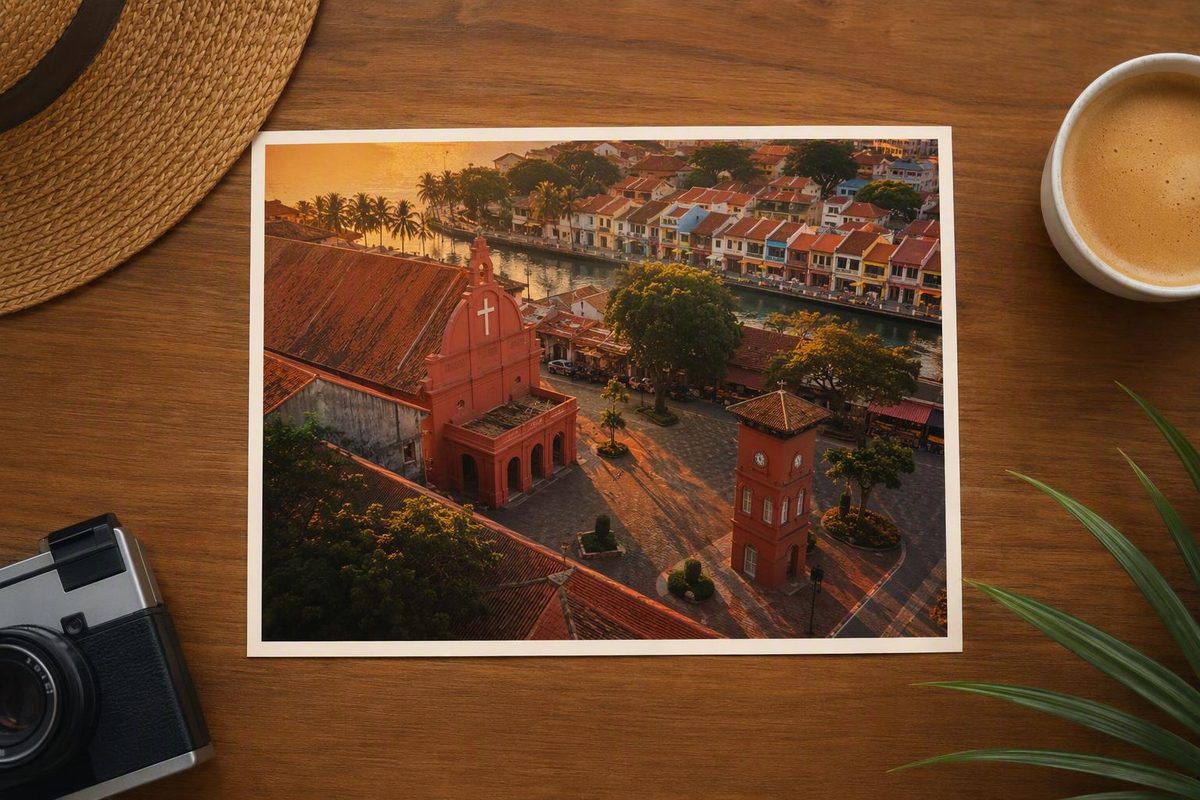
Melaka works best as a connected route, not a collection of isolated photo stops. The city’s story begins with a Malay sultanate and maritime trading port, continues through Portuguese, Dutch, British, and wartime rule, and remains visible in religious streets, shophouses, residential communities, and food traditions.
Geography does not place every surviving landmark in perfect chronological order. For most first-time visitors, the most efficient walk starts around Dutch Square, crosses St. Paul’s Hill to the remains of the Portuguese fortifications, reconnects with the earlier sultanate at the Melaka Sultanate Palace Museum, and then crosses the river toward Jonker Walk and Harmony Street.
One day is enough for that central loop if you make firm choices. An overnight stay creates room for museums, dinner, and an evening walk without watching the return-bus clock. A third day lets you choose an outlying community or historical landscape rather than spending another day circling the same central streets.
Malacca or Melaka? Start with the name, location, and historical context
Malacca and Melaka refer to the same destination. Melaka is the Malay and modern administrative spelling, while Malacca remains common in English searches and historical writing. Travelers planning a “Malacca Malaysia” trip will encounter both forms on maps, booking platforms, and older material; this guide uses Melaka.
Melaka City is the capital of the wider state of Malacca. It developed at the mouth of the Melaka River on the Strait of Malacca, a position connected to maritime routes between the Indian Ocean, Southeast Asia, and the South China Sea.
The settlement emerged around 1400 as the center of a Malay kingdom and an important trading port. Traders used it for commerce, provisions, and access to regional networks. Its importance therefore predates European conquest: Portuguese, Dutch, and British structures are later layers in a much longer urban history.
A concise chronology provides the necessary frame:
- Around 1400: Melaka developed as the center of a Malay sultanate and a strategically placed maritime port.
- 1511: Portuguese forces conquered Melaka.
- 1641: Dutch rule began after Melaka was taken from the Portuguese.
- Nineteenth century: British control became established; the Anglo-Dutch settlement of 1824 confirmed control in Britain’s favor.
These dates and the city’s location are summarized in Britannica’s history of Melaka.
The sequence appears in forts, churches, administrative buildings, religious institutions, community histories, and food. It should not imply that European conquest created the city. That is why the Melaka Sultanate Palace Museum matters even though it is a modern reconstruction rather than an original surviving palace: it restores the pre-1511 sultanate to a landscape otherwise dominated by later structures.
Melaka’s heritage status is also broader than any one monument. The historic cities of Melaka and George Town were jointly inscribed as a UNESCO World Heritage Site in 2008. The designation concerns an urban landscape shaped by trade and cultural exchange; it does not belong solely to A Famosa, Dutch Square, or another individual building. The joint inscription and year are summarized in the overview of Malacca City.
That wider view is essential. Malay, Chinese, Indian, Peranakan, Portuguese-Eurasian, Dutch, British, and other histories coexist in Melaka, but they are not interchangeable. A useful first visit notices how political power, migration, religion, commerce, and domestic life accumulated within a relatively compact area.
Is Melaka a day trip, an overnight stop, or a three-day destination?
There is no universally correct duration. Choose according to scope: one day for the visible heritage core, two days for better pacing and an evening, or three days for selected places beyond the central visitor district.
A Kuala Lumpur day trip is workable if you leave early and stay focused. Its main cost is not simply the intercity journey. You must also reach the departure terminal, wait and board, travel from Melaka Sentral to the historic center, and repeat the process in reverse. That leaves less room for museums, long meals, an evening market, or outlying neighborhoods.
An overnight stay changes the visit more than merely adding a few hours. It removes pressure from the afternoon, gives you room for an evening meal or riverside walk, and lets you divide outdoor sightseeing between two days.
A third day is useful when you want to reach Kampung Morten, Bukit Cina, the Portuguese Settlement, or the Melaka Straits Mosque. It should not become an excuse to collect every possible stop. Once you leave the central walking area, transfers take more time and can fragment the day.
| Time available | Feasible focus | Pace | Evening access | Likely omissions |
|---|---|---|---|---|
| One day | Dutch Square, St. Paul’s Hill, Porta de Santiago, one interior, riverfront, Harmony Street, Jonker Walk | Brisk but manageable with firm choices | Limited if returning to Kuala Lumpur | Most outer areas, multiple museums, long meals |
| Two days | Central historical route plus an evening and one deeper cultural theme | Balanced, with indoor breaks | Easy when staying centrally | Several outer districts unless using short rides |
| Three days | Heritage core plus one or two selected areas beyond it | Unhurried and selective | Multiple options | Few priority omissions, though seeing everything can still feel fragmented |
Weekend or weekday?
Weekends are associated with Jonker Walk’s night-market atmosphere and larger crowds. Weekdays are generally presented as quieter, which can make museums, religious streets, and meals easier to pace. A three-day itinerary guide likewise contrasts weekend market access with quieter weekday exploration in its Melaka planning overview.
The market schedule cannot be treated as settled. One supplied account reports operation from Friday through Sunday, while another reports Friday and Saturday. Because those published accounts conflict, verify the current nights and hours through a municipal or official local tourism channel before making nonrefundable plans.
Choose according to your priority:
- Choose a weekend if market atmosphere matters and you accept heavier congestion.
- Choose a weekday if you value quieter streets, easier museum pacing, and less competition for tables.
- Stay overnight if you want evening activity without depending on a late connection.
- Take a day trip if your goal is a focused central walk rather than comprehensive coverage.
The essential heritage walk: Dutch Square to Jonker Walk
The most efficient first-time route is geographical rather than strictly chronological:
Dutch Square → Stadthuys and Christ Church → St. Paul’s Hill → Porta de Santiago → Melaka Sultanate Palace Museum area → indoor or shaded pause → riverfront → Jonker Walk → Harmony Street → riverside finish
For a chronology-first variation, begin at the Sultanate Palace Museum area, continue to Porta de Santiago and St. Paul’s Hill, then descend to Dutch Square before crossing the river. That version better reflects historical order but may be less convenient depending on where your bus, taxi, or accommodation places you.
1. Begin at Dutch Square
Dutch Square, also called Red Square, is a practical orientation point. Its recognizable landmarks include the Stadthuys, Christ Church, the clock tower, and Queen Victoria’s Fountain.
The square introduces several periods at once. The Stadthuys served as a Dutch administrative or governor’s building and now has museum functions. Christ Church reinforces the Dutch-period setting, while Queen Victoria’s Fountain adds a later British imperial element. Heritage districts are rarely frozen in one moment; later governments reused and modified earlier civic spaces.
Pause long enough to identify the buildings and understand their relationship, but do not let the square consume the morning. Its exposed public space can feel more demanding after the day becomes hotter or busier.
2. Climb St. Paul’s Hill
Continue toward St. Paul’s Hill, where St. Paul’s Church stands as a roofless ruin with origins in the Portuguese period. The hill connects worship, defense, and the city’s relationship with the surrounding maritime landscape.
The climb is short, but “compact” does not mean effortless. Steps, slopes, heat, rain, and limited shade may matter, especially for travelers with reduced mobility. Available visitor accounts describe central Melaka as walkable while also identifying the hill as a distinct part of the route; anyone needing step-free access should confirm current conditions directly rather than assuming the full circuit is accessible.
If the climb is uncomfortable, shorten this section. Preserving enough energy for the river and religious streets is more useful than exhausting yourself at one stop.
3. Descend to Porta de Santiago
Continue downhill to Porta de Santiago. The gate is associated with A Famosa, the Portuguese fortification constructed after the conquest of Melaka. It is not the complete fortress.
Porta de Santiago is the principal surviving gate from what was once a much larger defensive complex. The distinction is important: a small surviving structure makes more sense when understood as evidence of a military landscape that has largely disappeared. The central-attractions overview from Travelsewhere distinguishes the remaining gate from the former fortifications.
Rather than treating it as an isolated backdrop, consider what the fortress represented: a colonial military position imposed on an already established Malay port.
4. Reconnect the route to the Melaka Sultanate
The nearby Melaka Sultanate Palace Museum supplies the route’s essential historical correction. It is a replica or reconstruction informed by accounts of a fifteenth-century palace, not an original royal building preserved intact.
If you have time for only one substantial interior, choose according to your main knowledge gap:
- Select the palace museum for the sultanate and pre-Portuguese context.
- Select a museum in the Stadthuys complex for later historical and ethnographic interpretation.
One carefully read museum contributes more than several rushed ticketed stops.
5. Take an indoor or shaded pause
After the hill and fort area, schedule a real break. Use a museum, lunch, café, or shaded riverside stop. This is part of the route rather than lost time.
The pause is especially useful on a day trip. Without it, a compact itinerary can become several uninterrupted hours of exposed walking followed by a crowded meal. It also creates a movable indoor block if rain arrives.
6. Cross toward Jonker Walk
The river provides a natural transition from monumental colonial buildings to streets associated with shophouses, commerce, worship, and food. Jonker Walk, or Jalan Hang Jebat, is the obvious entry point, but it should be treated as a corridor rather than the whole destination.
During the day, notice the scale and rhythm of the shophouses rather than looking only at souvenir displays. On a confirmed market evening, stalls and crowds change how the street functions. If architecture matters to you, visit in daylight and return later for the market instead of expecting the evening to offer both quiet observation and festival atmosphere.
7. Continue to Harmony Street
From Jonker Walk, continue toward the streets commonly grouped under the “Harmony Street” label. Landmarks include Cheng Hoon Teng Temple and Kampung Kling Mosque, with other places of worship nearby.
The aim is not to race between religious buildings. Notice how different institutions occupy a dense commercial and residential district. Enter only where visitors are permitted, follow posted dress and photography rules, keep your voice low, and avoid interrupting worship. The sites do not need unsupported “oldest in Malaysia” superlatives to be historically meaningful.
8. Finish along the Melaka River
End with the river rather than treating it only as a crossing. A riverside walk gives you control over distance and timing. A cruise offers a seated view of bridges, façades, embankments, and newer riverside development.
Neither is mandatory. Walking reveals street-level details and allows spontaneous stops; a cruise provides rest and another perspective but does not replace time in the neighborhoods. Confirm current cruise operations and the boarding point before building the day around one.
One-, two-, and three-day Melaka itineraries
These itineraries use the same historical spine but change the number of choices required. Keep museum hours, closure days, admission fees, cruise operations, and transport schedules outside the fixed plan until you have checked them shortly before visiting.
One day: capture the visible core
Early morning: Dutch Square and one interior
Begin at Dutch Square. Identify the Stadthuys, Christ Church, clock tower, and fountain, then choose one museum or historical interior. Do not attempt every museum simply because several are nearby.
Late morning: St. Paul’s Hill and Porta de Santiago
Climb the hill while you have energy, visit the church ruin, and descend to Porta de Santiago. Continue toward the Sultanate Palace Museum area, entering it only if it is your chosen interior.
Midday: lunch or an indoor pause
Take a substantial break. Use this time to reassess your energy and decide whether a river cruise would improve or overcrowd the afternoon.
Afternoon: riverfront and Harmony Street
Cross the river, walk a manageable waterfront section, and continue through Jonker Walk toward Cheng Hoon Teng Temple and Kampung Kling Mosque.
Late afternoon or evening: Jonker Walk
Return for food or browsing. Include the night market only if its operation has been confirmed and your return transport leaves enough margin to reach Melaka Sentral.
This day captures the visible central sequence. It sacrifices multiple museums, extensive food exploration, and nearly all outlying areas.
Two days: add cultural depth and an evening
A two-day visit should not be the one-day route repeated at half speed. Give each day a distinct purpose.
Day one: the central historical route
- Start at the Sultanate Palace Museum area for chronology, or Dutch Square for transport convenience.
- Continue through the Stadthuys and Christ Church setting.
- Visit St. Paul’s Hill and Porta de Santiago.
- Take an indoor lunch or museum break.
- Cross to Jonker Walk and Harmony Street.
- Reserve the evening for the riverfront, a meal, or the market if confirmed.
Day two: choose one deeper theme
- Peranakan history: Visit a Baba-Nyonya or Peranakan institution and pair it with a meal that distinguishes Peranakan food from other Melaka traditions.
- River and urban form: Take a longer river walk or cruise and revisit shophouse streets outside peak congestion.
- Malay residential heritage: Visit Kampung Morten respectfully as a living community.
- Food and religious geography: Spend more time around Harmony Street, then continue to Little India or another neighborhood meal.
- Museum-focused day: Use wet periods for interiors and keep outdoor sections movable.
The second day improves pace, makes an evening easy, and lets one cultural theme receive more than superficial attention.
Three days: move beyond the visitor hub
Keep the first two days focused. Use the third for one or two places requiring additional travel:
- Bukit Cina for Chinese burial history and memorial landscape.
- The Portuguese Settlement for Portuguese-Eurasian community history and food traditions.
- The Melaka Straits Mosque area for a geographically separate waterfront setting and contemporary religious architecture.
- Kampung Morten if it did not fit on day two.
- A return to one museum or street if rain, heat, or fatigue shortened an earlier visit.
Do not combine every outer stop merely because you have another day. Repeated vehicle transfers can recreate the rushed feeling the longer visit was supposed to prevent.
Weekend and weekday versions
For a weekend visit, reserve an evening for Jonker Walk only after confirming the market schedule. Visit the street in daylight as well if you want to see its façades and nearby religious sites more clearly.
For a weekday visit, use quieter streets to spend longer in museums, take an unhurried meal, and observe public architecture without expecting market activity. A weekday is not an incomplete version of Melaka; it offers a different pace.
Adjusting for rain
Use substitution rather than relying on a precise forecast:
- Keep museums and long meals as movable indoor blocks.
- Keep the hill, riverfront, and neighborhood walks flexible.
- Move an indoor block forward if rain begins.
- Resume the nearest outdoor sequence later instead of crossing the city for a replacement attraction.
- Do not assume that a river cruise will operate normally or be comfortable in poor conditions.
Adjusting for heat
Shape the day around exertion:
- Put the hill and longest outdoor walk early.
- Use a museum, meal, or extended rest during the most tiring part of the day.
- Resume with a shorter street or river section later.
- Take a short ride when discomfort begins to affect concentration or enjoyment.
The aim is not to maximize the stop count. It is to preserve enough attention to understand what you are seeing.
Beyond Jonker Walk: living neighborhoods and overlooked historical layers
Jonker Walk is a useful visitor hub, but it is not a complete representation of Melaka’s cultural geography. Its market, cafés, shophouses, and location concentrate tourism in a small area, while residential communities and historical landscapes extend beyond it.
Choose one extension according to your interests.
For Malay heritage: Kampung Morten
Kampung Morten is known for traditional Malay wooden houses and a village environment near the urban center. A travel account of the area describes it as a living village rather than simply a collection of preserved façades; the accompanying Melaka travel video also places the village within the city’s broader cultural landscape.
Approach it as a residential community, not an open-air attraction. Stay on appropriate public routes, avoid photographing residents or private interiors without permission, and confirm access before planning around a particular house.
For Chinese history: Bukit Cina
Bukit Cina is a Chinese cemetery associated with the long presence of Chinese communities in Melaka.
Visit quietly. Avoid stepping on graves or using memorial areas as casual photo props. Unsupported claims that it is definitively the oldest or largest cemetery of its kind outside China are unnecessary.
For Portuguese-Eurasian culture: the Portuguese Settlement
The Portuguese Settlement is associated with a Portuguese-Eurasian community whose identity includes Catholic traditions and Portuguese-derived cultural and food practices.
A meal can introduce dishes connected with the community, including curry debal, but food is only one expression of its history. One restaurant, event, or conversation cannot represent every resident. Confirm whether churches, community spaces, or events welcome visitors, and respect private gatherings and religious services.
For the sultanate period: Melaka Sultanate Palace Museum
The palace museum belongs both within and beyond the standard route because it changes how nearby colonial remains are interpreted. It is a reconstructed or replica palace used to present the sultanate period, not an original fifteenth-century royal building.
Choose it if your central route otherwise seems to begin with the Portuguese conquest. The museum helps place the fortifications and later Dutch buildings within a city that was already politically and commercially important.
For architecture: Melaka Straits Mosque
The Melaka Straits Mosque is geographically separate from the compact Dutch Square–Jonker Walk route. It fits more comfortably into a two- or three-day visit or a separate vehicle trip than into a compressed heritage day.
Treat it as an active religious space rather than only an architectural subject. Confirm visitor access and dress expectations directly, follow instructions from staff, keep photography unobtrusive, and avoid obstructing entrances or worshippers.
How to choose one extension
- Choose Kampung Morten for Malay domestic architecture and living heritage.
- Choose Bukit Cina for Chinese community history and memorial landscape.
- Choose the Portuguese Settlement for Portuguese-Eurasian culture and food.
- Choose the Sultanate Palace Museum for political history before European conquest.
- Choose the Straits Mosque for contemporary religious architecture in a separate waterfront setting.
Selecting one is not missing out. It is what gives a short visit depth.
What to eat in Melaka—and how food reflects the port city
Peranakan or Baba-Nyonya cuisine is central to many visitor accounts, but it should not become a catch-all label. A Malay asam pedas, Indian banana-leaf meal, Chinese oyster omelette, and Portuguese-Eurasian curry may all fit a Melaka itinerary without belonging to the same culinary tradition.
Foods and drinks commonly associated with the city include:
- Chicken rice balls: Rice formed into compact balls and served with chicken and accompaniments.
-
Nyonya laksa: A noodle dish associated with Peranakan cooking.
-
Oyster omelette: A savory egg-and-oyster dish.
- Coconut shakes: A cooling drink or dessert-like pause.
- Curry debal: A dish associated with Portuguese-Eurasian food traditions.
- Market snacks and sweets: Best sampled selectively rather than as a challenge to eat continuously.
These foods recur across published Melaka travel accounts, including a guide that connects Dutch Square, Jonker Walk, and the city’s commonly encountered dishes.
A practical one-day food structure is:
- One substantial meal near the area you are already exploring.
- One dessert or drink during the afternoon pause.
- One market or evening stop if the schedule and transport plan allow.
Jonker Walk is convenient for snacks and market atmosphere, but Melaka’s food geography extends beyond it. The Portuguese Settlement offers context for Portuguese-Eurasian dishes, while Little India provides a different community and dining environment.
Avoid building the trip around a definitive “best restaurant” list. Restaurants can change ownership, hours, menus, and standards. Choose a food tradition, identify two nearby possibilities, and confirm current operation on the day.
Do not assume that a dish or vendor is halal, vegetarian, vegan, or suitable for an allergy. Ask directly about ingredients and preparation, especially where pork, shellfish, shrimp paste, oyster sauce, or fish-based seasonings would be a concern. If a severe allergy is involved, do not rely on appearance or a translated dish name as proof of safety.
At busy markets:
- Read the visible menu before reaching the counter.
- Order clearly and keep the queue moving.
- Avoid blocking a stall or narrow lane for photographs.
- Ask before photographing staff at close range.
- Step aside after paying or collecting food.
- Share dishes if you want to sample several items without waste.
- Follow the stall’s system for returning dishes or disposing of rubbish.
Food reflects Melaka most clearly when it prompts precise questions: which community is associated with a dish, how ingredients arrived, and how recipes changed locally. Calling everything “fusion” can obscure the people who maintained and adapted those traditions.
Getting to Melaka from Kuala Lumpur, KLIA, or Singapore
Intercity buses are a commonly reported overland option for reaching Melaka. Travelers should generally plan around Melaka Sentral, not assume that every service stops beside Dutch Square, Jonker Walk, or their accommodation.
From Kuala Lumpur
Terminal Bersepadu Selatan, usually abbreviated to TBS, is a commonly cited departure point for buses to Melaka. Travelers starting in central Kuala Lumpur must also allow time to reach TBS, navigate the terminal, locate the correct gate, and board.
Published travel accounts commonly place the road journey in a broad range of roughly two to three hours, depending on origin, traffic, and the service used. This is not a door-to-door promise; one itinerary source describes the same broad planning range in its Kuala Lumpur–Melaka transport guidance.
Your total travel block also includes:
- Travel from your Kuala Lumpur accommodation to TBS
- Waiting and boarding time
- Traffic leaving Kuala Lumpur or entering Melaka
- Arrival at Melaka Sentral
- The transfer into the historic center
- A buffer before any fixed booking or return service
Melaka Sentral is reported to be about 3 km from Jonker Street, so a Grab ride, taxi, local bus, or another transfer may be necessary. The same central-attractions guide cited earlier provides this distance and identifies several local transport options.
For a day trip, work backward from the return departure. Decide when you must leave the river or Jonker area, then add the transfer and a terminal buffer. Avoid an itinerary that depends on immediate vehicle availability.
From KLIA or KLIA2
Some supplied travel sources report airport-bus connections from KLIA or KLIA2. Treat these as services to investigate rather than guaranteed current options.
Before relying on one, verify:
- The current operator
- The correct airport terminal
- Departure and arrival points
- The day’s timetable
- Luggage rules
- Whether advance booking is needed
- The operator’s procedure if a flight delay causes a missed departure
If a suitable direct service is unavailable, compare travel through Kuala Lumpur with a private road transfer. The practical choice depends on arrival time, luggage, group size, and tolerance for additional connections.
From Singapore
The Singapore–Melaka trip crosses an international border. Travelers need the documents required for their circumstances and should allow additional time for immigration and traffic. A published route account explicitly notes the passport requirement and warns that journey time depends on border and road conditions in its Singapore transport discussion.
Confirm the operator’s instructions, including:
- The exact departure point in Singapore
- The arrival point in Melaka
- Immigration procedures
- Whether passengers must remove luggage
- Entry requirements applicable to the traveler’s nationality and status
Do not plan a flight or another critical connection around the fastest advertised journey. Border processing makes the trip less predictable than a domestic transfer.
Using Melaka as an onward stop
Melaka fits naturally between Singapore and Kuala Lumpur. It can also form part of a longer peninsula route linking Kuala Lumpur, Ipoh, Penang, or the Cameron Highlands.
This avoids treating Melaka only as a return excursion. Travelers heading north from Singapore can stop in Melaka before continuing to Kuala Lumpur; travelers leaving Kuala Lumpur can continue south rather than backtracking.
Verify each leg separately.
Getting around comfortably: walking, Grab, trishaws, and current checks
Central Melaka is relatively compact and commonly explored on foot. The route through Dutch Square, St. Paul’s Hill, Porta de Santiago, the Sultanate Palace area, the river, Jonker Walk, and Harmony Street connects naturally without a vehicle between every stop.
However, “walkable” does not mean uniformly easy. Heat, rain, slopes, steps, uneven surfaces, road crossings, and crowds can change the effort required. Individual mobility, health, age, and travel with children also affect what feels manageable. A practical travel overview lists walking, Grab, taxis, local buses, and rickshaws among the available ways to move around the city.
Use walking as the default for the central sequence, not as a test of endurance. A short Grab or taxi ride is more practical for Melaka Sentral, the Portuguese Settlement, the Straits Mosque, or any point where continuing on foot has become uncomfortable.
Decorated trishaws operate as both transport and visitor experience, particularly around Dutch Square. Before departing, agree on the price, duration, route, and stopping expectations. Do not assume that an old published fare remains current or that every driver follows the same circuit.
A river cruise is another sightseeing option, not a substitute for the city. It can provide a seated view of the river corridor, but it cannot replace entering the surrounding streets or understanding how the landmarks connect.
Carry:
- Drinking water
- Sun protection
- Rain protection
- Comfortable footwear
- Some Malaysian ringgit
- A payment card
Having cash and a card is prudent, but ask before ordering or boarding rather than assuming every small vendor accepts cards.
Pre-departure verification
Check the following directly with the relevant attraction, operator, religious institution, municipal channel, or local tourism authority:
- Current Jonker Street Night Market nights and hours
- Museum closure days
- Attraction opening hours and admission fees
- Intercity bus terminal, operator, and timetable
- The final practical return service for your route
- River-cruise operation and boarding point
- Religious-site visitor hours, dress rules, and photography policies
- Pickup and drop-off points for outer neighborhoods
- Temporary closures, restoration work, or event-related restrictions
Detailed wheelchair and stroller access is not established by the available evidence. Travelers with mobility requirements should ask specifically about St. Paul’s Hill, steps, museum entrances, lifts, accessible toilets, pavement gaps, boat boarding, trishaw suitability, and vehicle pickup points. “Central” and “walkable” are not substitutes for an access audit.
There is also no adequate basis here for naming a definitive best month to visit. Published weather summaries conflict. A flexible route with movable indoor blocks is more reliable than a seasonal guarantee.
Frequently asked questions
Are Malacca and Melaka the same place?
Yes. Melaka is the Malay and modern administrative spelling, while Malacca remains common in English and historical references. Both names refer to the same destination, although Melaka City should be distinguished from the wider state of Malacca.
Can I visit Melaka as a day trip from Kuala Lumpur?
Yes. Leave early, concentrate on the central heritage loop, and choose one museum rather than attempting every interior.
Remember that the day includes more than the intercity bus journey: you must reach the Kuala Lumpur terminal, wait and board, transfer from Melaka Sentral, and repeat the process for the return. Stay overnight if evening atmosphere, longer meals, museums, or protection against delays matters more than returning the same day.
How many days should I spend in Melaka?
Choose according to scope:
- One day: The connected central route and one interior.
- Two days: Better pacing, an evening, and one deeper cultural theme.
- Three days: One or two places beyond the central visitor district.
The first day captures the visible core, the second adds depth, and the third expands the trip into residential, memorial, or geographically separate areas.
When is the Jonker Street Night Market open?
The supplied travel sources disagree: some report Friday and Saturday, while others include Sunday. Do not assume either schedule is current. Verify operating nights and hours through an official local source shortly before visiting.
Even when the market is confirmed, visit Jonker Walk during daylight if its shophouses, religious surroundings, and street details matter to you.
Is Melaka easy to explore without a car?
The central heritage area is commonly explored without one. Dutch Square, St. Paul’s Hill, Porta de Santiago, the riverfront, Jonker Walk, and Harmony Street form a connected walking route.
Short rides are useful for Melaka Sentral and outer areas such as the Portuguese Settlement or Straits Mosque. Heat, rain, steps, uneven surfaces, and individual mobility needs may also justify a ride within an otherwise walkable day.
With one day, concentrate on the connected heritage core. With two, slow the route and add an evening or deeper cultural stop. With three, choose a living community, memorial landscape, or separate architectural area beyond Jonker Walk.
Melaka’s value does not lie in accumulating the most landmarks. It lies in understanding how maritime trade, the sultanate, successive ruling powers, migration, religion, domestic life, and food coexist across the city. Before departure, verify market nights, attraction hours, transport schedules, access conditions, and religious-site rules—the details most likely to change.