 KL Observer
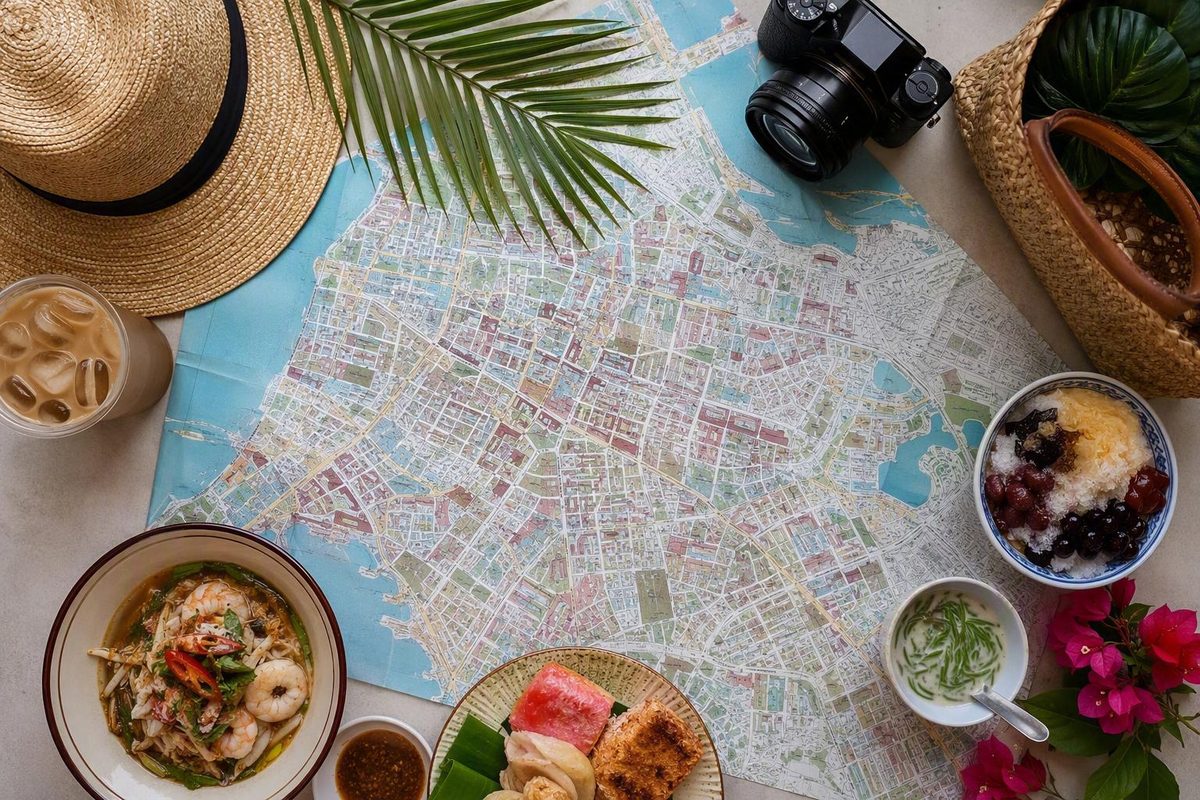
The formal name is George Town, written as two words. “Georgetown Penang Malaysia” remains a common search phrase, but the distinction matters when planning: George Town’s compact historic center is only one part of the much larger city jurisdiction and Penang Island.
For a first visit, stay near the heritage area, devote one weather-aware day to a connected central walk, and choose only the museums, mansions, or clan sites that genuinely interest you. Build food and indoor rests into the route. Once the center makes sense, use separate time and transport for Penang Hill, Kek Lok Si Temple, beaches, and nature attractions elsewhere on the island.
First, understand George Town, Penang Island, and the heritage core
Four geographic ideas are easy to confuse:
- Penang state includes Penang Island and territory on the Malay Peninsula.
- Penang Island contains George Town, Penang International Airport, Air Itam, Batu Ferringhi, Penang Hill, and numerous other districts and attractions.
- George Town’s modern city jurisdiction extends well beyond the old streets visitors usually picture, covering Penang Island and nearby islets.
- The historic district or heritage core is the compact northeastern area where visitors encounter many of the best-known shophouses, civic buildings, clan sites, religious landmarks, museums, and murals.
George Town is the capital of the Malaysian state of Penang. Its administrative reach and its walkable visitor center are therefore not interchangeable. A hotel or attraction can have a George Town address without being conveniently close to Armenian Street, Little India, or the Esplanade. The broader administrative geography is summarized in this George Town overview.
The UNESCO wording also requires precision. George Town’s historic district forms part of the joint World Heritage property “Melaka and George Town, Historic Cities of the Straits of Malacca,” inscribed in 2008. This does not mean that every building in George Town—or an individual landmark such as the Blue Mansion—has its own UNESCO designation.
Use the heritage core as the organizing unit for your first day. The Esplanade, Beach Street, Pinang Peranakan Mansion, Little India, the Street of Harmony, Armenian Street, Khoo Kongsi, and the clan-jetties area can be connected into one central route. Together, they reveal different functions of the same port city: government, commerce, worship, domestic life, clan organization, food, and waterfront residence.
Kek Lok Si Temple is in Air Itam. Penang Hill and The Habitat require a journey away from the historic streets. Batu Ferringhi lies along the northern coast, while Penang National Park is a separate excursion on the island’s northwestern side. Beaches, gardens, forest trails, and hill viewpoints can enrich a Penang itinerary, but they are not stops on a central George Town walk.
Keeping those geographic layers separate prevents two common mistakes: booking a broadly labeled “George Town” hotel that is inconvenient for the heritage area, and attempting to combine distant island attractions with a full day of central walking.
Choose how many days to spend in George Town
One full day is enough for an orientation, not a comprehensive visit to both George Town and Penang Island. Concentrate on one connected route through the heritage core, choose one substantial interior, pause for food, and finish with an evening meal.
For most first-time visitors, two to three full days is a practical range:
- One full day: Central highlights and one or two selected interiors.
- Two full days: Central highlights plus either deeper heritage visits or one excursion.
- Three full days: A central orientation, deeper heritage and food time, and a separate island excursion.
- Four or more full days: A slower island-wide trip with additional meals, rest periods, Penang Hill, Kek Lok Si, beaches, gardens, or nature.
These are planning recommendations rather than fixed rules. Travel accounts vary because some define the destination mainly as the old town, while others include the wider island. One George Town guide says the principal sights can fit into a shorter stay but recommends four or five days for a slower pace and wider Penang exploration.
Your ideal duration depends on:
- How quickly you walk in heat or rain
- Whether you want complete museum visits or exterior views
- How much time you spend over meals
- Whether weather interrupts outdoor segments
- Your interest in ordinary streets and traditional trades
- Whether your plan includes Air Itam, Penang Hill, or beaches
- Your need for rests or short vehicle transfers
A comfortable two-day plan could use the first day for the central walking route and the second for either mansion and museum interiors or an excursion to Air Itam and Penang Hill. With three days, you can do both without compressing them into the same afternoon.
Avoid combining a complete heritage walk, several paid interiors, Kek Lok Si, and Penang Hill in one day. Admission procedures, meals, traffic, rain, queues, and time spent inside buildings can quickly dismantle a schedule that looks possible on a map.
Four or five days are not necessary for every visitor. They become worthwhile when food is a major purpose of the trip, when you want beach or nature time, or when you would rather return to the historic center at different hours than complete it in one sweep.
Pick a base that matches the trip
For a first visit centered on heritage, architecture, and food, central George Town is the practical default. Staying within or immediately beside the heritage area lets you start early, return for a midday rest, and walk to dinner without arranging transport for every outing.
Do not rely solely on a booking platform’s broad “George Town” label. Check the property on a map against the places you expect to visit. If Armenian Street, Little India, Beach Street, or the Esplanade is a priority, examine the actual walking route rather than only the straight-line distance.
George Town’s accommodation mix includes hostels, guesthouses, mid-range hotels, boutique properties, modern business hotels, and restored heritage buildings. A shophouse stay may provide architectural atmosphere but can also involve stairs, street noise, compact rooms, or unconventional layouts. A larger modern hotel may offer more predictable facilities while feeling less embedded in the old streets.
If accessibility or comfort details matter, verify the following directly:
- Lift or step-free access
- Room location and window type
- Bathroom configuration
- Reception hours
- Luggage storage
- Nearby evening noise
- Vehicle pickup access
Chulia Street and Love Lane
The Chulia Street and Love Lane vicinity suits travelers who want cafés, bars, evening activity, and quick access to central streets. The same activity that makes the area convenient can also create noise, particularly in rooms facing busy roads or nightlife.
Travelers expecting to stay out in the evening may appreciate this location. Light sleepers should ask about room orientation, nearby venues, and soundproofing rather than assuming a restored heritage property will be quiet.
Quieter central and edge-of-core options
A property on a calmer heritage street or immediately outside the busiest evening cluster can offer a useful compromise: central access without placing the room directly above late activity.
Some accommodation guides describe core and buffer areas, but third-party maps and hotel descriptions are not always consistent. A George Town accommodation-area guide identifies Chulia Street and Love Lane as evening activity zones and discusses quieter alternatives around the historic area.
The practical question is simpler than the terminology: how far is the entrance from your planned morning route, evening food, and a workable vehicle pickup point?
George Town or Batu Ferringhi?
Choose George Town for:
- Heritage architecture and museums
- Food-led days
- Short central walks
- Street life and urban exploration
- Repeated access to the historic center
Consider Batu Ferringhi for:
- Beach and resort accommodation
- Pool and relaxation time
- A slower coastal routine
- A trip in which central heritage is secondary
The two areas serve different purposes. Batu Ferringhi may suit a resort holiday with one George Town day, but it is less efficient if you want to return repeatedly to museums, food streets, and evening activity in the center. Road travel is traffic-dependent, so it should not be treated as a quick, guaranteed transfer. This George Town and Batu Ferringhi comparison similarly frames the decision as urban heritage versus beach-oriented relaxation.
If both are major priorities, consider splitting the stay. Spend the heritage portion in George Town and move to Batu Ferringhi when you are ready for the resort portion. Compare the inconvenience of changing hotels with the likely time spent commuting before booking.
Follow one connected walk through the historic center
A logical first route begins near the Esplanade, continues through the commercial and religious heart of the old city, and ends near the waterfront communities or Muntri Street. The goal is not to enter everything. It is to understand how the districts connect.
One published itinerary measures this route at 5.5 kilometers, although its introduction also describes it as roughly six kilometers. It estimates several hours with a refreshment stop while warning that full visits to major attractions require additional time. Treat those figures as orientation rather than a promise; meals, photography, admission queues, crossings, and indoor visits can lengthen the day considerably. The underlying sequence appears in this step-by-step George Town walking route.
Segment 1: Esplanade and civic waterfront
Begin around the Town Hall, Padang, Esplanade, and Fort Cornwallis vicinity. This segment introduces the formal civic and colonial face of the waterfront through public buildings, open space, and the edge of the historic port district.
You do not need to enter the fort during an orientation walk. If it strongly interests you, make it the principal morning interior or return separately. Otherwise, view the surroundings and continue before the outdoor conditions become less comfortable.
From here, move toward the Jubilee Clock Tower area and continue along or near Beach Street. Construction and road conditions can alter the cleanest pedestrian line, so use current crossings instead of insisting on an exact historical route.
Segment 2: Beach Street and Pinang Peranakan Mansion
Beach Street helps reveal the old city’s commercial structure. Continue toward Pinang Peranakan Mansion, which can serve either as a walk-by landmark or as the day’s principal indoor stop.
Entering the mansion shifts the visit from façades and street patterns to furnishings, decorative objects, and domestic material culture associated with George Town’s Peranakan community. If you go inside, reduce the number of later admissions rather than trying to preserve an overfilled schedule.
Segment 3: Little India
Continue into Little India for food, textile shops, religious life, music, and active commerce. It is a logical place for breakfast, tea, or a cooling drink if you began early.
This is also where the route becomes more visibly a working neighborhood rather than a line of monuments. Notice shopfronts and ordinary activity, but keep entrances and narrow pavements clear. If a religious procession or ceremony is underway, give it space.
Segment 4: Street of Harmony
Move toward Jalan Masjid Kapitan Keling, often called the Street of Harmony because places of worship belonging to different religious communities stand close together.
St George’s Church, the Goddess of Mercy Temple, Sri Maha Mariamman Temple, and Kapitan Keling Mosque are prominent examples along or near this corridor. They are not interchangeable architectural exhibits.
Enter only when visitors are permitted, follow posted instructions, dress appropriately, and accept that worship takes priority over sightseeing.
Segment 5: Armenian and Cannon streets
Continue toward Armenian Street and the surrounding lanes. This part of the center is closely associated with murals, small shops, cafés, and visitor activity, but street art should not become the only reason to look around.
Pay attention to shophouse details, trades, side lanes, religious buildings, and the ways businesses occupy historic structures. Murals can fade, be altered, become obscured by construction, or disappear, so treat them as part of an evolving street environment rather than a guaranteed checklist.
Nearby Cannon Street leads toward Khoo Kongsi. A full visit to the clan complex is substantially different from photographing an entrance and moving on. If it is your chosen major heritage interior, allow time and shorten another part of the day.
Segment 6: Clan jetties and waterfront residence
From the Armenian Street and clanhouse area, continue toward the clan jetties. The setting changes again, from masonry shophouses and clan institutions to residential communities built along the waterfront.
Use only routes open to visitors. Keep voices low, avoid peering through doors or windows, and ask before photographing residents. The presence of souvenir shops or visitor activity does not make every adjacent space public.
Segment 7: Blue Mansion and Muntri Street, if time allows
The Blue Mansion and Muntri Street can form the final segment, but only if your energy, weather, and current access arrangements support the extra cross-center movement.
Travelers who have already made several long stops may prefer to finish near the waterfront and schedule the mansion separately. If you want to see its interior, treat it as a planned destination rather than an incidental doorway and check the current visitor arrangement before setting out.
A heat-aware version of the route
A more comfortable structure is:
- Early morning: Esplanade, waterfront landmarks, and Beach Street
- Late morning: Little India and the Street of Harmony
- Midday: Mansion, museum, café, or long lunch
- Later afternoon: Armenian Street, Cannon Street, and Khoo Kongsi
- Early evening: Clan-jetties area or Muntri Street, followed by dinner
“Walkable” does not mean comfortable in all conditions. Shade, pavement quality, traffic, crossings, rain, and individual mobility vary. Travelers with limited walking tolerance can divide the route into two sections and use a short vehicle transfer between them.
For a shorter version, omit either end. Start in Little India if the civic waterfront is less important, or finish after the jetties and visit the Blue Mansion separately. Another option is to begin at the Esplanade and end around Armenian Street, saving Khoo Kongsi and the waterfront communities for a different morning.
Choose which heritage sites deserve more than a walk-by
The best interior is not necessarily the most famous. Choose according to what you want to understand: domestic material culture, clan organization, architecture, religious life, or waterfront residence.
Pinang Peranakan Mansion
Pinang Peranakan Mansion provides an indoor introduction to furnishings, antiques, decorative objects, and material culture associated with George Town’s Peranakan community. It works particularly well as a midday break between outdoor sections.
Treat the visit as interpretation rather than decoration. Look at how room arrangements, furniture, ceremonial objects, and imported influences communicate status and domestic life. Confirm current admission and access arrangements directly instead of building the day around old third-party listings.
Khoo Kongsi
Khoo Kongsi is a Hokkien Chinese clanhouse complex, not merely an ornamental façade. Clan institutions could serve religious, social, administrative, and community functions.
A complete visit allows you to examine the complex and its relationship to the surrounding buildings. Passing through the nearby streets provides context but only a partial impression. If clan organization and architectural detail are priorities, make this one of your principal admissions.
Cheong Fatt Tze Mansion, or the Blue Mansion
Cheong Fatt Tze Mansion, commonly called the Blue Mansion, is a late-19th-century heritage building that combines Eastern and Western architectural elements. It also operates as accommodation, so unrestricted visitor access should not be assumed. A Penang guide covering the mansion associates interior access with guided visits and recommends advance planning.
Verify the current schedule, booking requirements, meeting point, and photography rules directly with the property. Its location within historic George Town does not give the building a separate UNESCO designation.
The Street of Harmony
Jalan Masjid Kapitan Keling brings several active religious buildings into close proximity:
- St George’s Church
- Goddess of Mercy Temple
- Sri Maha Mariamman Temple
- Kapitan Keling Mosque
The corridor is most meaningful when approached as evidence of living religious and civic geography, not as four façades to collect. Access can differ by building and time of day. Dress modestly, remove shoes where requested, remain quiet, and do not cross barriers or interrupt ceremonies.
Clan jetties
The clan jetties have historical and architectural interest, but they remain residential communities. Visitor access is a privilege, not permission to inspect private domestic life.
Remain on public or signed visitor paths, keep doorways clear, and avoid close-up photography without consent. Commercial activity along a visitor route does not make every neighboring walkway or home public.
Verify before setting out
- Same-day admission and closures
- Timed or guided-tour requirements
- Current ticketing procedures
- Dress and shoe-removal rules
- Photography restrictions
- Step-free or mobility-specific access
- Whether religious events affect visitor entry
Choosing two substantial interiors over five hurried admissions usually produces a clearer understanding of George Town. Let the remaining buildings provide context along the walk.
Plan food as part of the route, not a separate checklist
Food is central to the visitor experience because George Town’s eating culture reflects overlapping Malay, Chinese, Indian, and other regional traditions. That does not require calling it Malaysia’s official or objectively best food city. Its practical strength is that meals can be connected naturally with markets, worship, commerce, neighborhoods, and evening life.
Dishes commonly associated with a first visit include:
- Muah chee: A snack made with rice flour, sugar, and peanuts, as described in this first-time George Town food guide.
Dish names do not establish dietary suitability. Ask vendors directly about pork, lard, shellfish, shrimp paste, stocks, shared cooking surfaces, allergens, and halal or vegetarian suitability. When a restriction is medically important, explain it clearly and decline the dish if the answer remains uncertain.
A food-led walking day needs spacing. Four substantial dishes in rapid succession can make both eating and walking uncomfortable. A more practical pattern is:
- Breakfast, tea, or another drink in Little India
- A small snack around Armenian Street or the clan area
- A long indoor lunch or café break at midday
- An evening hawker meal after the main walk
Share small portions when appropriate, especially if a group wants to sample several dishes. Leave enough time between stops to distinguish one meal from another. Appetite, weather, spice tolerance, and walking pace should determine the number of stops—not an online checklist.
Avoid declaring one stall definitively “best” or “most authentic.” Such judgments often come from personal travel accounts, changing reputations, or commercially linked recommendations. A queue may demonstrate popularity, but it does not guarantee that the food suits your tastes or dietary requirements.
Simple courtesy helps crowded food spaces function:
- Decide what you want before reaching the counter when possible.
- Queue without blocking menus, walkways, or neighboring stalls.
- Order and ask questions clearly.
- Follow the venue’s seating and payment system.
- Leave a scarce table after finishing when others are waiting.
- Ask before taking close-up photographs of staff or customers.
- Do not turn a working stall into a prolonged photo set.
Cafés and sit-down meals are not distractions from sightseeing. They provide shelter, hydration, recovery time, and an opportunity to reassess the route. A slow lunch may make the later outdoor segment more enjoyable than pushing continuously through the middle of the day.
Keep Penang Hill and Kek Lok Si separate from the central walk
Kek Lok Si, Penang Hill, and The Habitat belong to a wider Penang itinerary. They should not be inserted into the middle of a heritage-core walk merely because general travel lists place them under “things to do in George Town.”
Kek Lok Si Temple is in Air Itam, outside the central walking area. At a high level, it is a large Buddhist temple complex containing a seven-tiered pagoda and a prominent Guanyin statue. Secondary sources report conflicting exact measurements for the statue, so its scale is more useful to planning than a disputed figure.
Allow time for transport, movement through the complex, weather, and current access arrangements. Check opening areas, dress expectations, internal transport operations where relevant, and closures directly before visiting.
Penang Hill is a forested recreation area with viewpoints, trails, dining, religious buildings, and colonial-era structures. It is not simply a viewing platform. The time required depends on whether you intend to use the funicular, walk trails, eat, visit a nature attraction, or pause at viewpoints.
Visibility depends on current weather. Cloud, rain, or haze can reduce the view, so do not build the excursion around a guaranteed panorama. Check funicular operations, ticketing, queues, trail conditions, and closures before traveling to the lower station.
The Habitat is a separate nature attraction on Penang Hill featuring the Curtis Crest Tree Top Walk and Langur Way Canopy Walk. These features and the broader Air Itam excursion context are covered in a first-timer’s guide to Penang Hill, The Habitat, and Kek Lok Si.
Kek Lok Si and Penang Hill can sometimes be combined because both take visitors away from the heritage core toward the Air Itam side of the island. Whether that pairing is sensible depends on:
- Weather and hill visibility
- Funicular and attraction operations
- Transport availability
- Queues
- Temple access
- The amount of walking planned
- Your energy and interest
Do not force the combination. One substantial excursion followed by an unhurried George Town evening can be more satisfying than rushing through both places and returning with another full sightseeing schedule.
Beaches, botanical gardens, and Penang National Park are optional wider-island extensions. They are not essential to understanding central George Town, and each requires separate transport and weather planning. If nature or beach time is a major purpose of the trip, add days rather than removing meals and rest from the heritage portion.
Reach George Town and choose transport by distance and weather
Penang Island has regional connections through Penang International Airport, ferry service, and road bridges. Butterworth serves as a mainland gateway associated with rail, bus, and ferry connections. These transport links are summarized in the wider George Town transport and geography overview.
Traveling by rail from Kuala Lumpur toward Butterworth is one possible overland approach. Timetables and service patterns can change, so check the railway operator’s current information rather than relying on an old journey duration.
At Butterworth, follow current directions between the railway or bus facilities and the ferry terminal. Before travel, verify the ferry’s schedule, fare, accepted payment methods, luggage procedures, and terminal arrangement with the current operator. Older guides may reproduce details that no longer apply.
Within the historic center, walking is the default for clustered attractions, not for every destination carrying a George Town address. The Esplanade, Little India, Armenian Street, clan sites, and nearby waterfront can form a coherent pedestrian day. Air Itam, Penang Hill, Batu Ferringhi, the airport, beaches, and national-park areas require a different transport calculation.
Local buses and the free CAT service are reported options in and around central George Town. Consult current operator information for routes, stops, direction of travel, and frequency. Do not treat a scheduled service as an on-demand substitute for every walk.
Use ride-hailing or another suitable vehicle when:
- Traveling beyond the center
- Carrying luggage
- Rain makes walking impractical
- Heat has reduced your comfortable range
- Someone in the group has limited mobility
- A bus would involve excessive waiting or transfers
- You need to preserve energy for a timed visit
A short distance on a map can involve exposed walking, awkward crossings, or an indirect street pattern. Conversely, a short central vehicle trip may be slowed by traffic or one-way roads. Choose the mode according to actual conditions rather than distance alone.
Batu Ferringhi requires particular caution. The coastal journey is traffic-dependent and should not be treated as a quick addition after a full central walk. If you stay there, leave a generous margin for timed George Town admissions or onward transport.
When arriving from the airport or mainland, confirm the final stage before departure—especially if you have luggage or are traveling outside the daytime hours assumed by many itineraries. Avoid relying on unsupported transfer-time estimates or late-night service guarantees.
Adapt the day for heat, rain, worship, and residential spaces
A compact map does not guarantee an easy walk. Heat, sudden rain, traffic, exposed crossings, queues, and individual mobility can change how far the heritage center feels in practice.
Schedule the longest outdoor sections earlier or later in the day. Use a museum, mansion, long lunch, or café as a deliberate midday break. Carry water and suitable sun or rain protection, and choose footwear appropriate for repeated stops and potentially wet surfaces.
Do not make broad seasonal promises from a general travel guide. Check a short-term forecast close to the day of travel and reassess hill excursions separately from central walking conditions. A rainy street morning does not necessarily determine later hill visibility, and a clear start does not guarantee an uninterrupted outdoor day.
A rain-adjusted central plan could prioritize:
- Pinang Peranakan Mansion
- A pre-checked Blue Mansion visit
- A covered food venue or long lunch
- Shops, galleries, or cafés
- Short street-art and religious-corridor sections between showers
Do not assume every indoor attraction can accept walk-in visitors immediately. Timed admission, guided access, private functions, worship, and temporary closures can still disrupt a wet-weather plan.
At places of worship:
- Wear modest clothing.
- Follow posted visitor rules.
- Remove shoes where requested.
- Keep voices and phones quiet.
- Do not enter restricted areas.
- Avoid photographing people at prayer without permission.
- Pause the visit rather than disrupting a ceremony.
At the clan jetties, remember that people live beside the visitor route. Stay on public paths, do not peer into homes, ask before photographing residents, and keep doorways and narrow sections clear.
Around murals, do not block traffic or make other pedestrians wait through a long staged photo session. Murals and access routes can change, so no itinerary should promise that every image seen online remains visible.
Traditional trades deserve similar restraint. A workshop is not automatically a demonstration venue. Observe from public space unless invited inside, do not interrupt active work for photographs, and accept a refusal without argument.
Travelers with mobility needs should verify access building by building. Historic structures may contain steps, narrow passages, uneven thresholds, or limited lift access, while streets may have inconsistent pavements and crossings. Short rides between selected accessible stops can be more practical than attempting the entire circuit.
Before leaving your accommodation, check:
- Timed-entry and guided-tour bookings
- Same-day attraction closures
- Ferry, bus, rail, and funicular operations
- Rain and hill-visibility conditions
- Clothing and shoe-removal requirements
- Photography policies
- Mobility-specific entrances and facilities
- Vehicle pickup points
The simplest successful plan is to stay near the heritage core, devote one weather-aware day to a connected walk, and select only a few interiors for deeper visits. Pace food stops instead of collecting dishes in quick succession. Put Penang Hill, Kek Lok Si, beaches, and nature excursions on separate days whenever possible.
Use the formal spelling—George Town—and verify current transport, ticketing, tour, access, and operating details directly with the relevant provider before setting out.
Is it George Town or Georgetown, Penang?
The formal name is George Town, written as two words. “Georgetown” is a common search and informal spelling. George Town is Penang’s capital and is located on Penang Island.
How many days do I need in George Town?
One full day allows a selective central overview. Two days provide time for the heritage core plus either deeper visits or an excursion. Three days allow both, while four or more suit a slower island-wide trip. These are planning guidelines rather than fixed requirements.
Can I explore George Town on foot?
Yes. The central heritage area supports a connected route linking the Esplanade, Beach Street, Little India, the Street of Harmony, Armenian Street, Khoo Kongsi, and the clan-jetties area.
That does not make every part of the wider city or island walkable from the center. Heat, rain, crossings, pavement conditions, and mobility needs may make buses or short vehicle rides preferable.
Should I stay in George Town or Batu Ferringhi?
Stay in George Town if heritage architecture, food, museums, and urban walking are the priorities. Choose Batu Ferringhi if beach access, resort facilities, and a slower coastal stay matter more.
If both are central to the trip, consider splitting the stay rather than commuting repeatedly. Road travel between the areas is traffic-dependent.
Are Penang Hill and Kek Lok Si in central George Town?
No. Kek Lok Si is in Air Itam, while Penang Hill and The Habitat require transport away from the historic core. Plan them as a separate excursion, or as a dedicated half-day only when weather, current operations, transport, and your energy make that realistic.