 KL Observer
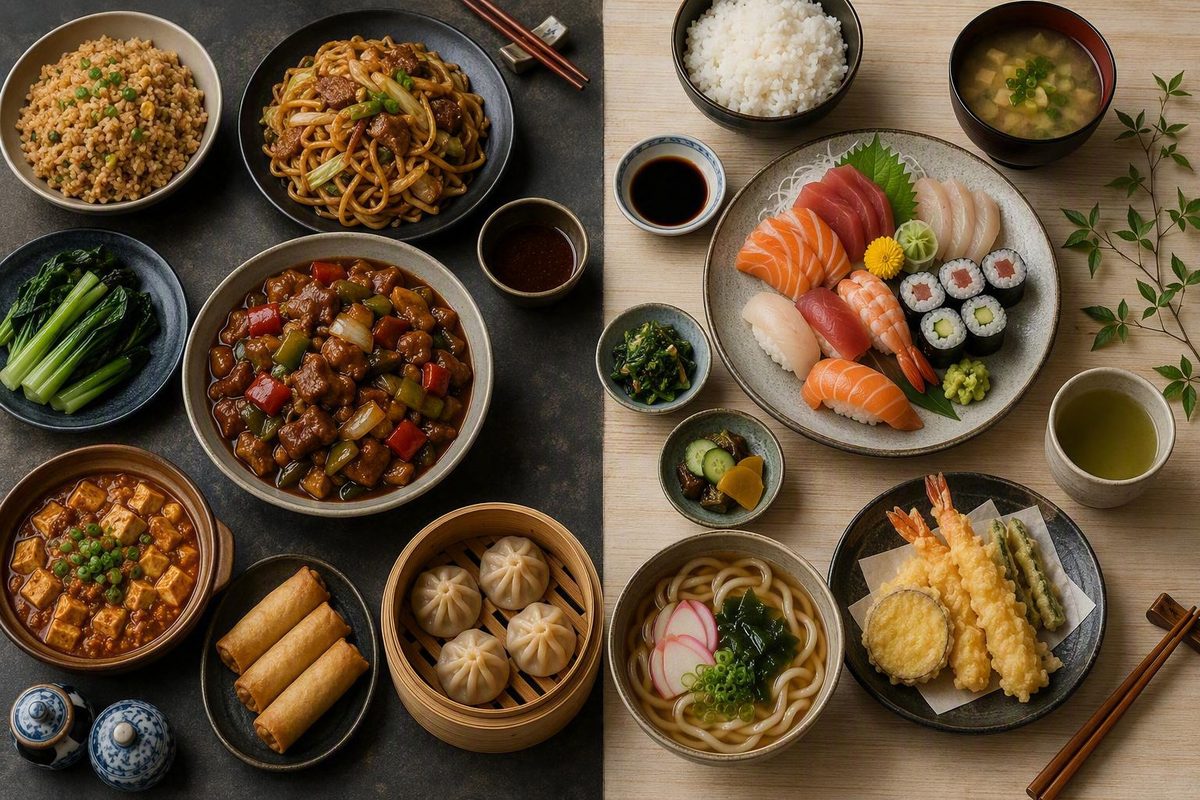
The short answer: what is the main difference?
The difference between Chinese and Japanese food is not a simple split between two ingredient lists. Both cuisines use rice, noodles, soy-based seasonings, tofu, vegetables, meat, and seafood. What usually distinguishes a particular dish is how those foundations are seasoned, cooked, textured, arranged, and served.
As broad tendencies, many Chinese dishes are associated with layered aromatics, sauces, contrasting textures, stir-frying, braising, steaming, and roasting. Garlic, ginger, sesame products, dried chilies, Sichuan peppercorns, five-spice, prepared sauces, and fermented black soybeans are among the flavor builders found in different Chinese traditions.
Many Japanese dishes are associated with seafood, fermented seasonings, sea vegetables, grilling, simmering, frying, and visibly raw preparations. Familiar flavor builders include miso, shoyu, rice vinegar, sake, kombu, nori, bonito flakes, wasabi, and togarashi. Separate bowls, plates, and set-meal components are also commonly associated with Japanese presentation. A consumer overview from Co+op discusses many of these shared ingredients and broad culinary contrasts.
These are tendencies, not definitions. China and Japan each contain substantial regional, local, seasonal, restaurant, street-food, and household variation. Mild Chinese congee challenges the idea that Chinese food must be intensely seasoned; Japanese curry, ramen, tempura, and tonkatsu challenge the idea that Japanese food must be raw or minimally seasoned.
This article is therefore a practical overview, not a comprehensive map of every regional tradition. To compare two dishes more accurately, ask:
- What is the staple?
- Which ingredients build the primary flavor?
- How is the food cooked?
- What textures does the technique create?
- Which protein or vegetable is emphasized?
- How are the components presented?
- Is the meal served communally, individually, or in another format?
That framework is more reliable than judging a cuisine by one ingredient—or by value-laden contrasts such as “heavy versus healthy” or “ordinary versus refined.”
Chinese food vs. Japanese food at a glance
The table summarizes common associations rather than universal rules. No single row can reliably identify a dish on its own.
| Feature | Chinese cuisines | Japanese cuisines |
|---|---|---|
| Shared foundations | Common examples include rice, noodles, soy-based seasonings, tofu, vegetables, meat, and seafood. Methods include steaming, boiling, grilling, and frying. | Common examples include rice, noodles, soy-based seasonings, tofu, vegetables, meat, and seafood. Methods include steaming, boiling, grilling, and frying. |
| Rice | Often associated with steamed rice, fried rice, congee, and many other preparations. | Often associated with short-grain white rice served as a distinct meal component or incorporated into a composed dish. |
| Noodles | Diverse traditions include egg noodles and vermicelli, among many other forms and preparations. | Familiar categories include udon, soba, ramen, and yakisoba. |
| Characteristic flavor builders | Depending on the dish: garlic, ginger, sesame oil or paste, dried chilies, Sichuan peppercorns, five-spice, hoisin sauce, oyster sauce, and fermented black soybeans. | Depending on the dish: miso, shoyu, rice vinegar, sake, kombu, nori, bonito flakes, wasabi, and togarashi. |
| Soy-based products | Common examples include soy sauce, tofu, and fermented black soybeans. | Common examples include shoyu, tamari, miso, and tofu. |
| Proteins | Meat, poultry, seafood, eggs, tofu, and other soy products appear across different traditions. | Seafood is especially visible in familiar dishes, but meat, poultry, eggs, tofu, and other cooked proteins are also common. |
| Cooking methods | Often associated with stir-frying, braising, steaming, boiling, deep-frying, and roasting, though none is exclusive to China. | Often associated with grilling, simmering, steaming, boiling, frying, and raw preparation, though none is exclusive to Japan. |
| Texture | Dishes may emphasize contrasts such as crisp and tender, silky and crunchy, or chewy and soft. | Dishes may emphasize the distinct texture of each component, whether raw, grilled, simmered, fried, chewy, or delicate. |
| Raw preparations | Raw food is not the dominant overseas image of Chinese cuisine, but “Chinese food is always cooked” is too rigid a rule. | Sushi and sashimi make raw seafood highly visible, but much Japanese food is simmered, grilled, steamed, boiled, or fried. |
| Presentation | Ingredients are often combined within a dish, while several finished dishes may be placed together for sharing. | Components are often arranged separately or presented in individual bowls, plates, and set-meal combinations. |
| Service | Family-style service with central dishes is a common pattern, with many exceptions. | Individual dishes and set meals are a common pattern, with many exceptions. |
| Illustrative dishes | Mapo tofu, Peking duck, congee, xiaolongbao, kung pao chicken, hotpot, dumplings, and fried rice. | Sushi, sashimi, miso soup, yakitori, okonomiyaki, ramen, tempura, tonkatsu, takoyaki, and Japanese curry. |
The overlap in the first row matters as much as the contrasts elsewhere. Rice or soy sauce alone cannot identify a dish as Chinese or Japanese. Even a method such as frying or grilling is inconclusive. The more meaningful clues emerge when seasoning, technique, texture, presentation, and service are considered together.
Shared staples, different treatments: rice, noodles, tofu, and soy
Ingredient overlap is a central similarity between Chinese and Japanese food, but it does not make the cuisines interchangeable. A staple’s form and culinary role can change substantially from one dish to another.
Rice
Chinese rice preparations include steamed rice, fried rice, and congee. These examples show how one grain can function as a relatively plain accompaniment, a prepared dish incorporating other ingredients, or a soft porridge.
Japanese food is commonly associated with short-grain white rice. It may be served as a distinct meal component or used in a composed dish. The contrast is not that China has “varied rice” while Japan has only one form. Rather, fried rice and congee are useful Chinese examples, while short-grain rice is a particularly familiar Japanese staple. A chef-authored comparison makes the same broad distinction between Chinese rice preparations and Japanese short-grain rice.
Compare congee with a bowl of cooked short-grain rice. Both begin with rice, but cooking time, water, texture, seasoning, and position within the meal produce different results. Separately served rice keeps more of its grain structure while providing a base or counterpart for other foods.
Noodles
“Chinese noodles” is an extremely broad category, not one standardized food. Egg noodles and vermicelli are documented examples, but they do not classify every noodle eaten across China. Chinese noodle dishes may be served in broth, stir-fried, or combined with sauces, meat, tofu, and vegetables.
Familiar Japanese categories include:
- Udon, recognized for its thick form
- Soba, associated with buckwheat
- Ramen, commonly served with seasoned broth
- Yakisoba, a stir-fried noodle dish
These names may make Japanese noodle menus seem easy to categorize, but each category still contains multiple preparations. Nor can a noodle dish be assigned to one cuisine merely because it arrives in broth or from a wok. The noodle, seasoning, toppings, cooking method, and menu context must be considered together.
Tofu
Tofu demonstrates how a shared ingredient can assume different roles. Firmer tofu can hold its structure in a stir-fried or strongly seasoned preparation. Silken tofu can provide a softer component in dishes such as miso soup.
Mapo tofu and tofu in miso soup illustrate the contrast. Mapo tofu places tofu within an integrated, strongly seasoned dish. Miso soup uses tofu as one identifiable component of a liquid preparation. The difference involves texture, seasoning, cooking context, and presentation—not simply “Chinese tofu” versus “Japanese tofu.”
Tofu type is not determined solely by nationality. Chinese cooks do not use only firm tofu, and Japanese cooks do not use only silken tofu. The structure required by the particular dish is more informative than a national label.
Soy-based seasonings
Both cuisines use soy in multiple forms. Chinese examples include soy sauce, tofu, and fermented black soybeans. Japanese examples include shoyu, tamari, miso, and tofu.
A liquid seasoning, fermented paste, tofu, and fermented beans contribute different textures, concentrations, and culinary functions. The useful question is not simply whether a dish “contains soy,” but what form the soy takes and how it is used.
Flavor and seasoning: bold and subtle are tendencies, not rules
Chinese food is frequently described as bold, layered, aromatic, or sauce-forward. Those descriptions can be useful when they refer to particular dishes, techniques, and regional styles. They become misleading when applied to every Chinese meal.
Flavor builders found in selected Chinese traditions include:
- Garlic and ginger
- Sesame oil and sesame paste
- Dried chilies
- Sichuan peppercorns
- Five-spice
- Hoisin sauce
- Oyster sauce
- Fermented black soybeans
These ingredients can build several dimensions of flavor within one preparation. The exact combination depends on the dish.
Sichuan peppercorns and dried chilies help explain why some diners associate Chinese food with heat. Yet they belong to selected dishes and traditions, not to Chinese cuisine as a whole. Congee, steamed foods, boiled dumplings, and gently seasoned dishes do not fit the stereotype that every Chinese plate must be fiery.
Japanese cuisine is often described as subtle or focused on keeping the main ingredient perceptible. Commonly associated flavor builders include:
- Miso and shoyu
- Rice vinegar and sake
- Kombu, nori, and other sea vegetables
- Bonito flakes
- Wasabi
- Togarashi
A broth, dipping sauce, glaze, or fermented seasoning can create substantial depth without producing the same profile as an aromatic stir-fry or chili-rich sauce. “Subtle” therefore does not mean flavorless. Miso can be assertive, while sea vegetables and bonito flakes can form a noticeable savory foundation.
Nor is Japanese food uniformly mild. Wasabi provides pungency, and togarashi can add heat. Curry can be richly seasoned, ramen broths can be intense, and grilled foods may carry concentrated seasoning or glaze.
Likewise, “bold” does not necessarily mean hot with chili. A Chinese braise may taste deep and aromatic without being spicy. Roasted foods can develop pronounced flavor through seasoning and cooking rather than chili heat. Garlic, ginger, sesame, fermented beans, and five-spice produce different kinds of intensity.
Claims that one cuisine universally uses more salt, oil, spice, meat, or seafood are not useful without clearly defined dishes and evidence. The better questions are: Which region? Which recipe? Which cook? Which restaurant? Which meal context? A national label provides orientation, but the particular dish explains the flavor.
Cooking methods, proteins, and texture
Cooking technique is one of the strongest clues in a comparison, but no general technique belongs exclusively to either cuisine.
Chinese culinary traditions include stir-frying, braising, steaming, boiling, deep-frying, and roasting. Japanese traditions include grilling, simmering, steaming, boiling, frying, and raw preparation. The overlap is considerable: both cuisines boil, steam, grill, and fry. Differences often lie in how a technique is combined with ingredients, seasoning, cutting, timing, and service. A restaurant overview likewise lists overlapping Chinese and Japanese ingredients and techniques, while noting substantial regional variation.
Chinese methods and dishes
Stir-frying cooks cut ingredients quickly and can bring protein, vegetables, aromatics, and sauce together in one preparation. The result may preserve contrast between tender and crisp components while still presenting them as a unified dish.
Braising creates a different result. Its importance is one reason Chinese cooking cannot be reduced to rapid wok cookery.
Steaming and boiling also have prominent roles. Dumplings may be steamed or boiled, while congee is cooked to a soft consistency. Such dishes contradict the idea that Chinese cooking is synonymous with deep-frying.
Roasting is visible in dishes such as Peking duck, while deep-frying appears in preparations designed to produce a crisp exterior. These methods belong to a broad technical repertoire rather than defining the whole cuisine.
Mapo tofu, Peking duck, congee, and dumplings illustrate markedly different outcomes: tofu in a seasoned preparation, roasted poultry, rice porridge, and filled wrappers. Together, they show why “Chinese food” cannot be reduced to one appliance, texture, or cooking speed.
Japanese methods and dishes
Raw seafood is highly visible in sushi and sashimi, but it represents only one part of Japanese food. Japanese cuisine also includes grilled skewers, soups, noodles, breaded cutlets, battered fried foods, savory pancakes, curry, and simmered preparations.
Consider the range:
- Miso soup is a hot liquid preparation.
- Yakitori demonstrates grilling.
- Tempura uses frying to create a crisp coating.
- Tonkatsu is a breaded, fried cutlet.
- Japanese curry is cooked and sauce-based.
- Ramen combines noodles with broth and toppings.
- Okonomiyaki is a cooked savory pancake.
- Grilled and simmered dishes use heat while producing very different textures.
This range prevents sushi and sashimi from becoming stand-ins for an entire national cuisine. A commercial food overview similarly places cooked Japanese foods alongside sushi and other raw preparations.
Protein choices
Seafood is especially visible in many internationally familiar Japanese dishes, notably sushi and sashimi. It also appears in grilled, simmered, and fried forms. Yet Japanese food includes poultry, pork, eggs, tofu, and other cooked proteins, as yakitori and tonkatsu demonstrate.
Chinese cuisines use seafood, meat, poultry, eggs, tofu, and vegetables in varied combinations. It would be misleading to turn the comparison into a population-level claim that one country “eats more” of a given protein. The defensible observation is narrower: seafood and raw preparation are prominent in the global image of Japanese cuisine, while stir-fried, braised, roasted, and communal meat or tofu dishes are prominent in familiar images of Chinese cuisine.
Texture as the result of technique
Texture may reveal more than an ingredient list. The same broad category of protein or vegetable can become crisp, tender, silky, chewy, or delicate depending on preparation.
- Stir-frying can preserve contrast between tender and crisp ingredients.
- Braising can soften ingredients and connect them with seasoned liquid.
- Frying can produce a crisp exterior around a softer center.
- Steaming can retain moisture and create tender food.
- Grilling can brown the exterior while preserving a distinct interior.
- Simmering can soften ingredients and integrate them with broth.
- Raw preparation preserves textures that heat would change.
Rather than saying Chinese food is always texturally varied while Japanese food is always delicate, examine the particular result. Xiaolongbao, mapo tofu, Peking duck, sashimi, udon, and tempura all offer distinct textures, but none can summarize its national cuisine.
Presentation and dining style
Chinese meals are commonly associated with family-style service: several dishes may be placed centrally for diners to share. A meal might include vegetables, tofu, poultry or seafood, dumplings, and rice, allowing each person to move among different dishes.
Japanese dining is commonly associated with separate bowls, plates, or set-meal components. Rice, soup, a main item, and side dishes may remain visually distinct rather than being combined before service. A chef’s comparison describes this broad tendency toward family-style Chinese service and separately arranged Japanese dishes.
These arrangements can produce different dining experiences. Central dishes emphasize sharing, interaction, and variety across the table. Separately arranged components can make the contrast among individual foods more visible.
Neither approach is inherently more refined, respectful, thoughtful, or sophisticated. Shared presentation requires decisions about balance and coordination; separate presentation requires decisions about proportion and contrast. Aesthetic preference should not be mistaken for a hierarchy between cuisines.
Both patterns also have many exceptions:
- A Chinese diner may order an individual bowl of noodles or congee.
- A Japanese group may share several plates.
- Street food may be served as a single portion.
- Restaurant formats may differ from household meals.
- Hotpot and other interactive meals follow their own service logic.
- Dumplings, sushi, skewers, soups, and rice bowls each suggest different ways of eating.
Serving format alone therefore cannot identify national origin. A communal table is not automatically Chinese, and an individual tray is not automatically Japanese. Presentation becomes useful only when considered with the staple, seasoning, method, and structure of the dish.
Representative dishes—and the limits of familiar restaurant menus
Representative dishes are useful when they illustrate a specific feature. They become misleading when treated as a complete national menu.
Selected Chinese examples include:
- Mapo tofu
- Peking duck
- Congee
- Xiaolongbao
- Kung pao chicken
- Hotpot
- Dumplings
- Fried rice
Selected Japanese examples include:
- Sushi
- Sashimi
- Miso soup
- Yakitori
- Okonomiyaki
- Ramen
- Tempura
- Tonkatsu
- Takoyaki
- Japanese curry
These lists contain varied staples, techniques, textures, temperatures, and serving formats. They are starting points for comparison, not checklists of everything either cuisine contains.
Comparing dishes by dimension
Congee and short-grain rice demonstrate contrasting treatments of a staple. One turns rice into a soft porridge; the other is commonly served with its grain structure intact as a distinct meal component.
Mapo tofu and tofu in miso soup show how texture and surrounding seasoning alter tofu’s role. In one case, tofu sits inside an integrated, strongly seasoned dish. In the other, it remains an identifiable component of a soup.
A stir-fried dish and yakitori highlight different cooking structures. A stir-fry may combine cut ingredients, aromatics, and sauce in one cooking process. Yakitori places pieces on skewers and uses direct grilling.
Xiaolongbao and sushi offer another contrast. Their base, temperature, texture, assembly, and presentation differ before their seasoning is even considered.
Restaurant menus show only a narrow slice
Overseas restaurant favorites can introduce diners to important dishes, but they seldom reveal the full range of household, regional, seasonal, street, banquet, or ceremonial food. A menu dominated by stir-fries does not prove that Chinese cuisine is mainly wok-cooked. A menu dominated by sushi does not prove that Japanese cuisine is mainly raw.
Diaspora adaptation further complicates the picture. Chop suey and some restaurant forms of chow mein were created or modified to appeal to American customers, according to a Co+op overview of Chinese and Japanese cuisine. Such dishes may have genuine importance within diaspora food traditions while remaining poor substitutes for Chinese cuisine as a whole.
The same principle applies more broadly: popularity abroad does not make a dish nationally comprehensive. A familiar restaurant item may reflect a particular region, diaspora community, restaurant format, local ingredient supply, or customer expectation.
Culinary exchange also makes rigid national boundaries difficult to apply, but simplified origin stories are rarely helpful. For this comparison, their present culinary use is more relevant than an oversimplified origin narrative.
Common myths and a better way to compare the cuisines
The largest mistakes in Chinese-versus-Japanese food comparisons come from turning visible tendencies into absolute rules.
Myth: Chinese food is always spicy
Some Chinese dishes and regional traditions use dried chilies, Sichuan peppercorns, and other forceful seasonings. Others are mild, aromatic, savory, or restrained.
Even “spicy” needs clarification. Chili heat is different from the aromatic effect of five-spice or the distinctive sensation produced by Sichuan peppercorns. A dish can be bold without being hot, and it can be mild without being plain.
Congee, steamed dishes, boiled dumplings, and gently seasoned preparations make an “always spicy” description untenable.
Myth: Chinese food is always oily, fried, sauce-covered, or cooked in a wok
Stir-frying and deep-frying are important methods, but so are steaming, boiling, braising, and roasting. Congee is not fried. Dumplings may be boiled or steamed. Peking duck illustrates roasting, and braised dishes rely on longer cooking in liquid rather than rapid wok heat.
A sauce can be central to one preparation and minimal in another. Even stir-frying does not by itself describe the amount of oil or sauce in a finished dish.
Myth: Japanese food is mostly raw fish
Sushi and sashimi are globally visible, but Japanese food also includes ramen, tempura, yakitori, miso soup, tonkatsu, okonomiyaki, takoyaki, grilled dishes, simmered foods, noodles, and curry.
Raw preparation remains a meaningful point of comparison because it is especially prominent in the international image of Japanese food. It is not a complete description of Japanese cooking.
Myth: Japanese food is always light and minimally seasoned
Wasabi and togarashi complicate the idea that Japanese food lacks pungency or heat. Miso, shoyu, curry, and concentrated broths can create pronounced flavor. Tempura and tonkatsu are fried; yakitori is grilled; ramen may combine a strongly flavored broth with noodles and toppings.
“Light” may reasonably describe a particular soup, sashimi course, or simply seasoned grilled item. It should not be projected onto every dish.
Myth: One cuisine is inherently healthier
A national cuisine label does not describe the contents of a particular meal. “Chinese food” might refer to congee, steamed vegetables, roast duck, fried rice, dumplings, or hotpot. “Japanese food” might refer to sashimi, miso soup, ramen, curry, tempura, or tonkatsu.
Any meaningful comparison must begin with two defined dishes rather than two national labels.
Regional and household variation is the central limitation
China and Japan do not each have one uniform cooking style. Regional specialties, local ingredients, household habits, restaurant formats, seasonality, and individual cooks all affect the result. Broad comparisons should lead toward dish-level and regional understanding rather than replace it.
Comparisons also need equivalent contexts. Placing a celebratory shared meal beside an individual weekday lunch may exaggerate differences caused by occasion. Comparing Chinese-American takeout with a specialist sushi restaurant confuses restaurant format with national cuisine. A fairer approach compares similar settings: home meal with home meal, noodle shop with noodle shop, or celebratory meal with celebratory meal.
A practical way to compare any two dishes
When reading a menu or tasting an unfamiliar dish, use this checklist:
- Staple: Is the foundation rice, noodles, a wrapper, tofu, vegetables, or something else?
- Primary seasoning: Do you notice aromatics, fermented beans, a prepared sauce, miso, shoyu, vinegar, sea vegetables, chili, or another dominant element?
- Cooking method: Is it stir-fried, braised, steamed, boiled, roasted, grilled, simmered, fried, or raw?
- Texture: Is the intended contrast crisp and tender, silky and firm, chewy and soft, or raw and delicate?
- Protein: Does the dish center seafood, meat, poultry, egg, tofu, or vegetables?
- Presentation: Are the ingredients integrated, layered, skewered, wrapped, topped, or kept separate?
- Serving format: Is it a shared central dish, an individual bowl, a set meal, a snack, or an interactive pot?
No checklist can determine origin with certainty. Shared ingredients, regional variation, diaspora adaptation, and culinary exchange blur national boundaries. The purpose is not to prove where a dish comes from at a glance, but to replace stereotypes with closer observation.
Frequently asked questions
Is Chinese food always spicier than Japanese food?
No. Selected Chinese dishes and regional styles prominently use dried chilies and Sichuan peppercorns, but Chinese cooking also includes mild congee, steamed dishes, boiled foods, and gently seasoned preparations.
Japanese food can also be pungent or hot. Wasabi provides a sharp sensation, while togarashi can add heat. Compare individual dishes rather than assuming one national cuisine is always spicier.
Is Japanese food mostly sushi and raw fish?
No. Sushi and sashimi make raw seafood especially visible, but Japanese cuisine includes extensive cooked food. Familiar examples include miso soup, ramen, yakitori, tempura, tonkatsu, okonomiyaki, takoyaki, yakisoba, grilled foods, simmered dishes, and Japanese curry.
What ingredients do Chinese and Japanese food share?
Both cuisines use rice, noodles, soy-based seasonings, tofu, vegetables, meat, seafood, and fresh or preserved ingredients.
The distinction lies in treatment. Rice may become congee or fried rice, while Japanese meals are commonly associated with short-grain rice. Tofu may appear in a strongly seasoned integrated dish or as an identifiable component of miso soup. Soy may take the form of liquid seasoning, paste, tofu, or fermented beans.
How do Chinese and Japanese cooking methods differ?
Chinese culinary traditions are prominently associated with stir-frying, braising, steaming, boiling, deep-frying, and roasting. Japanese traditions are prominently associated with grilling, simmering, steaming, boiling, frying, and raw preparation.
These lists overlap, and none of the methods belongs exclusively to one cuisine. The more revealing distinction is how each technique is combined with ingredients, seasonings, textures, and service.
Is Chinese or Japanese food healthier?
Neither label provides enough information to answer the question. Congee, roast duck, fried rice, ramen, sashimi, curry, and tempura are substantially different dishes even when grouped under a national cuisine.
A useful comparison must examine two specific meals. Country of origin and presentation alone do not establish how those meals compare.
The most useful distinction
The most useful difference between Chinese and Japanese food is not a rigid contrast between two national menus. It is the way particular traditions combine shared ingredients with different flavor builders, techniques, textures, presentation choices, and serving formats.
Chinese food is broader than spicy stir-fries, and Japanese food is broader than sushi. Neither cuisine has one flavor profile, cooking method, or dining style. Compare individual dishes and equivalent meal settings, then use the national label as context—not as a substitute for observing what is actually on the table.