 KL Observer
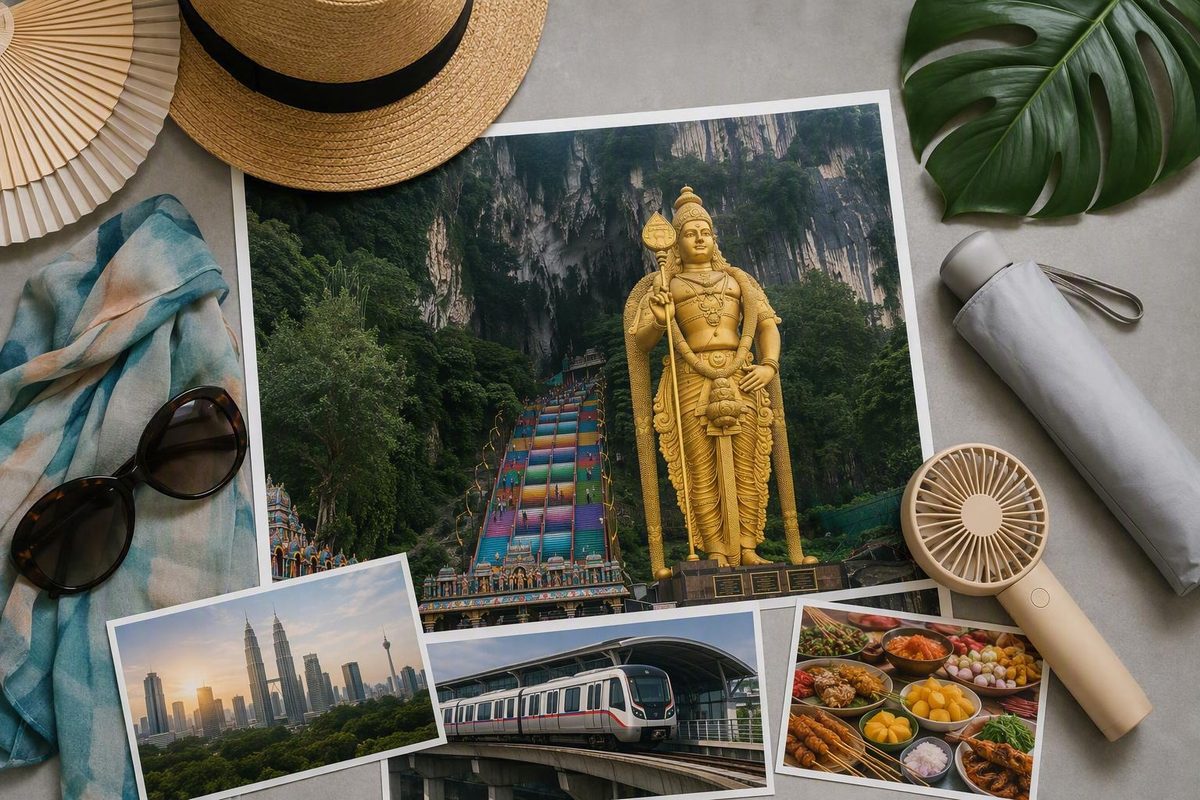
Batu Caves is a limestone-cave and active Hindu temple complex in Gombak, Selangor, about 13 km north of Kuala Lumpur. For a first visit, plan a focused excursion around the golden Murugan statue, the colorful staircase, and the principal temple area. KTM Komuter serves Batu Caves station, but this guide is best used for the broad shape of the trip: confirm current train times, opening arrangements, charges, and secondary-attraction access shortly before departure.
Batu Caves at a glance
Although commonly promoted as a Kuala Lumpur attraction, Batu Caves is not administratively within the city. It stands in neighboring Selangor and is principally associated with the Hindu deity Murugan. Its defining landmarks are the large golden Murugan statue, 272 colorful steps, Hindu temples and shrines within the limestone setting, Cave Villa, and Ramayana Cave. The complex is a living sacred site rather than simply a cave or photography location. An overview of Batu Caves records its location, religious identity, landmarks, and 272-step approach.
The main visitor experience involves climbing the staircase to the principal temple area. Anyone with limited mobility, difficulty using stairs, or uncertainty about a sustained ascent should make that requirement central to the decision to visit. Optional attractions at ground level or elsewhere in the complex should not be assumed to provide equivalent access to the main sanctuary.
How to approach the journey from Kuala Lumpur
KTM Komuter serves Batu Caves station, which Tourism Malaysia describes as approximately a five-minute walk from the complex. Its destination guide also identifies bus and car as possible alternatives. Check the Tourism Malaysia Batu Caves guide for this basic transport orientation.
For a rail-led outing, use Batu Caves station as the confirmed destination reference. Avoid building the day around an undated route, fare, boarding point, or service frequency copied from an old itinerary. Before leaving, consult current KTM information for:
- The most practical boarding or interchange point
- The timetable and service frequency in both directions
- The current fare and accepted payment method
- Any service disruption
- A workable return train
Rail offers a simple organizing principle: travel to Batu Caves station, walk to the complex, complete the main visit, and return to the same station. Bus and car remain possible alternatives, but route numbers, parking arrangements, and charges can change. This article therefore does not prescribe a station-by-station journey, fixed fare, or journey time.
A simple route through the main complex
A first visit can follow a straightforward, untimed sequence:
- Enter the main complex and get oriented. Remember that you are entering an active religious site.
- View the golden Murugan statue. It stands at the foot of the main ascent and is reported to be approximately 42.7 metres tall.
- Approach the colorful staircase. Allow worshippers and ceremonies priority.
- Climb the 272 steps. Set a pace appropriate to your ability rather than treating the ascent as a race.
- Enter the principal temple area. Hindu temples and shrines occupy the limestone setting above.
- Decide whether to add another attraction. Check access and admission arrangements before committing to Cave Villa or Ramayana Cave.
Do not build the itinerary around Dark Cave unless a current authoritative notice confirms that it is open to visitors. Its appearance in older destination material is not enough to establish present access.
There is no need to force the excursion into a fixed duration. The visit may take longer if you pause during the climb, encounter religious activity, or add a secondary attraction. An untimed plan is more dependable than an estimate that assumes every part of the complex is operating normally.
The 272 steps, crowds, and accessibility limits
The staircase is both Batu Caves’ signature visual feature and a substantial physical barrier. Reaching the principal temple area requires the full ascent, so it should not be described as easy, universally suitable, or incidental to the experience.
Visitors who cannot manage the stairs should seek current accessibility information before traveling. Do not assume that an escalator or another step-free route is available unless present-day official guidance expressly confirms it. Announcements or proposals do not establish that an accessible alternative has been completed and opened.
Tourism Malaysia recommends arriving before 8:00 AM to avoid crowds. That is useful guidance rather than a guarantee of a quiet visit: worship, group arrivals, holidays, ceremonies, and festivals can still affect conditions. The recommendation appears in Tourism Malaysia’s destination information.
An early arrival is practical only when it aligns with the current train schedule and site access. Check those details together rather than choosing an arrival time first and assuming transport will support it.
A sacred site shaped by Murugan and Thaipusam
Batu Caves is principally dedicated to Murugan, and its temples and shrines remain places of worship. Sightseeing should not take precedence over prayer, ceremonies, or processions. If an area is being used for religious observance, wait or adjust the order of your visit.
The complex is also a major focal point for Malaysia’s annual Tamil Hindu festival of Thaipusam.
| Decision factor | Ordinary early visit | Thaipusam visit |
|---|---|---|
| Primary experience | Temple visit and landmarks | Major religious festival |
| Atmosphere | Regular worship alongside visitors | Ceremonies and observance dominate |
| Crowd planning | Early arrival may reduce congestion | Prepare for very large crowds |
| Logistics | Check normal operations | Check festival-specific arrangements |
Choose an ordinary early visit for a more straightforward route through the main complex. Choose Thaipusam only when experiencing the festival itself is the purpose of the trip and you are prepared for substantially different conditions.
Ordinary-day train information, access arrangements, and movement patterns should not be assumed to apply during Thaipusam. Consult festival-specific notices separately. For clothing, photography, and access within worship areas, follow current signs and instructions at the site rather than relying on generalized online rules.
Limestone, history, and wildlife beyond the landmark view
The familiar statement that Batu Caves is more than 400 million years old needs qualification. That age applies to the limestone, not to the cave voids themselves. The encyclopedia account estimates that cave development began roughly 60–120 million years ago.
The historical record also requires careful wording because published summaries differ. One account records the completion of a Murugan temple in 1891, the installation of wooden stairs in 1920, construction of the present concrete staircase in 1940, and its multicolor repainting in 2018. The separate 1920 tourism-page claim that the temple was built that year should not be treated as definitively resolving the complex’s earlier history.
Batu Caves has ecological as well as religious significance. Recorded life includes bats, plants, and species associated with limestone habitats, while access to parts of the inner cave system is restricted for protection. Not every cave passage should therefore be treated as a public attraction.
Long-tailed macaques occur around the complex and may disturb visitors while seeking food. Do not initiate interaction with them, and do not feed, touch, or pose with them. Follow posted wildlife instructions at the site. The Batu Caves account documents the macaques, ecological records, protected inner areas, geological estimate, and historical sequence.
What to verify before leaving your hotel
The stable orientation facts are simple: Batu Caves is in Gombak, Selangor; it is an active Hindu sanctuary associated with Murugan; and its principal landmarks are the golden statue, colorful staircase, and temple area above.
Operational information can change. Use this final checklist shortly before departure:
- KTM Komuter: Confirm the timetable, boarding or interchange plan, fare, payment method, disruptions, and return service.
- Main-complex access: Check current opening arrangements and any restrictions affecting the principal temple area.
- Admission charges: Verify whether any part of the intended visit has a fee and which payment methods are accepted.
- Secondary attractions: Confirm the same-day status, prices, and access rules for Cave Villa and Ramayana Cave.
- Dark Cave: Do not assume it is open without a current authoritative notice.
- Accessibility: Seek explicit confirmation of any current assistance or step-free provision if the staircase is not manageable.
- Festivals and ceremonies: Look for special transport, operating, or access arrangements.
- Visitor rules: Check current clothing and photography requirements, then follow signs within worship areas.
- Driving: Verify parking availability, charges, payment methods, and any festival-period restrictions.
- Facilities: Confirm the availability of toilets, drinking water, food outlets, lockers, or other services important to your visit.
Batu Caves suits travelers interested in an active Hindu sanctuary, a distinctive limestone landscape, and a focused excursion beyond central Kuala Lumpur. Use Batu Caves station as the rail destination, prioritize the Murugan statue and main ascent, and add secondary attractions only after confirming access. This creates a workable plan without depending on transport schedules, prices, or opening arrangements that may no longer be current.