 KL Observer
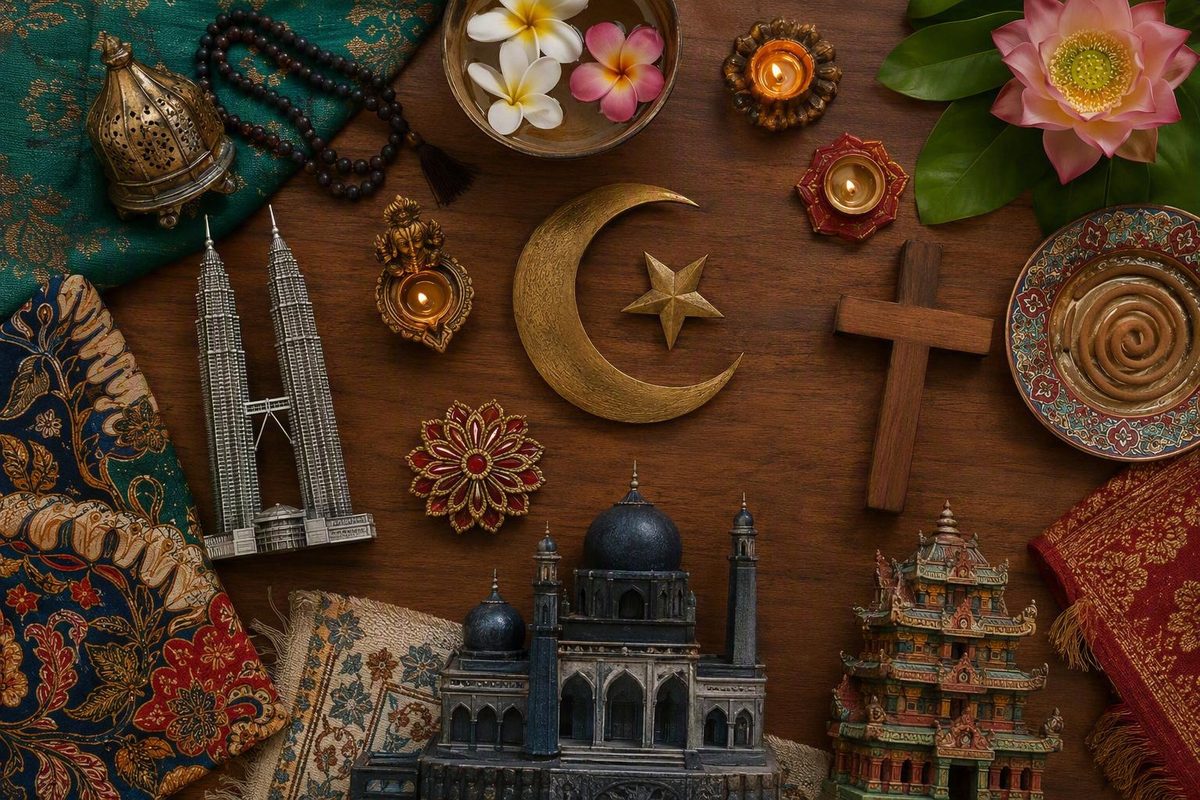
Malaysia is religiously diverse, but Islam is both the majority faith and the religion of the Federation under Article 3 of the Federal Constitution. The country also has substantial Buddhist, Christian and Hindu communities, alongside Sikhs, followers of Chinese traditional religions, practitioners of Indigenous traditions and people with other or no stated religious affiliations.
Understanding religion in Malaysia requires separating several related subjects: population statistics, constitutional status, state-administered Islamic institutions, ethnic identity, personal belief and regional variation. No single label captures all of them.
Malaysia’s religious landscape at a glance
Islam is Malaysia’s largest religion by population. It also holds a distinct constitutional position as the religion of the Federation. Other faiths, however, are central to the country’s social and cultural life rather than marginal exceptions.
The figures below are secondary-source reproductions of Malaysia’s 2020 census results. They describe national population shares, not the religious balance in every state, city or neighborhood.
Religious composition reported for the 2020 census
| Census category | Share of population |
|---|---|
| Islam | 63.5% |
| Buddhism | 18.7% |
| Christianity | 9.1% |
| Hinduism | 6.1% |
| Other religions | 0.9% |
| No religion or no information* | 1.8% |
*The final category requires caution. One supplied secondary source calls the 1.8% group “atheist,” while another uses the broader wording “no religion or no information.” The official census terminology should control, but it has not been independently verified in the available evidence. The published percentages also total 100.1% because of rounding. The figures are reproduced in a secondary overview of Malaysia’s 2020 census results.
The table establishes the broad national ranking: Islam is the majority religion, Buddhism is the second-largest category, and Christianity and Hinduism follow. It does not show how intensely people practice, whether they combine formal affiliation with family customs, or how religious identity operates in a particular community.
A national table also gives limited visibility to smaller traditions. Sikhism, Chinese traditional religions and diverse Indigenous traditions are practiced in Malaysia, as are other religious and belief systems. The available evidence does not support reliable current population shares for each of these communities, so their presence should be recognized without inventing precision.
Three different ideas are often compressed into the phrase “Malaysia religion”:
- Population religion: how people are classified or identify in census categories.
- Constitutional religion: Islam’s formal position and the legal framework surrounding religious life.
- Lived religion: worship, food, clothing, festivals, family traditions and personal identity.
Confusion arises when one of these is treated as if it fully explains the others. A census category does not describe every aspect of a person’s belief, and a national percentage does not represent every part of the federation.
What the Constitution says about Islam and religious practice
Article 3 identifies Islam as the religion of the Federation. That is more constitutionally precise than the common shorthand “official religion.” The same constitutional formulation recognizes that other religions may be practiced in peace and harmony.
Article 11 is commonly described as protecting the right to profess and practice a religion. Those protections operate within a wider constitutional and statutory framework, however, including provisions permitting restrictions on the propagation of religious doctrines or beliefs among Muslims. A published academic overview summarizes Articles 3 and 11 in these terms.
Malaysia’s constitutional structure therefore contains two simultaneous features:
- Islam has a special national and institutional position.
- Non-Muslim religions are recognized and practiced by substantial communities.
Leaving out either feature produces an incomplete account. Describing Malaysia only as constitutionally Islamic overlooks its multireligious population and visible non-Muslim institutions. Describing it only as religiously diverse overlooks the distinct position assigned to Islam.
Religious freedom should not be understood as unlimited or applied identically to every person. Constitutional language establishes a broad framework, but practical questions can also involve federal law, state enactments, administrative procedures and court decisions. Formal religious status, conversion, marriage, children, religious teaching and institutional jurisdiction may be treated differently depending on the people and authorities involved.
The evidence available here contains secondary descriptions rather than a verified, consolidated version of the current Federal Constitution and all relevant state laws. It therefore supports a broad explanation, not definitive interpretation of a particular legal dispute.
For visitors, the practical picture is easier to see. Mosques, Buddhist and Chinese temples, Hindu temples, churches, gurdwaras and other religious spaces form part of Malaysian towns and cities. Their presence reflects the country’s diversity, while Islam’s constitutional and institutional role extends beyond the personal faith of individual Muslims.
Why Malay identity and Islam are legally connected
Malay, Malaysian and Muslim are not interchangeable terms.
Malaysian is a nationality encompassing many ethnic, linguistic and religious communities. Malay is both an ethnic and a constitutional category. Article 160’s definition of a Malay includes professing Islam, together with other characteristics. A Malaysian citizen is not necessarily Malay or Muslim, and a Muslim in Malaysia is not necessarily ethnically Malay. The constitutional connection between Malay identity and Islam is described in the same academic overview of Malaysian religious life.
This connection helps explain why formal conversion out of Islam may raise questions extending beyond private belief. For someone legally categorized as Malay, Islam is connected not only to worship but also to a constitutionally defined ethnic identity. That does not mean all Malays relate to Islam in the same devotional, cultural or personal way.
Religion can operate on several levels at once:
- personal belief;
- worship and observance;
- family inheritance;
- cultural or ethnic identity;
- participation in community institutions;
- a category recorded in official systems;
- a source of public or national identity.
These dimensions may reinforce one another, but they should not automatically be treated as identical. Someone may identify strongly with a religious community while practicing selectively. Another person may participate in family celebrations without viewing every custom as a statement of personal theology.
Survey research illustrates how closely many Malaysian Muslims connect religious and national identity. In a 2022 survey, nearly all surveyed Malaysian Muslims said being Muslim was important to being truly Malaysian, while three-quarters described Islam as an ethnicity into which a person is born. The same research found that most surveyed Muslims in Malaysia favored making sharia the official law of the land, according to the Pew Research Center report on religious identity and pluralism.
Those results apply to surveyed Malaysian Muslim adults, not to every Malaysian or to the country’s non-Muslim communities. Support for “sharia” also does not establish which laws, institutions or areas of life respondents had in mind. An attitude survey cannot prove that Malaysia has—or that respondents uniformly favor—one nationwide sharia code.
Broad ethnic-religious associations require similar care. Indigenous communities include Christians and Muslims as well as followers of traditional beliefs. None of these patterns determines an individual’s religion.
The major faith communities and their place in Malaysian life
Islam is Malaysia’s largest religion. The U.S. State Department’s report on conditions during 2023 described Malaysian Muslims as overwhelmingly Sunni and said official regulation particularly favors the Shafi’i school. Mosques, daily prayer, Friday congregational worship, Ramadan fasting and Hari Raya celebrations are among the most visible expressions of Muslim life, although the form and degree of observance vary.
Buddhism is the second-largest census category. Temples may be used for worship, teaching, meditation, remembrance and gatherings. Buddhism is particularly visible in areas with substantial Malaysian Chinese populations, but ethnicity should never be substituted for an individual’s stated religious identity.
Christianity is the third-largest national category and is especially prominent in East Malaysia. Churches are visible in cities and rural communities, while Christmas is only one public expression of a much broader religious life.
Hinduism is the fourth-largest census category and has longstanding associations with parts of Malaysia’s Indian community. Not every Indian Malaysian is Hindu, however. Hindu religious life includes temple worship and public observances such as Deepavali, with practices varying among families, communities and traditions.
Sikhism is another established part of Malaysia’s religious landscape.
The available evidence supports recognizing Chinese traditional beliefs as part of Malaysia’s religious diversity, but not reducing them to one standardized set of practices or assigning them a current share that conflicts with the reported 2020 census categories.
“Indigenous beliefs” is also an umbrella phrase rather than the name of one uniform religion. Indigenous communities in Peninsular Malaysia, Sabah and Sarawak have distinct histories and traditions.
Festivals, buildings and signature practices offer useful introductions to these communities, but they are not complete descriptions. Nor does the presence of many faiths prove that relations are uniformly harmonious or conflictual. Experiences differ by place, institution, issue and individual circumstance.
Why religion looks different across Malaysia
Malaysia’s national Muslim-majority figure conceals substantial regional variation. Peninsular Malaysia, Sabah and Sarawak have different demographic histories, and individual states and federal territories also differ from one another.
East Malaysia is essential to understanding Malaysian Christianity. According to the U.S. State Department’s report on conditions during 2023, approximately two-thirds of the country’s Christian population lived in Sabah and Sarawak at that time. These states are therefore not demographic footnotes to a story centered only on Peninsular Malaysia; they are central to the national religious picture.
Sarawak provides a bounded example. A secondary table reproducing census figures reports the state as 50.1% Christian and 34.2% Muslim. The same table reports Muslims at 45.3% in Kuala Lumpur and 45.5% in Penang. In those two jurisdictions, Muslims were the largest reported religious group but did not exceed half of the population, making them a plurality rather than a majority in the cited figures. These percentages appear in the secondary state and territory census breakdown.
The distinction is straightforward:
- A majority is more than half of the relevant population.
- A plurality is the largest group but remains below half.
Calling Muslims a plurality in Kuala Lumpur or Penang does not mean the Muslim community is small. It means no single reported religious category crosses the 50% threshold.
Regional comparisons should remain bounded. Kuala Lumpur is highly urban and cannot represent all of Peninsular Malaysia. Penang does not represent every northern state. Sabah and Sarawak should not be collapsed into a supposedly uniform East Malaysian identity, and neither state represents the other in every respect.
Conditions may also vary within a state. A traveler moving among central Kuala Lumpur, George Town, Kuching, Kota Kinabalu and a predominantly Malay town may encounter different balances of mosques, churches and temples. Local festival activity and expectations at public or religious institutions may also differ.
The available evidence is not sufficient for a complete state-by-state ranking. The supported examples establish the essential point: Malaysia is Muslim-majority nationally but not religiously uniform across all states, territories or cities.
Civil law, sharia institutions and limits on religious choice
Malaysia has parallel civil and sharia institutions, but this does not mean two equal and completely separate legal systems govern everyone in the same way. Their jurisdictions differ, and disputes may concern which court or authority has power over a particular issue. Islamic administration is substantially organized at state level: nine states have sultans serving as their highest Islamic authorities, while the King performs that role in the other states and the Federal Territories.
According to the U.S. State Department’s report on legal and religious-freedom conditions during 2023, Muslims seeking formal conversion out of Islam generally needed sharia-court approval, which the report said was seldom granted; non-Muslims were generally less restricted in changing religion. The report also said official recognition of a marriage involving a Muslim and a non-Muslim could require the non-Muslim partner to convert. It described Federal Court decisions in 2018 and 2022 as opposing the unilateral conversion of children without both parents’ consent and affirming civil-court oversight in some disputes involving state Islamic authorities.
The same report said official regulation favored Sunni teaching, particularly the Shafi’i school, and restricted some Shia and other non-Sunni practices. It also described apostasy provisions as varying by state. Some states had written penalties involving fines, imprisonment or caning, while severe provisions reported in Kelantan and Terengganu had not been imposed and had unresolved legal status. These are dated descriptions from a foreign government report, not Malaysian legal authority or current advice for an individual case.
Several distinctions are important:
- Written law is not the same as routine enforcement. A provision’s existence does not show how often it is used, whether its validity is settled or how a court would apply it.
- Sharia is not one uniform national statute book. State laws and institutions can differ.
- Personal belief and formal legal status may diverge. Private convictions can change even when altering official records is difficult.
- Civil courts still have a role. Jurisdiction may itself be contested, and court decisions can determine when civil review is available.
It is therefore misleading to answer whether conversion from Islam is simply “legal” or “illegal.” The supported conclusion is narrower: formal recognition of conversion out of Islam is much more restricted for Muslims than religious change is for non-Muslims, and the process can involve state religious authorities and sharia courts.
A general article cannot determine the validity of a particular interfaith marriage, custody arrangement, child-conversion decision or identity-document request. Such matters may depend on current federal law, state enactments, court judgments, official religious status and individual facts. Anyone dealing with an actual case should consult a qualified Malaysian lawyer.
How religion shapes festivals, food and everyday interactions
Visitors may encounter religion through mosque domes, temple roofs, church services, calls to prayer, festival decorations, clothing, food labels and changing patterns of travel.
Major observances include Hari Raya Aidilfitri, Wesak, Christmas, Deepavali and Lunar New Year. They arise from different religious and cultural traditions but may have a wider public presence through decorations, family visits, public holidays and community events.
Travel effects vary by location and year. A major celebration may increase demand for intercity transport and accommodation, create heavy traffic on particular routes or alter business hours. Travelers should check transport operators, hotels and individual venues close to their journey rather than assuming one nationwide pattern.
Food is another everyday point of contact. Many Malaysian restaurants are halal, meaning their ingredients and preparation follow Islamic dietary requirements. Visitors should not bring pork or alcohol into a halal establishment unless the venue explicitly permits it. If a restaurant’s policy is unclear, asking directly is more respectful than inferring from appearance or location.
Malaysian cuisine is not religiously uniform. Pork may appear in some Chinese Malaysian cooking, while some restaurants shaped by Hindu dietary practices may avoid beef or emphasize vegetarian dishes. Seafood, alcohol, meat preparation and cooking fats can matter for religious or personal reasons. Travelers with dietary restrictions should ask specific questions rather than relying on ethnic labels.
Courtesy also matters when ordering and photographing food. A respectful Kuala Lumpur food crawl should allow working stalls to serve customers efficiently: decide before reaching the counter, state dietary restrictions clearly, avoid blocking queues and ask before turning a stall or its staff into a photo subject.
Greeting practices vary by person. Some people may prefer not to shake hands with someone of another gender. Waiting briefly for the other person to initiate is a respectful approach. If no hand is offered, a smile, nod or hand-to-chest gesture is a comfortable alternative. This is an individual preference, not a universal rule for all Muslims or Malaysians.
Clothing expectations also depend on context. Central Kuala Lumpur, a beach, a village, a government office and an active place of worship may call for different choices. Modest clothing is a useful conservative default at religious sites, but it is not a universal everyday dress code for every visitor in every Malaysian setting.
Religion is not inherently an inappropriate topic of conversation. Many people are happy to explain a festival, building or food practice when asked with genuine interest. Sensitivity means avoiding assumptions, arguments and intrusive personal questions—not treating ordinary respectful conversation as impossible.
A practical rule is to observe before acting. Notice whether shoes are being removed, whether a ceremony is in progress, how people greet one another and whether photography appears appropriate. If uncertainty remains, ask politely.
A respectful visitor checklist for mosques and temples
Rules at places of worship are venue-specific. Posted notices, staff instructions and official visitor information take precedence over any general travel guide.
For mosque visits, modest clothing is the safest starting point. Covering shoulders and knees will prevent many avoidable problems, although individual mosques may require more coverage. Some lend robes or headscarves and may ask visitors to wear them even when their own clothing appears modest.
Remove shoes wherever signs or staff direct, particularly before entering carpeted areas. Use the racks provided, keep voices low, silence phones and avoid crossing directly in front of someone who is praying.
Treat photography conservatively. Do not photograph worshippers without permission, especially during prayer. Avoid flash and close-up images. A mosque may allow photography along a visitor route while restricting prayer halls, imam areas, upper levels or other reserved spaces.
Visitor access may change around daily prayers and is particularly worth checking near Friday noon worship. Use the mosque’s official website, social account or telephone number when available rather than relying on old travel posts or booking-platform hours.
Published travel sources disagree over whether non-Muslims may enter mosque prayer halls. Some present a broad prohibition, while others describe access as dependent on the mosque, visitor area and prayer schedule. The safe conclusion is that there is no universal assumption: follow the designated route and ask before entering an active or restricted space. A user-contributed guide to Malaysian mosque etiquette likewise emphasizes staff instructions, quiet conduct and respect for restricted areas.
At Hindu, Buddhist and Chinese temples, modest clothing remains prudent, but footwear and access rules vary. Follow signs and attendants rather than assuming one temple’s policy applies everywhere.
Do not enter a ceremonial area simply because no barrier is visible. Avoid touching statues, offerings, ritual objects or instruments unless invited. Where incense is being used, do not move between worshippers and an altar merely to improve a photograph.
Photography policies may range from generally permissive to prohibited in selected halls. Ask before photographing ceremonies or individuals. Even when photography is allowed, flash, prolonged posing and obstruction can be disruptive.
Third-party etiquette advice is best treated as preparation rather than authority. Even broad guidance on Malaysian places of worship should yield to the current rules of the site being visited.
A compact checklist is more useful than trying to memorize a supposed national dress code:
- Cover shoulders and knees as a conservative starting point.
- Carry a light extra layer for additional coverage.
- Wear shoes that are easy to remove.
- Follow signs and staff instructions before entering reserved areas.
- Ask before photographing worshippers, ceremonies or interiors.
- Keep voices low and phones silent.
- Avoid crossing directly in front of someone praying.
- Check access directly with the venue.
- Allow extra time around Friday prayers and major festivals.
- Accept a loan robe, scarf or other garment when staff require it.
No single statistic or label fully explains religion in Malaysia. Islam’s majority status, constitutional role and state-administered institutions are central to the national picture. So are substantial Buddhist, Christian, Hindu, Sikh, Chinese traditional, Indigenous and other communities, together with pronounced regional differences.
The most useful approach is to distinguish constitutional status from personal belief, national percentages from local conditions, and general etiquette from venue-specific rules. Travelers do not need to master every legal or theological detail, but they should avoid assumptions, prepare modestly for religious sites and follow current local instructions.
Frequently asked questions
What is the main religion in Malaysia?
Islam is Malaysia’s main religion by population. The secondary reproduction of the 2020 census used above reports Islam as the largest category, followed by Buddhism, Christianity and Hinduism.
The national Muslim majority does not mean every state or city has the same religious balance. Composition varies substantially, particularly between parts of Peninsular and East Malaysia.
Is Islam Malaysia’s official religion?
The constitutionally precise phrase is that Islam is the religion of the Federation, as stated in Article 3. “Official religion” is common shorthand but can imply a simpler arrangement than the constitutional wording supports.
The same framework recognizes that other religions may be practiced. Islam’s special position and the presence of substantial non-Muslim communities are simultaneous features of Malaysia.
Can Malaysians change their religion?
It depends partly on a person’s existing formal religious status. According to the U.S. State Department’s report on conditions during 2023, non-Muslims were generally less restricted in changing religion, while Muslims seeking formal recognition of conversion out of Islam generally required sharia-court approval, which the report said was seldom granted.
Rules and procedures may vary by state and individual circumstances. Because conversion can affect marriage, children and identity records, anyone dealing with an actual case should obtain current Malaysian legal advice.
Are Sabah and Sarawak as religiously Muslim-majority as the national figures suggest?
No. The national percentage does not describe every part of East Malaysia. Christianity is especially prominent in Sabah and Sarawak, and the secondary census table cited above reports a Christian majority in Sarawak.
Sabah and Sarawak also differ from each other and contain substantial internal diversity. Neither should be treated as representative of all East Malaysia without further local evidence.
Can non-Muslim tourists visit mosques in Malaysia?
Many Malaysian mosques receive non-Muslim visitors, but access depends on the venue, visitor area and prayer schedule. Prayer halls, upper levels or other spaces may be restricted, and tourist access may be reduced during prayers, particularly around Friday noon worship.
Check the mosque’s current official information before visiting. Dress modestly, remove shoes where directed, keep quiet, avoid photographing worshippers and follow staff instructions concerning loan garments and permitted areas.