KL Observer

Feature

How to Choose, Serve and Store Bursting Mango Pearls

By Aina Rahman ·

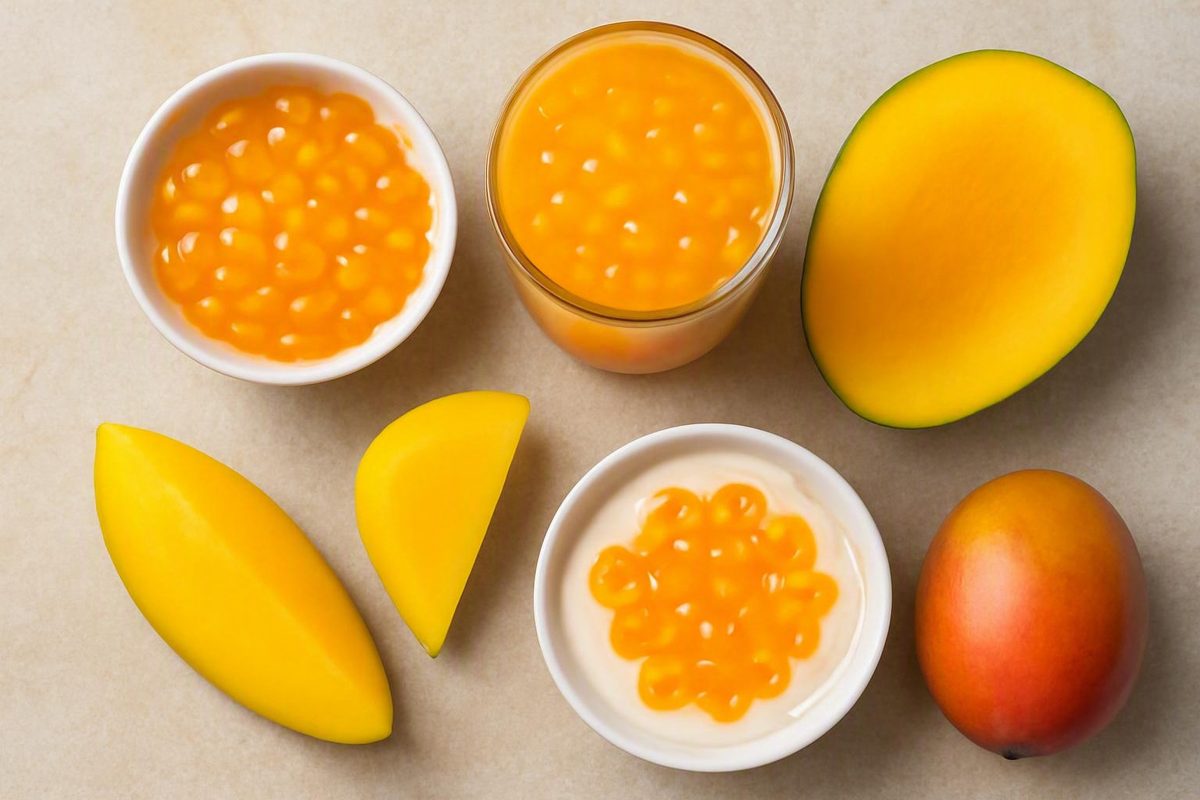
Mango popping boba adds a liquid burst and a soft, gel-like shell to drinks and desserts. It is not the same as chewy tapioca boba, and “mango” on the front of a package does not necessarily mean the pearls contain mango juice.

Choosing a product therefore involves more than comparing flavor names. Package size, expected turnover, sweeteners, colors, preservatives, dietary documentation, warnings and post-opening storage instructions all affect the practical value of a purchase. The cheapest large jar may suit a busy beverage counter but prove wasteful for a household that cannot finish it within the product-specific storage window.

This guide compares documented US online listings from Tea Zone, POSSMEI, Syruvia and Fanale. It is a general or imported-product guide rather than a survey of Kuala Lumpur availability. Because the evidence consists primarily of seller-controlled pages rather than independent testing, there is no defensible overall winner.

What mango popping boba is—and what makes it pop

Mango popping boba consists of small spheres with a thin, gel-like membrane surrounding mango-flavored liquid. When the membrane breaks under pressure from a bite, it releases the center. The same type of topping may be called bursting boba, popping pearls, fruit pearls, juice balls or popping bubbles.

Commercial formulations vary, but documented examples use sodium alginate and calcium salts as part of the membrane-forming system. Other possible ingredients include water, sweeteners, acids, stabilizers, flavorings, colors and preservatives. These are common formulation categories, not a universal recipe; the current package label is the best guide to an individual product’s composition.

Popping boba differs substantially from other familiar toppings:

  • Popping boba: A delicate membrane surrounding a liquid center, creating a quick burst when bitten.
  • Tapioca pearls: Solid, cassava-based pearls with a dense, chewy texture.
  • Jelly toppings: Solid or consistently gelled pieces rather than liquid-filled spheres.

A commercial comparison of jelly and popping boba also describes most packaged popping boba as ready to serve and warns against boiling it because heat can damage the outer skin. This is supplier guidance rather than independent food-science testing, but it is consistent with the no-cooking instructions on several compared product listings.

The product name alone cannot confirm the source of its mango character. Some products list mango juice, while others list mango flavor. Phrases such as “mango popping boba,” “mango-flavored pearls” or “real-fruit flavor” should not replace inspection of the ingredient list.

Side-by-side comparison of packaged mango popping boba

The table compares only information visible in the supplied product listings. Prices, options, packaging, formulas and availability may change, so verify the live listing and physical label before ordering.

Product Package and displayed price Mango, ingredients and nutrition Origin and dietary claims Storage and other qualifications
Tea Zone Mango POPPING PEARLS 7 lb jar; displayed base price of $19.00 Lists mango flavor, not mango juice. The formula includes fructose, sucralose, potassium sorbate and FD&C Yellow No. 6. Origin is not supplied. The seller labels it caffeine-free, vegetarian-style, vegan-friendly, gluten-free and dairy-free, but does not show certification details. Ready to use with no cooking required. No shelf life or post-opening storage period is supplied. The listing displays a California Proposition 65 warning mentioning chemicals including lead.
POSSMEI Mango Popping Boba 7.05 lb bottle; displayed price of $19.99 Lists mango flavor, not mango juice. The formula includes fructose-glucose syrup, potassium sorbate, FD&C Yellow No. 5 and FD&C Red No. 40. Taiwan is the listed country of origin. No detailed dietary certifications are supplied. Listed shelf life is 18 months. Store unopened in a cool, dry place; refrigerate after opening and consume as soon as possible. No exact opened use-by period is given. The page displays a Proposition 65 warning and says not to feed the product to children under three.
Syruvia Mango Bursting Boba 2 lb option; displayed price of $19.99. Linked 1 lb and 7 lb options also appear. Lists sugar, mango juice, natural flavor and potassium sorbate. Per listed 28 g serving: 30 calories, 8 g carbohydrate, 7 g total sugar, 6 g added sugar, 15 mg sodium, 0 g fat and 0 g protein. The seller states that it is made in the USA and gluten-free. The latter is a seller claim, not a category-wide conclusion. Ready to serve without cooking. Keep sealed pouches at room temperature and refrigerate for up to two weeks after opening.
Fanale Mango Popping Bursting Juice Balls Displayed price of $16.95; options include a 1 lb tub, a 7 lb tub and multi-tub cases. The page does not clearly tie the price to one option. Described as mango-flavored juice balls, but the supplied text does not establish a complete ingredient list or transcribed nutrition panel. Origin and documented dietary certifications are not established by the supplied listing text. The 7 lb option conflicts with a separate 7.26 lb net-weight specification. The page also presents conflicting sold-out, stock-limit and add-to-cart signals, so availability cannot be resolved.

For listings with an unambiguous package-price relationship, the approximate price per listed pound is:

  • Tea Zone: $19.00 ÷ 7 lb = about $2.71 per listed pound
  • POSSMEI: $19.99 ÷ 7.05 lb = about $2.84 per listed pound
  • Syruvia: $19.99 ÷ 2 lb = about $10.00 per listed pound

Fanale is excluded from this normalization because its displayed price is not clearly attached to a particular package option. Its conflicting 7 lb and 7.26 lb figures should not be silently reconciled.

These calculations use listed net weight, which may include the liquid or syrup surrounding the pearls. None of the compared listings supplies a clearly documented drained pearl weight. A nominal 7 lb package therefore does not establish that it contains 7 lb of portionable spheres.

Package format also changes the meaning of value. A smaller pouch can cost considerably more per pound but still be the more economical purchase if it can be finished during the stated refrigerated period. Conversely, a large jar may be practical for a café or event serving many drinks in a short time.

No independent comparative tasting, shell-strength testing or ingredient-quality assessment was supplied. Price, package size and label differences can be compared, but they do not establish which product tastes best or offers the highest overall quality.

How to read the ingredient and nutrition labels

Start by separating products that list mango juice from products that list mango flavor:

  • Syruvia lists mango juice and natural flavor.
  • Tea Zone lists mango flavor.
  • POSSMEI lists mango flavor.
  • Fanale’s supplied page does not provide enough transcribed ingredient information for the same comparison.

This distinction identifies what appears in the formulation, but it does not prove how strong, natural or appealing the finished flavor will be. A product containing juice can also contain added flavor, sugar and preservatives. A flavor-only formulation could still suit someone who prioritizes cost or a particular menu profile. Neither ingredient-list length nor the presence of juice independently proves taste, authenticity, healthfulness or quality.

Commercial popping-boba formulations can combine several functional ingredient groups:

  • Liquid base: Usually water
  • Sweetener: Sugar, fructose, glucose syrup or another sweetening system
  • Membrane-forming ingredients: Sodium alginate and calcium salts
  • Acids: Such as citric or malic acid
  • Stabilizers and thickeners: Formula-specific gums or modified starches
  • Flavor: Juice, natural flavor, unspecified fruit flavor or a combination
  • Color: Natural or artificial, depending on the product
  • Preservative: Such as potassium sorbate in some packaged products

No ingredient in that list should be assumed to appear in every brand.

Tea Zone’s formula lists fructose and sucralose, meaning it uses both a caloric sweetener and a high-intensity sweetener. It also lists potassium sorbate, FD&C Yellow No. 6, starch acetate, xanthan gum, CMC and sodium erythorbate. POSSMEI lists fructose-glucose syrup, potassium sorbate, FD&C Yellow No. 5, FD&C Red No. 40, starch acetate and xanthan gum. Syruvia uses sugar, mango juice, natural flavor and potassium sorbate alongside its membrane-forming and acidifying ingredients.

For a practical comparison, inspect these points:

  1. Mango juice or mango flavor: Check the ingredient list rather than relying on the front label.
  2. Added sugar: Look at both the ingredients and nutrition panel.
  3. High-intensity sweeteners: Ingredients such as sucralose may matter to buyers with a taste or label preference.
  4. Preservatives: Determine whether the formula includes potassium sorbate or another preservative.
  5. Artificial colors: Compare named FD&C colors if color sourcing matters to you.
  6. Allergen statements: Look for direct allergens and manufacturing or cross-contact language.
  7. Dietary documentation: Distinguish a seller’s “vegan-friendly” or “gluten-free” description from formal certification.
  8. Serving size: Compare nutrition values only after checking whether the listed serving weights are equivalent.
  9. Formula date: Ask whether the current physical label matches the online ingredient list.

Syruvia is the only compared listing that supplies a complete nutrition example in the available evidence. The figures shown in the table apply only to that product and its listed 28 g serving. They cannot be generalized to Tea Zone, POSSMEI, Fanale or mango popping boba as a category.

This matters when comparing different sweetening systems. A formula containing sugar, one containing fructose-glucose syrup and one using fructose plus sucralose will not necessarily have the same nutrition profile, sweetness intensity or serving assumptions. Equivalent nutrition panels were not available for three of the four products.

Package size, portions and the real cost per drink

A transparent starting assumption is 30 g per 16 oz drink. Syruvia’s listing recommends approximately 30 g, or two tablespoons, for that cup size, while its featured mango milk-tea recipe uses two to three tablespoons.

Thirty grams is useful for planning, but it is not a universal standard. A lightly topped fruit tea may use less, while a dessert-style drink may use more. Cup geometry, ice volume, other toppings and personal preference all affect the practical portion.

Using 30 g as a mathematical assumption, the theoretical yields are:

Listed package weight Calculation Theoretical 30 g portions
1 lb 453.6 g ÷ 30 g About 15
2 lb 907.2 g ÷ 30 g About 30
7 lb 3,175 g ÷ 30 g About 106
7.05 lb 3,198 g ÷ 30 g About 107

These are not guaranteed drink yields. They assume every gram of listed net weight can be portioned into a drink, even though the container may include packing liquid. They also ignore pearls left during scooping, spills, damaged shells and deliberate overportioning.

Applying the same simplified assumption to the unambiguous displayed prices gives:

Product Displayed package price Theoretical portions Approximate product cost per 30 g portion
Tea Zone, 7 lb $19.00 106 $0.18
POSSMEI, 7.05 lb $19.99 107 $0.19
Syruvia, 2 lb $19.99 30 $0.66

These figures cover only the topping. They exclude shipping, taxes, cups, straws, beverage ingredients, labor, refrigeration, damaged product and discarded leftovers. A business should use its delivered package cost and measured yield rather than the displayed product price alone.

A simple purchase-planning formula is:

Expected number of drinks × planned grams of popping boba per drink = required portionable product weight

Add an allowance for packing liquid and normal handling loss. Because the compared sellers do not disclose drained pearl weight, an operator can test-weigh an actual package: use a consistent scoop, record how many servings the container produces and adjust later orders from that result.

Package choice should reflect turnover:

  • Occasional home use: A 1 lb package may be easier to finish and store.
  • A party or several planned recipes: A 1–2 lb format may provide enough capacity without committing to a large opened jar.
  • A café, dessert counter or high-volume event: A roughly 7 lb container can reduce nominal topping cost if it is used within the product’s storage instructions.
  • Uncertain demand: Start smaller, even if the listed price per pound is higher, and measure actual consumption before buying bulk.

The lowest listed price per pound is not necessarily the lowest practical cost. If half of a bulk jar is discarded because demand was overestimated, the effective cost of each served portion rises sharply. Refrigerator space and opened-container turnover belong in the purchasing calculation alongside price.

How to serve mango popping boba in drinks and desserts

The documented Tea Zone, POSSMEI and Syruvia products are sold as ready to use. They require no cooking. The basic service method is straightforward:

  1. Prepare the beverage base.
  2. Chill it and complete any mixing or shaking.
  3. Transfer the finished drink to its serving cup.
  4. Gently spoon in the mango popping boba.
  5. Serve with a wide bubble-tea straw.

Add the pearls after preparing the drink rather than crushing them during aggressive mixing. Handle them gently because their defining feature—the thin shell—is also what makes them more delicate than tapioca pearls or solid jelly.

Do not boil packaged popping boba. The commercial guidance and product descriptions available here support ready-to-use cold service, while heat may damage the membrane and cause the spheres to leak.

Documented or suggested cold applications include:

  • Tea: Green tea, black tea, fruit tea or a chilled bubble-tea base
  • Citrus drinks: Lemonade and other cold citrus-style drinks
  • Blended beverages: Smoothies and slushies
  • Milk tea: Added after the tea and milk have been mixed and cooled
  • Cultured desserts: Yogurt and frozen yogurt
  • Frozen desserts: Ice cream
  • Fruit dishes: Fruit salad and layered fruit desserts
  • Asian-style desserts: Mango sago
  • Other chilled desserts: Add the pearls shortly before service

For one 16 oz drink, begin with a cold beverage base and approximately 30 g, or about two tablespoons, of pearls. Adjust from there. Someone who wants an occasional burst may prefer less, while a drink designed to showcase the topping may use more.

A simple mango milk tea can be assembled with cooled black tea, milk, ice and two to three tablespoons of mango popping boba. Mix the tea and milk before adding the pearls so the shells stay out of the main stirring step.

Because the topping can be sweet, a less-sweet base may create a more balanced drink. Possible combinations include:

  • Mango popping boba with unsweetened green tea
  • Mango popping boba with citrus lemonade
  • Mango popping boba with passion fruit tea
  • Mango popping boba with chilled black tea
  • Mango popping boba with lightly sweetened yogurt

These are editorial pairing ideas, not findings about universal consumer preferences. Taste the completed drink before adding extra syrup or fructose.

Mixed-texture drinks are another option. Coconut jelly or crystal boba can provide a firmer or more consistent chew beside the liquid burst of mango pearls. Keep total topping volume in mind: combining several toppings reduces the space available for ice and the beverage itself.

The available evidence does not establish reliable holding performance in hot, highly acidic, carbonated, dairy or plant-based drinks under every formulation and service condition. General menu suggestions are not the same as shell-stability testing. For an unfamiliar application, make a small trial and observe it over the intended service period before preparing a large batch.

Storage, handling and opened-container planning

There is no universal post-opening life for mango popping boba. Storage guidance varies by product, and the current physical package should take priority over general online advice.

POSSMEI lists an 18-month unopened shelf life, with the expiration date marked on the package. Its instructions say to keep the unopened product in a cool, dry place, refrigerate it after opening and consume it as soon as possible. “As soon as possible” does not establish a specific number of refrigerated days.

Syruvia says sealed pouches can be kept at room temperature and should be refrigerated after opening for up to two weeks. That period is specific to Syruvia and should not be transferred to Tea Zone, POSSMEI, Fanale or another formula.

As a separate commercial point of reference, Yen Chuan recommends refrigeration and use within three to five days after opening. This is supplier guidance, not an authoritative food-safety rule or a substitute for the manufacturer’s label. The difference between that recommendation and Syruvia’s two-week direction illustrates why one category-wide period should not be assumed.

For day-to-day handling:

  • Keep the pearls in their supplied liquid or syrup when the label directs.
  • Use a clean spoon, scoop or ladle.
  • Avoid crushing the pearls against the package.
  • Reseal the container securely.
  • Return it to refrigeration promptly when required.
  • Mark the opening date on the package.
  • Use a consistent portioning and handling procedure.
  • Follow the storage temperature and opened use-by period on the current label.

Do not drain an entire container merely to make portioning easier unless the manufacturer permits it. Removing the liquid changes the product’s documented storage condition and makes the original use-by guidance harder to apply.

Opened-container turnover should influence package selection. Tea Zone’s supplied listing does not provide a shelf life or opened-container instruction, while POSSMEI does not define an exact post-opening period. A prospective bulk buyer should contact the seller before assuming that a large jar will remain usable for a preferred number of days.

The evidence pack does not establish authoritative spoilage thresholds based on odor, bubbling, fermentation or shell texture. It would therefore be unsafe to invent a sensory test that supposedly guarantees suitability. Follow the label and ask the manufacturer when instructions are incomplete.

Freezing is similarly unresolved. The supplied sources do not demonstrate that commercial mango popping boba can be frozen and thawed without damaging the membrane or changing the liquid center. Unless the package provides freezing instructions, do not treat freezing as a documented way to extend use.

Dietary claims, warnings and questions for the seller

Vegan, gluten-free, dairy-free, caffeine-free and halal status are product-specific. They are not inherent properties of every mango popping boba.

Tea Zone’s seller labels its product caffeine-free, vegetarian-style, vegan-friendly, gluten-free and dairy-free. The supplied page does not display certification details or extensive manufacturing cross-contact information. These descriptions should therefore be treated as seller-provided claims about that product, not proof about the category.

Syruvia describes its product as gluten-free. Again, this is a product-specific seller statement. Anyone who needs to avoid gluten should inspect the current package for certification or cross-contact language and contact the manufacturer if the documentation is incomplete.

The same principle applies to other requirements:

  • Allergens: Ask about direct ingredients and shared production equipment.
  • Halal status: Look for a current certification mark and named certifying body rather than inferring suitability from the ingredients.
  • Vegan suitability: Confirm the complete formula and relevant processing information for the specific product.
  • Color or preservative preferences: Read the exact ingredient list because formulas vary.
  • Gluten control: Distinguish a seller’s gluten-free description from documented manufacturing controls or certification.

The Tea Zone listing and the POSSMEI listing display California Proposition 65 warnings mentioning chemicals including lead. The supplied pages do not provide product-specific exposure measurements or enough information to quantify what the warnings mean for a serving. The notices should be reported as listing warnings, not converted into either a definitive safety conclusion or an assurance that there is no concern.

POSSMEI also instructs customers not to feed its product to children under three. Separately, Bobalicious Bubble Tea’s commercial topping guide warns that round toppings may present a choking risk to young children. That guide is not a pediatric authority, so the broader point should remain narrowly framed: a soft shell or liquid center does not cancel the product-specific age warning or establish that a round topping is suitable for a particular child.

Before placing a large or recurring order, consider asking the seller:

  1. Does the product have current vegan, gluten-free or halal certification?
  2. What allergen and cross-contact controls apply at the manufacturing facility?
  3. Does the listed net weight include packing liquid?
  4. What is the drained weight of the pearls?
  5. What exact refrigerated use-by period applies after opening?
  6. What refrigerator temperature does the manufacturer require?
  7. Should the pearls remain submerged in their original liquid?
  8. Does the current physical formula match the online ingredient list?
  9. What is the unopened expiration date of the units being shipped?
  10. What documentation supports any warning shown on the listing?
  11. Are the package dimensions suitable for the available refrigerator space?
  12. Can the package be securely resealed after each service?

Clear answers can be more valuable than a small difference in price per pound, particularly for a food business managing allergens, labeling and waste.

Can you make mango popping boba at home?

Homemade mango popping boba is possible as a spherification project, but the supplied recipes do not establish a consistently reliable substitute for a packaged product. The general approach combines a mango liquid with sodium alginate, then forms drops in a separate calcium bath so a membrane develops around each portion.

A mango-specific China Sichuan Food recipe uses:

  • 2 tablespoons mango cubes
  • 200 ml water
  • 3 g sodium alginate
  • A separate bath containing 30 g calcium lactate per litre of water

Its method is to blend the mango, water and sodium alginate until smooth, remove surface bubbles and rest the mixture for at least four hours or overnight. A syringe, dropper or squeeze bottle is then used to release individual drops into the calcium bath. The spheres remain in the bath for about one minute before being rinsed in water.

Bath time affects the result under that recipe’s troubleshooting guidance. Excessive time can produce a shell that is too thick to burst as intended, while insufficient time can leave fragile or poorly formed spheres. Drop size, mixing, resting and handling may also affect the result, but the evidence does not support a definitive mango-specific troubleshooting formula.

Reliability needs a prominent qualification. A reader reported a failed, gloopy result under the mango recipe. A second popping-boba recipe and discussion contains conflicting sodium-alginate quantities—5 g in one place and 10 g in another—and several readers reported spheres becoming gelatinous throughout instead of retaining a liquid center. That second recipe demonstrates watermelon rather than mango, although it proposes mango juice as a variation.

Because of these inconsistencies, the recipes should be treated as experimental starting points rather than technically validated production methods. The supplied material also does not justify classifying the procedures definitively as direct or reverse spherification.

Nor does it establish how to adjust for mango pulp, acidity, puree concentration or naturally occurring calcium. Avoid improvising a confident correction from the limited evidence.

For leftovers, the mango-specific recipe recommends refrigeration in an airtight container for up to three days. The second recipe recommends keeping homemade pearls in light syrup or diluted juice and using them within two to three days. These are recommendations from the respective mango recipe and watermelon-based recipe, not independently validated food-safety or commercial shelf-life instructions.

A practical buying decision

There is no evidence-based overall winner among the four compared brands. The most practical product is the one whose package size, formula, documentation and storage window fit how quickly—and by whom—it will be used.

Use this decision framework:

  • Choose a smaller package when demand or post-opening turnover is uncertain.
  • Consider a bulk jar only when expected use fits its exact label-specific storage instructions.
  • Compare the mango source: juice, flavor or an inadequately documented formula.
  • Check sweeteners, colors and preservatives against your own label preferences.
  • Verify dietary claims rather than assuming all mango popping boba is vegan, gluten-free or halal.
  • Review warnings and age restrictions on the exact product.
  • Choose packaged pearls when ready-to-use convenience and predictable purchasing matter most.
  • Try homemade spherification only when the experiment itself is part of the appeal and variable results are acceptable.
  • Recheck the live listing and physical label because prices, package options, formulas, storage instructions and availability can change.

Frequently asked questions

Does store-bought mango popping boba need to be cooked or rinsed?

The documented Tea Zone, POSSMEI and Syruvia products are sold ready to use and require no cooking. Add them gently to a finished cold drink or dessert.

Routine rinsing is not established as necessary for these packaged products. Keep the pearls in their supplied liquid unless the current label directs otherwise, and do not boil them.

Is mango popping boba made with real mango juice?

Sometimes, but not always. Syruvia lists mango juice, while Tea Zone and POSSMEI list mango flavor. The available Fanale text does not establish a complete ingredient list.

Check the ingredients rather than relying on the product name or mango imagery. The presence of juice does not by itself prove better taste, quality or nutritional value.

How much mango popping boba should I use in a 16 oz drink?

About 30 g, or roughly two tablespoons, is a useful starting point. Adjust the amount for cup size, sweetness, ice and other toppings rather than treating it as a universal serving standard.

How long does mango popping boba last after opening?

It depends on the product. Some listings give a defined refrigerated period, while others merely say to consume the product as soon as possible or omit post-opening instructions.

Follow the physical package label, mark the opening date, reseal the container and contact the manufacturer if the refrigerated use-by period is missing.

Is mango popping boba safe for young children?

Do not assume that a soft shell or liquid center removes concerns associated with a round topping. POSSMEI specifically says not to feed its product to children under three.

Follow the warning on the exact product. Ingredient composition, allergen information and dietary suitability should also be checked for the individual product and intended consumer.