 KL Observer
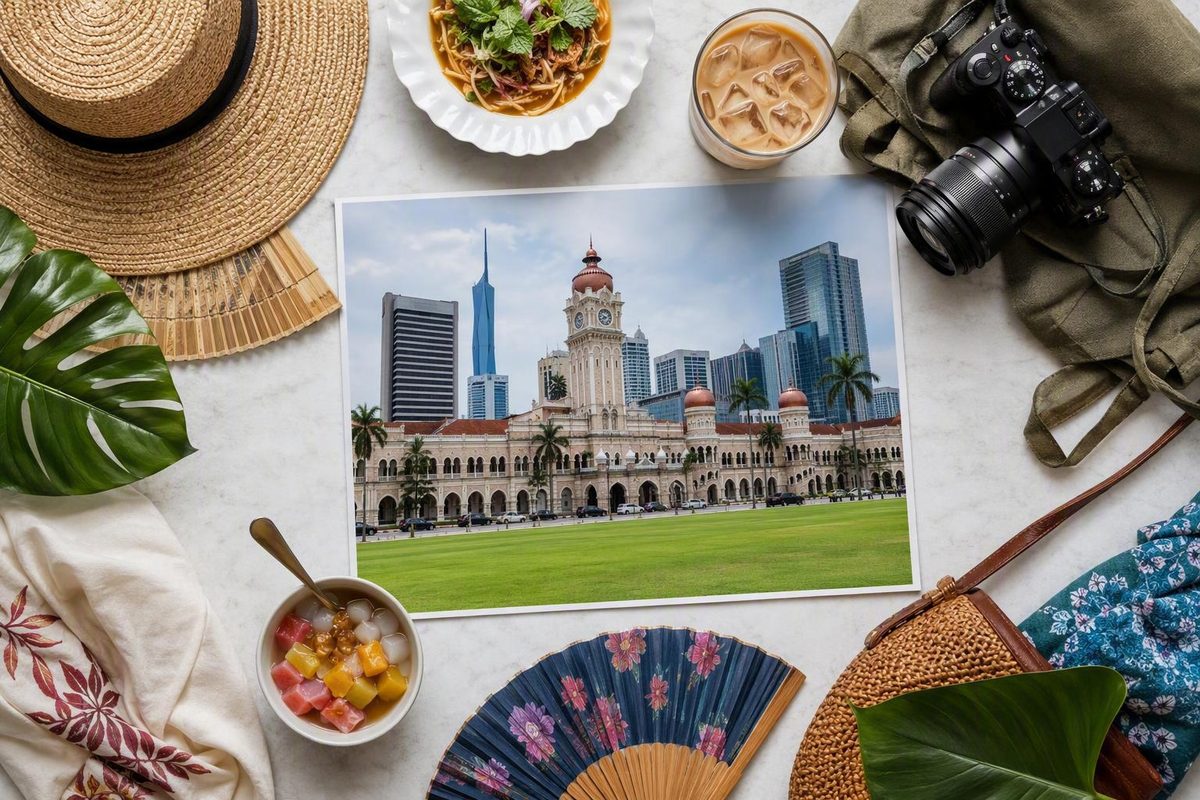
Independence Square in Kuala Lumpur is best approached as the historical anchor of a compact city walk, not as a long standalone attraction. Arrive by rail, understand the open field and the buildings framing it, then continue through the old civic district toward Central Market and Chinatown.
The square’s defining event occurred at the former Padang at the transition into 31 August 1957, when the British flag was lowered and the Malayan flag was raised. The Sultan Abdul Samad Building faces the field, while the Royal Selangor Club recalls the site’s earlier sporting use. Together with the nearby rivers, religious buildings, museum, markets, and commercial streets, these landmarks reveal several layers of central Kuala Lumpur’s history (Merdeka Square historical overview).
For a visit limited to the square and its principal exterior sights, allow less than an hour; Tripadvisor publishes the same broad duration for the attraction (Dataran Merdeka visitor listing). A wider exterior-focused walk can fill roughly two hours, while museum entry, religious-site visits, shopping, meals, or weather delays require longer.
Because the field is exposed and public events may affect access, choose your timing carefully. Check the day’s weather, live transit conditions, individual venue rules, and any announced event restrictions before departure.
What Independence Square is—and whether it belongs in your itinerary
Independence Square, Merdeka Square, and Dataran Merdeka are names for the same historic public space in central Kuala Lumpur. Dataran Merdeka is the Malay name commonly found on local maps and signs; English-language guides use both Independence Square and Merdeka Square.
The site is an open field opposite the Sultan Abdul Samad Building and beside the Royal Selangor Club. That arrangement is central to the experience. You are not arriving at a conventional attraction with a ticketed entrance, indoor galleries, or a fixed sequence of exhibits. You are entering a civic landscape whose meaning comes from the former Padang, the flag-raising area, and the buildings around it.
A quick visit can include:
- A broad view across the field
- The Sultan Abdul Samad Building exterior
- The flag-raising area and commemorative plaque
- The prominent flagpole
- The Royal Selangor Club exterior
- Smaller nearby features such as the Cop’s Fountain
The square becomes more rewarding when it forms part of a continuous walk. Masjid Jamek and the river area lie on one side of the heritage district; Medan Pasar, Central Market, Petaling Street, and Chinatown extend the route in another direction. Linking these places avoids traveling across Kuala Lumpur merely to stand beside the field for a few minutes.
Prioritize Dataran Merdeka if you are interested in:
- The history and symbolism of Malayan independence
- Civic architecture and broad exterior views
- Urban photography
- A short heritage walk rather than a full-day attraction
- A rail-based route toward Central Market or Chinatown
- The way a former colonial civic space acquired national meaning
It may be less satisfying as an isolated stop if you want extensive interpretation, indoor exhibits, shopping, food, or several hours of structured activity. Those needs are better met by combining the square with a museum, religious site, market, café, or Chinatown.
The practical verdict is straightforward: include Dataran Merdeka when it fits the geography and theme of your day. Its value lies not only in the independence story but also in the relationships visible across the surrounding district.
From colonial Padang to a national civic space
Dataran Merdeka makes more sense when its history is separated into stages. The police training ground, sporting Padang, independence-era flag ceremony, later redevelopment, and modern civic use are connected, but they did not all emerge at the same moment.
Before the cricket ground
The land was initially used as a police training ground. It later developed into the Selangor Club Padang, an open field associated with cricket and other sports. “Padang” means a field or open ground, which explains why historical accounts use that term rather than “square.”
The field stood beside the Selangor Club, now known as the Royal Selangor Club. During this period, the Padang functioned as a colonial recreation ground, while the administrative buildings across from it represented another part of the civic district.
The flag ceremony at midnight
At the transition into 31 August 1957, the British flag was lowered and the Malayan flag was raised at the Padang. A black marble plaque identifies the location associated with the flag raising (Independence Square history and features).
That moment gave the former recreation ground a different national meaning. A field associated with colonial administration and sport became the setting for a visible transfer of sovereignty.
The formal ceremony happened elsewhere
The midnight flag raising at the Padang is sometimes conflated with the formal independence ceremony later that day. They were separate occasions.
The symbolic lowering and raising of the flags happened at the former Padang. The formal independence ceremony later on 31 August 1957 took place at Merdeka Stadium, not at Dataran Merdeka.
That distinction does not diminish the square’s importance. Instead, it explains why the Padang and Merdeka Stadium occupy different places in the independence story.
From Padang to modern civic venue
The former Padang was subsequently redeveloped and became known as Dataran Merdeka. The later redevelopment and naming should not be compressed into the events of independence night.
In modern use, the square is associated with National Day activities, civic ceremonies, political rallies, and other public gatherings. Its symbolic role follows naturally from the flag ceremony: an open space once shaped by colonial recreation became a place where national identity and public life could be displayed.
The useful chronological sequence is therefore:
- The land served as a police training ground.
- It became the Selangor Club Padang and a setting for cricket and other sports.
- The British flag was lowered and the Malayan flag raised at the transition into independence day.
- The formal independence ceremony took place later at Merdeka Stadium.
- The former Padang was subsequently redeveloped as Dataran Merdeka.
- It became a recurring setting for national, civic, and political events.
This sequence is more accurate than treating every independence-related ceremony as though it occurred in the same place.
What to look for around the square
Begin with the full landscape rather than immediately focusing on one object. Dataran Merdeka works as a spatial composition: an open former Padang, a line of civic facades, a club connected to the field’s sporting history, and a flag-raising area that changed the site’s meaning.
Sultan Abdul Samad Building
The Sultan Abdul Samad Building is the defining architectural backdrop. Its long frontage and clock tower face the field, making it the structure most readily associated with photographs of the square.
Treat it primarily as an exterior landmark unless current public-entry arrangements have been confirmed separately. The available visitor material does not establish dependable public opening hours, a visitor entrance, or a regular tour schedule.
The wider viewpoint is often the most informative. Stand far enough back to see the relationship between the building and the former Padang rather than photographing only the clock tower or individual facade details.
Royal Selangor Club
The Royal Selangor Club stands beside the square and connects directly to the site’s earlier identity as the Selangor Club Padang. Its position helps explain why a large recreation field developed within the former administrative district.
Consider it an exterior heritage stop unless access has been independently confirmed. Visibility from the square should not be interpreted as an invitation to enter.
Flag-raising area, plaque, and flagpole
Look for the black marble plaque marking the location associated with the first raising of the Malayan flag. The nearby flagpole is one of the square’s most prominent vertical elements.
Published estimates of the flagpole’s height conflict. One travel account reports approximately 95 metres (Merdeka Square travel account).
Another destination guide gives a figure of approximately 100 metres, so the available evidence does not support presenting either measurement as definitive (Independence Square destination guide). Its visual and symbolic role matters more than an unresolved exact height, and world-record claims should be avoided.
The plaque is easier to overlook than the pole, but it is the more precise interpretive feature. The pole shapes the skyline; the plaque connects the visitor to the historical location.
Cop’s Fountain
The Cop’s Fountain is a smaller feature that can disappear within a route dominated by the field and major facades. Historical summaries date it to 1897, adding another physical layer to the district’s late-19th-century setting (Independence Square history and features).
It deserves a short pause rather than a major detour. Details such as the fountain help make the visit more than a single photograph of the Sultan Abdul Samad Building.
St. Mary’s Anglican Cathedral
St. Mary’s Anglican Cathedral is close enough to serve as an optional addition near the square. It contributes to the district’s historical and religious landscape, particularly for visitors walking around the northern side of Dataran Merdeka.
If you hope to enter, consult the cathedral’s current information before visiting. Services, private activities, maintenance, and venue rules may affect access. Dress and behave as you would in an active place of worship rather than treating it solely as an architectural exhibit.
National Textile Museum
The National Textile Museum can add an indoor component to the route. Its exterior also contributes to the surrounding heritage streetscape, so it remains a useful visual stop even if you do not enter. Commercial destination material identifies the museum, Sultan Abdul Samad Building, and Royal Selangor Club among the principal landmarks around the square (Klook’s Merdeka Square overview).
A museum visit substantially changes the schedule. Confirm current opening hours, admission arrangements, gallery access, and temporary closures directly with the venue before building the day around entry.
The essential distinction is between outdoor landmarks and venues with their own operating rules. The field, flag area, facades, and streetscape can form an exterior walk. Museums, clubs, religious sites, and civic interiors require separate checks.
Getting there by rail and finishing the walk on foot
For many first-time visitors using public transport, Masjid Jamek LRT station is a commonly recommended and geographically logical approach, rather than an objectively best station for every itinerary.
Masjid Jamek works especially well if you want to begin with the mosque and historic river district before proceeding to the civic square. A tourism directory recommends taking the train to Masjid Jamek, walking toward the mosque, and then continuing to Merdeka Square (Merdeka Square public-transport guidance).
Do not plan around a particular station exit unless you verify it on the day. Exit availability, barriers, construction, and your direction of arrival can affect which path is simplest.
At landmark level, the approach works like this:
- Leave the Masjid Jamek station area toward Masjid Jamek and the historic river district.
- Orient yourself using the mosque, rivers, and nearby civic buildings.
- Continue toward the Sultan Abdul Samad Building.
- Locate the open field of Dataran Merdeka across the civic area.
- After seeing the square, continue toward Medan Pasar and Central Market rather than automatically returning to the station.
This is an orientation sequence, not a turn-by-turn or accessibility-audited route. Use current mapping and follow posted pedestrian instructions at crossings.
Alternatives for a longer route
Pasar Seni may be a better starting or finishing station if your day emphasizes Central Market, Petaling Street, or Chinatown. From there, reverse the heritage route: begin around the market or Chinatown, walk through Medan Pasar, and reach Dataran Merdeka later.
Kuala Lumpur railway station can also fit a broader Old Town itinerary. Its usefulness depends on your rail service, luggage, weather, and intended next stop. It should not automatically replace Masjid Jamek for a square-focused visit.
Third-party transit information reports nearby stops named for Dataran Merdeka and the National Textile Museum, while also identifying Pasar Seni and Kuala Lumpur railway station as walkable alternatives (Moovit transit overview for Independence Square). Bus routes, stop locations, operating times, and walking estimates can change, so verify them through an official live transit channel on the travel date.
What not to assume about the station walk
A short map distance does not establish that the route is:
- Step-free
- Fully shaded
- Free of difficult curbs
- Suitable for every wheelchair or mobility aid
- Protected from rain
- Convenient with heavy luggage
- Unaffected by event barriers or roadworks
If access conditions matter, verify station lifts, exits, crossings, curbs, and temporary closures directly. Build extra time into the journey rather than relying on an optimistic map estimate.
Once at the square, continuing on foot is usually the most coherent way to experience the surrounding heritage district. Its landmarks are geographically close, but crossings, crowds, heat, and rain can make the route slower than it appears on a map.
When to visit for lower heat, architecture, or evening atmosphere
There is no universally best hour. Choose according to what you want to see and how much exposure to heat, rain, crowds, or darkness you are comfortable managing.
Early morning for an outdoor-first visit
Early morning is a practical option if you want to cover the exposed field before the hotter part of the day. It is not guaranteed to be cool: humidity, cloud cover, and changing conditions can still make the walk uncomfortable.
Morning also suits a route continuing toward Central Market or Chinatown. You can cover the open civic area first, then move toward denser streets and a possible indoor break later.
Check the day’s actual forecast rather than relying on a fixed seasonal rule. Conditions can change during a short walk, and a route planned for sun may need to become a rain route.
Daylight for reading the architecture
Daylight makes the district’s physical relationships easiest to understand. You can see:
- The width and openness of the former Padang
- The Sultan Abdul Samad Building across from it
- The Royal Selangor Club beside the field
- The flagpole and plaque area
- Smaller details such as the fountain and facade elements
- The connection between the civic district, rivers, and commercial streets
If historical interpretation is your priority, daylight is the clearest choice. It also makes pedestrian conditions easier to assess visually.
Midday may be uncomfortable because visitor guidance characterizes the square as having limited shade, seating, and on-site amenities. The same guide recommends early morning or evening as practical alternatives (Nomado Travel’s Merdeka Square guide).
Evening for illuminated facades
Evening offers a different experience. Surrounding buildings may be illuminated, and the square can be combined with a walk toward the River of Life area. This timing favors atmosphere over close reading of plaques and small details.
Do not build the visit around a guaranteed lighting, mist, or river display. Third-party guides describe evening effects, but the available evidence does not establish a current operating schedule. Treat any display as a possible addition rather than the foundation of the itinerary.
Current nighttime lighting coverage, staffing, security conditions, and unrestricted late access are also not established here. Keep guidance general: follow posted instructions, use routes you are comfortable with, and reconsider the walk if weather, barriers, or local conditions make it unsuitable.
What to carry
For a morning, daytime, or evening walk, a conservative kit includes:
- Drinking water
- Sun protection
- Lightweight rain protection
- Comfortable footwear
- A charged phone
- Any personal medical or mobility essentials
- A confirmed indoor fallback
Choose the fallback before reaching the square. It may be a museum if entry has been confirmed, or a café, market, or other public venue farther along the route. Do not assume the field itself will provide shelter, seating, water, or refreshments.
A compact one-hour heritage circuit
A compact circuit can fit into approximately one hour if you remain focused on exteriors. As a scale reference, one published Old Town itinerary connects six central sights over 1.4 kilometres and estimates about one hour, although real walking time varies with crossings, photographs, weather, and stops (GPSmyCity’s Kuala Lumpur Old Town walking tour).
Treat this as a route concept rather than a verified turn-by-turn or step-free path.
1. Begin at Masjid Jamek and the river area
Leave Masjid Jamek LRT station and orient yourself around Masjid Jamek and the Klang–Gombak river area. This gives the walk a geographical beginning in the old river district before the civic square.
If you want to enter Masjid Jamek, do not count that visit within the compact circuit. Visitor hours, services, dress requirements, and entry procedures require separate planning.
2. Continue toward Dataran Merdeka
Walk toward the Sultan Abdul Samad Building and Dataran Merdeka. When the field comes into view, pause before moving closer. The broad view explains the district better than a series of tightly framed photographs.
Use the square stop to identify three principal elements:
- The Sultan Abdul Samad Building across from the field
- The flag-raising area and plaque
- The Royal Selangor Club beside the former Padang
If time permits, add the Cop’s Fountain or National Textile Museum exterior. Avoid adding an indoor visit unless you are willing to abandon the nominal schedule.
3. Walk toward Medan Pasar
Continue toward Medan Pasar, using current mapping and available pedestrian crossings. This segment shifts the route from the ceremonial and administrative landscape toward older commercial streets.
Pause where it is safe and permitted to do so. Never rush a signal or use an unsuitable crossing merely to preserve an itinerary estimate.
4. Finish at Central Market
Finish at Central Market if time and conditions permit. This creates a practical endpoint with possible food, shopping, or an indoor break. Pasar Seni station then provides an alternative to retracing your path to Masjid Jamek.
The published Old Town itinerary continues beyond Central Market to Petaling Street and Kwai Chai Hong, but including every stop within the short schedule leaves little time for interpretation. Treat compact geography as an opportunity, not an obligation.
Reverse version from Pasar Seni
If you arrive at Pasar Seni or begin in Chinatown, reverse the route:
- Central Market
- Medan Pasar
- Sultan Abdul Samad Building
- Dataran Merdeka
- River area and Masjid Jamek
- Masjid Jamek LRT station
The reverse version works particularly well when shopping, lunch, or Chinatown is the first priority. It also avoids unnecessary backtracking.
A slower two-hour walk toward Central Market and Chinatown
With approximately two hours, you can follow the same geographical line more slowly and continue beyond Central Market. This is an editorial planning estimate for an exterior-focused route, not a published opening time or guaranteed duration.
The walk moves from rivers and civic space into commercial streets, allowing the district to read as an urban story rather than an arbitrary list of attractions. Museum entry, a religious-site visit, a meal, extensive shopping, or a weather delay can turn it into a longer outing.
Start at Masjid Jamek and the rivers
Begin near Masjid Jamek LRT station. Spend a few minutes understanding the relationship among the mosque, rivers, and surrounding streets before heading toward Dataran Merdeka.
The river area introduces one geographical layer of central Kuala Lumpur. Dataran Merdeka then presents the administrative, ceremonial, and colonial recreation landscape. Moving between them on foot makes that transition visible.
Masjid Jamek can be an exterior stop or a separate visit. If entering, check current visitor hours, dress requirements, and on-site instructions directly.
Explore Dataran Merdeka deliberately
At the square, look from more than one viewpoint. Begin across the field toward the Sultan Abdul Samad Building, then move toward the flag-raising area. Find the plaque, note the flagpole, and look back across the former Padang.
Continue toward the Royal Selangor Club exterior. Its position beside the field helps connect the present civic square with the earlier cricket ground.
St. Mary’s Cathedral is a logical optional side stop near the square. Do not force it into the route if doing so reduces the time available for your main interests.
Add the National Textile Museum conditionally
The National Textile Museum is geographically convenient, but decide in advance whether it will be an exterior stop or an indoor visit.
If you want to enter, confirm current opening hours, admission charges, gallery access, and entry rules directly. Proximity to Dataran Merdeka does not guarantee that a museum or civic interior will be open when you arrive.
Continue through Medan Pasar
From the civic district, continue toward Medan Pasar. The character of the walk changes as monumental facades and open ground give way to a denser commercial environment.
This transition is one of the route’s strengths. Dataran Merdeka tells a story of administration, recreation, sovereignty, and public ceremony. Medan Pasar and the streets beyond introduce trade and everyday urban movement.
Pause at Central Market
Central Market is the most useful place to plan a rest. One visitor guide reports no food stalls directly on Dataran Merdeka, making Central Market, Chinatown, or nearby cafés more dependable places to seek refreshments (Nomado Travel’s Merdeka Square guide).
Use the stop according to conditions:
- In strong sun, take an indoor or cooling break before continuing.
- In rain, wait rather than forcing the next street segment.
- If you are tired, finish at Pasar Seni.
- If conditions remain comfortable, continue into Chinatown.
Continue to Petaling Street
Petaling Street extends the route into one of central Kuala Lumpur’s established commercial areas. The contrast with the square is immediate: the open civic scale gives way to narrower, busier streets with shops, food, signs, and pedestrian activity.
Allow extra time for crowds and browsing. A meal, shopping stop, or extended photography session will push the walk beyond its nominal duration.
Optional finish at Kwai Chai Hong
Kwai Chai Hong can serve as an optional final stop beyond Petaling Street. Add it only if the weather, available time, and your energy level support another segment.
The full sequence is geographically coherent:
- Masjid Jamek and the rivers
- Dataran Merdeka
- Sultan Abdul Samad Building
- Royal Selangor Club exterior
- National Textile Museum exterior or independently confirmed visit
- Medan Pasar
- Central Market
- Petaling Street
- Optional Kwai Chai Hong
It can also be reversed from Chinatown or Pasar Seni.
Know when two hours is not enough
Allow longer if you plan to:
- Enter a museum
- Visit Masjid Jamek or St. Mary’s Cathedral
- Stop for a full meal
- Browse Central Market
- Spend substantial time on Petaling Street
- Wait for rain to pass
- Navigate with children, luggage, or reduced mobility
- Photograph the district at a deliberate pace
This route has not been audited for step-free access, curb quality, continuous shelter, pavement condition, or current construction. Travelers with specific access needs should verify each segment rather than assuming that a compact map distance means an easy route.
Access, events, and practical limitations to check before leaving
Third-party visitor guides commonly describe the outdoor square as free and generally accessible throughout the day. However, that does not amount to authoritative confirmation of current hours or unrestricted access under every circumstance.
Because the available operational information comes largely from third-party travel and transit pages rather than current venue or City Hall notices, treat it as planning context rather than a guarantee. Current official guidance should take priority whenever it is available.
An open public space can still be affected by preparations, security controls, ceremonies, maintenance, demonstrations, or temporary barriers. “Normally accessible” and “guaranteed access” are different claims.
National Day and major events
Dataran Merdeka is closely associated with National Day on 31 August.
A commercial visitor guide also associates Malaysia Day on 16 September with possible public activity at the square, but this should not be interpreted as a promise of a specific annual event at that location.
Political rallies, civic gatherings, cultural events, and maintenance may alter the route at other times. Follow current notices and on-site instructions rather than assuming that an ordinary walking plan will remain available.
What to check on the day
Before departure, look for current information from:
- Kuala Lumpur City Hall
- The organizer of any advertised event
- Official public-transport operators
- The museum, religious site, or building you hope to enter
- An official or reputable weather service
For rail and buses, check live service conditions instead of relying on old screenshots or undated route lists. For individual venues, distinguish between a building being visible and its interior being open.
Facilities that should not be assumed
The available evidence does not authoritatively verify the current location or availability of:
- Public toilets
- Drinking-water points
- Shaded seating
- Sheltered waiting areas
- Parking
- Passenger drop-off areas
- Step-free paths
- Accessible crossings
- Overnight staffing
- Nighttime security arrangements
Plan conservatively. Use facilities at a confirmed venue before beginning the exposed portion of the walk, and do not wait until you are on the field to look for water or shelter.
A sensible packing list is short:
- Water
- Sun protection
- Rain protection
- Comfortable footwear
- Personal mobility or medical essentials
- A charged phone
- A flexible route with a confirmed indoor fallback
Pacing matters as much as packing. If the weather becomes uncomfortable, shorten the outdoor segment and move toward Central Market or another confirmed indoor venue. If rain affects visibility or crossings, pause rather than trying to preserve the schedule.
Dataran Merdeka works best as a concise but historically important stop. Approach by rail, use the square as the anchor of a one-direction heritage walk, and choose a cooler part of the day where possible. Its meaning comes not only from the independence-era flag raising but also from the way the former colonial Padang relates to the surrounding civic district.
Frequently asked questions
Are Independence Square, Merdeka Square, and Dataran Merdeka the same place?
Yes. All three names refer to the same historic public space in central Kuala Lumpur. Dataran Merdeka is the Malay name commonly translated as Independence Square, while Merdeka Square is another widely used English-language form.
When checking maps, transit directions, or attraction listings, search for Dataran Merdeka first. Local signs and nearby stops may use the Malay name even when an English-language guide says Independence Square.
Did Malaya’s formal independence ceremony take place at Dataran Merdeka?
No. The symbolic flag ceremony took place at the former Padang at the transition into 31 August 1957, when the British flag was lowered and the Malayan flag was raised. The formal independence ceremony later that day took place at Merdeka Stadium (Merdeka Square and independence history).
Dataran Merdeka is therefore central to the independence story, but it should not be described as the location of the entire formal ceremony.
Is Independence Square free and open 24 hours?
Third-party guides commonly describe the outdoor square as free and accessible throughout the day, but the available evidence does not provide authoritative confirmation of unrestricted 24-hour access. One destination guide presents it as continuously open while discussing an outdoor public area rather than a controlled indoor attraction (Merdeka Square access overview).
Access may change for ceremonies, rallies, maintenance, security operations, or other organized events. Check current City Hall, event, and transit information before relying on late-night access or traveling during a major public occasion.
Which train station should I use for Dataran Merdeka?
Masjid Jamek LRT station is a commonly recommended approach, especially if you want to begin with Masjid Jamek and the river area before walking toward the Sultan Abdul Samad Building and the square.
Do not rely on a particular exit without checking current station information. Pasar Seni may be more convenient when combining the square with Central Market or Chinatown, while Kuala Lumpur railway station can fit a broader Old Town route.
How long should I allow for Independence Square and nearby landmarks?
Allow less than an hour for the square and principal exterior landmarks. That is generally enough for the field, Sultan Abdul Samad Building facade, flag-raising area, plaque, flagpole, and Royal Selangor Club exterior; a major visitor platform likewise suggests a duration of under an hour for the square itself (Dataran Merdeka visitor listing).
Allow roughly two hours for an exterior-focused route beginning near Masjid Jamek and continuing through Dataran Merdeka, Medan Pasar, Central Market, and potentially Petaling Street. A published Old Town walk covering 1.4 kilometres and six central sights is estimated at about one hour, but crossings, photographs, weather, and stops can extend it considerably (Kuala Lumpur Old Town walking-tour scale reference).
Add more time for museums, religious-site entry, meals, shopping, rain delays, or a longer Chinatown extension. The most practical plan is route-first: arrive by rail, keep the square as the historical anchor, continue in one direction, and adjust the distance to the day’s conditions.