 KL Observer
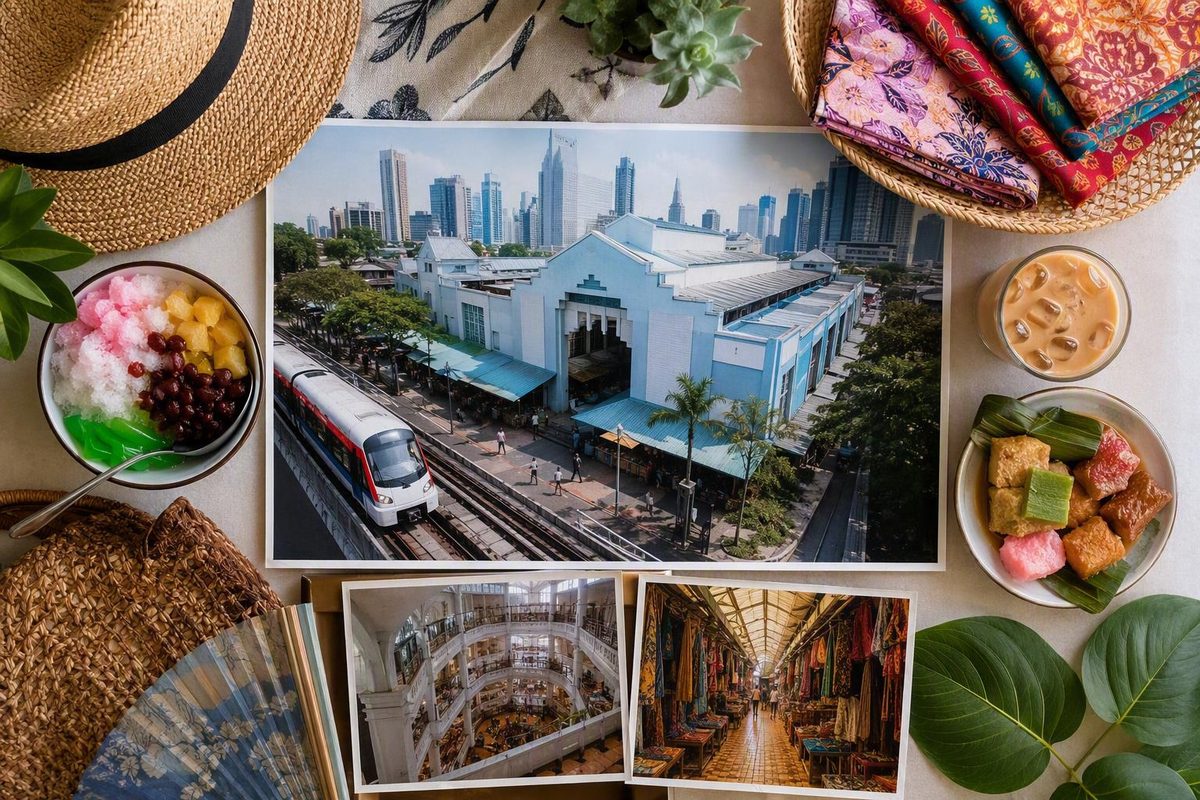
Central Market (Pasar Seni) is a compact, air-conditioned crafts-and-souvenir complex a short walk from Pasar Seni station, which sits on both the Kelana Jaya LRT Line and the Kajang MRT Line. The operator listed opening hours of 10:00 a.m. to 10:00 p.m. daily when checked on September 18, 2026. Allow one to two hours for a straightforward browse, two to three if you add a gallery, workshop or meal, and half a day if you continue into Petaling Street and Chinatown.
Treat the main building, the Central Market Annexe, Kasturi Walk and Petaling Street as four separate places in one walkable area. Do them in that order where practical, and follow the current signs rather than a remembered station exit or market entrance.
Pick your time, priority and the weather; the stop sequence and the checks to make update beside the buttons.
Central Market stop planner
Time you haveAllow ~2–3 hours
- Pasar Seni stationKelana Jaya LRT or Kajang MRT. Follow signs for Jalan Hang Kasturi and Central Market; older traveller reports put the walk at ~2–5 min.
- Main building (air-conditioned)Start here: batik, textiles, pewter, wood carving and souvenir sections.
- Longer comparison in the main buildingCompare textiles, artwork and gifts; ask where and by whom each item was made.
- Drink, snack or mealLeave time for it; food outlets may not follow the complex hours.
- Kasturi Walk (covered)Short transition beside the building, then back to Pasar Seni.
Confirm before you go
- Operator hours 10:00–22:00 daily (listed 18 Sep 2026); individual tenants may differ.
- Free entry to the main building is a third-party report, not operator policy.
Sources: operator homepage hours, reviewed 18 Sep 2026; rail lines from the Central Market location overview; ~ walk times are older traveller reports; walking times between Chinatown stops are unsourced (—).
Hours, Entry and Rail Lines at a Glance
| Detail | What to plan around |
|---|---|
| General hours | 10:00 a.m. to 10:00 p.m. daily per the operator homepage, reviewed September 18, 2026; individual tenants may differ |
| Admission | A third-party guide reports free entry to the main building; the operator publishes no general admission policy |
| Nearest station | Pasar Seni |
| Rail lines | Kelana Jaya LRT Line and Kajang MRT Line |
| Basic visit | About one to two hours |
| Extended visit | About two to three hours with a gallery, activity or meal |
The free-entry report and the one-to-two-hour estimate come from a third-party Central Market visitor guide, not from the operator. Museums, exhibitions, workshops and other separate attractions may charge their own fees. Both visit lengths are planning ranges, not fixed durations.
The general hours do not necessarily cover every tenant, gallery, workshop or food outlet. If one experience is the reason you are going, confirm its opening time, admission, reservation requirement and accessibility directly before you set out.
The Main Building, Annexe, Kasturi Walk and Petaling Street Are Different Places
“Central Market” gets used loosely for several neighbouring places. They combine easily on foot, but they are not the same experience.
| Area | Setting | Go for |
|---|---|---|
| Main market building | Indoor retail, air-conditioned | Crafts, batik, traditional wear, souvenirs, food, services |
| Central Market Annexe | Separate arts space within the complex | Galleries, studios, exhibitions, selected attractions |
| Kasturi Walk | Covered pedestrian lane beside the building | Snack and souvenir stalls on a short outdoor pass |
| Petaling Street | Street-market district, not part of Central Market | Street shopping, food, temples, neighbourhood atmosphere |
The main building is the organised retail core and the place to start if you want crafts, textiles, cultural gifts or a weather-protected browse.
The Annexe carries the galleries, studios and exhibitions. Venue listings can outlast the spaces they describe, so confirm a specific gallery or exhibition rather than assuming every previously named attraction still operates.
Kasturi Walk has historically hosted snack, souvenir and other small stalls. “Covered” applies to the lane itself, not to every approach to it or to the onward streets into Chinatown.
Petaling Street belongs to the wider Chinatown district. It is close enough to combine with the market, but Central Market is a particular complex and Chinatown is the surrounding neighbourhood.
Addresses look inconsistent for the same reason. References place the market along Jalan Tun Tan Cheng Lock and the pedestrian section of Jalan Hang Kasturi, while the operator’s contact address names the Central Market Annexe. That contact address is not proof of the main visitor entrance.
Get Off at Pasar Seni and Keep the Last Walk Short
Pasar Seni station is served by the Kelana Jaya LRT Line and the Kajang MRT Line, which puts Central Market on two cross-city rail corridors, according to the Central Market location overview.
Treat the final approach as a short walk rather than an exact minute count. Older traveller directions estimate roughly two minutes from the station and three to five minutes from the adjacent transport area, but the real figure depends on your starting point, pace, crossings and the current access route (traveller-reported directions).
Do not commit to a particular station exit unless you have checked current station information, especially if you need a step-free route. Follow signs toward Jalan Hang Kasturi and Central Market, or ask station staff. Older directions may say “Putra LRT line”; that line is now the Kelana Jaya LRT Line.
The main building is reported to be air-conditioned and Kasturi Walk is covered, which makes the pair useful in heat or rain. The station approach and the onward walks to Petaling Street, the temples and other Chinatown landmarks are not continuously sheltered.
Bus stops change more often than the rail anchor. Do not build the route around older claims that a Go KL bus stops directly outside Central Market unless current official transport information confirms it.
Decide Whether You Are Shopping, Making, Looking or Eating
Start with your purpose rather than trying to inspect every tenant.
Shopping. The operator’s directory covers antiques and collectibles, arts and crafts, apparel and accessories, batik and traditional wear, gifts and souvenirs, food and beverages, groceries, personal care, technology and services, per the current Central Market store categories. Commonly reported products are batik clothing and textiles, jewellery and accessories, pewterware, wood carvings and artwork, traditional games such as miniature wau or congkak, packaged snacks and general souvenirs. None of that guarantees where an item was made, who made it or whether it was handmade.
Hands-on and cultural activities. The operator advertises DIY batik painting, galleries, henna, Chinese seal art, traditional wear, massage or reflexology, food offerings and a Kuala Lumpur history exhibition. An advertised attraction does not establish its current price, session time, duration, capacity or walk-in availability.
Galleries. Look toward the Annexe rather than assuming every art space sits inside the retail building. If one exhibition matters, verify that venue specifically.
Food. Keep the plan loose enough to inspect what is open on arrival, because outlets may not follow the complex’s hours. A full meal rather than a snack belongs in the two-to-three-hour plan.
When buying a craft or textile, ask where it was made, who made it, what materials and technique were used, and whether the seller can explain the design. Clear answers help you understand the purchase; they do not prove authenticity, and nothing here supports assuming every item is Malaysian-made, artisan-produced or better than merchandise sold elsewhere.
Three Visit Plans From One Hour to Half a Day
Each plan moves through adjacent areas in a sensible sequence. None promises a one-directional route regardless of entrance, temporary closures or current pedestrian access.
One Hour: Main Building and Kasturi Walk
Arrive through Pasar Seni station and follow the signs. Inside the main building, stick to the craft, textile, batik, artwork and souvenir sections rather than every retail category. Finish with a brief pass through Kasturi Walk; in difficult weather, or if the outdoor stalls do not interest you, return to Pasar Seni instead of adding a Chinatown circuit.
This version works best when Central Market is a pause between other rail-based stops rather than the centrepiece of the day.
Two to Three Hours: Crafts, One Extension and Food
Browse the main building first, then add one extension: a confirmed gallery or exhibition in the Annexe, a pre-confirmed batik or cultural activity, or a longer comparison of textiles, artwork and gifts. Leave time for a drink, snack or meal.
One extension is more reliable than stacking several activities whose schedules, prices and capacity differ from the market’s general hours. In poor weather, keep the visit in the main building and Annexe and let Kasturi Walk be a short transition rather than a destination.
Half a Day: Central Market Into Chinatown
Start at Pasar Seni, then follow this sequence: the main building, the Annexe if a relevant venue is open, Kasturi Walk, Petaling Street, and one or two Chinatown landmarks such as Sri Mahamariamman Temple or Guan Di Temple.
This is a directional framework. The best order shifts with the entrance you use, road crossings, temporary barriers, weather and what is actually open. Walking times between these points are approximate, and the wider route is not fully shaded even though the market is indoors and Kasturi Walk is covered.
If time and weather hold, Merdeka Square, Masjid Jamek or River of Life are optional extensions. In heavy heat or rain, shorten the outdoor section and return via Pasar Seni rather than forcing a longer heritage circuit.
Central Market Versus Petaling Street
The two answer different needs; they are complementary rather than competing versions of the same market.
| Factor | Central Market | Petaling Street |
|---|---|---|
| Setting | Organised indoor complex | Busier street market |
| Shopping focus | Arts, crafts, batik, cultural gifts, galleries | General street-market goods and souvenirs |
| Weather protection | Air-conditioned building, covered areas nearby | Variable shelter across an outdoor district |
| Food emphasis | Food within the complex | Stronger street-food and neighbourhood focus |
| Pricing | Often presented as more fixed-price; vendor-dependent | Bargaining more visible; vendor-dependent |
| Suggested time | Compact browse or extended craft stop | Flexible, especially with food and Chinatown |
Choose Central Market for indoor craft browsing, cultural souvenirs, a gallery or an advertised activity. Choose Petaling Street for the street-market atmosphere and when food and the surrounding Chinatown streets will be a larger part of the visit.
Neither can reliably be called more authentic or higher quality. There is no market-wide rule that every Central Market shop uses fixed prices or that every Petaling Street stall expects bargaining. The two are close enough to combine on foot, but crowds, crossings, weather and your exact endpoints decide the walking time.
Why Guides Give Three Different Dates
Guides disagree on dates because they describe separate stages of the building. A tertiary history distinguishes the 1888 origin, the 1937 building completion and the October 1985 to April 1986 adaptive reuse:
- 1888: Central Market originated as a wet market.
- 1937: The current Art Deco building was completed.
- October 1985 to April 1986: Adaptive-reuse work turned the former wet market into an arts-and-culture destination.
The building was preserved after proposed demolition, though descriptions of its formal heritage status vary and should not be overstated. Warisan KL gives wider Kuala Lumpur heritage context; it does not replace the operator for current hours, admission, activities or access.
What you see now is an older market structure adapted for retail, art, food and cultural activities, neither simply an old wet market nor just a modern souvenir centre.
Confirm These Before You Commit to a Venue
Before building the visit around a specific activity or venue, confirm the market’s general hours for your date, the individual hours of the tenant, gallery or attraction you care about, whether entry to the main building is still free, the price of each workshop or exhibition, and whether batik painting or another hands-on activity needs a reservation. If accessibility matters, ask the operator or station staff about step-free routes, lifts, accessible toilets and the most suitable exit. Check card, cash or QR payment with individual vendors.
Parking, ride-hailing pickup points, prayer rooms, luggage storage, baby-changing facilities, Wi-Fi and photography permissions are not confirmed here; ask directly.
The decision rule is short: use Pasar Seni station, begin with the main building, and add the Annexe, Kasturi Walk or Chinatown only when each addition fits your time, your interests and the weather.